If you’ve ever tried to pin down machine learning vs artificial intelligence, you’re in good company. You’ve heard both terms a hundred times this week. One headline calls something “AI.” Your coworker calls the same thing “machine learning.” A vendor’s slide deck uses both in a single breath, as if they’re identical. They aren’t.
The confusion around machine learning vs artificial intelligence isn’t your fault. In fact, most explainers hand you a one-line answer, then bury you in phrases like “neural networks” and “gradient descent” before you’ve caught your breath. This guide flips that order. You’ll get the plain-English version first – one analogy that makes the whole thing click and the technical bits only where they earn their place.
Here’s the short answer you came for: machine learning is a part of artificial intelligence, not a rival to it. AI is the big idea. ML is one powerful way to get there. So stick around and you’ll also see exactly where deep learning and generative AI fit, and how to tell which term you actually need in any given sentence.
Machine learning vs artificial intelligence: what’s the difference?
Artificial intelligence is the broad field of building machines that mimic human thinking. Machine learning is a subset of AI that learns patterns from data instead of following hand-coded rules. Put simply: all machine learning is AI, but not all AI is machine learning. AI is the goal; ML is one method for reaching it.
In short, that single distinction clears up most of the mess. When people say “AI,” they might mean anything from a chess program written in the 1980s to today’s chatbots. When they say “machine learning,” they mean something narrower and more specific – a system that improved by studying examples. Keep reading and the boundary gets sharp.
What is artificial intelligence?
Artificial intelligence (AI) is any technique that lets a computer do things we’d normally call “intelligent”: recognizing a face, understanding a sentence, planning a delivery route, or beating a grandmaster at chess. The definition is deliberately wide.
And that width matters. AI includes systems that never learn anything on their own. A tax-filing tool that follows thousands of if-this-then-that rules is AI – it’s just old-school, rule-based AI. So is the ghost chasing you in a 1980s arcade game. Nobody trained those systems on data; a human wrote every rule by hand.
This is the part most people miss. AI is the umbrella. Underneath it sit several approaches – rule-based expert systems, search algorithms, robotics, and yes, machine learning. For decades, hand-coded rules were the dominant flavor. Then data changed everything.
What is machine learning?
Machine learning (ML) is the subset of AI that gets better at a task by studying examples, rather than being programmed with every rule up front. Feed it enough labeled examples and it figures out the pattern itself, then makes predictions on data it has never seen.
Here’s the mechanism, minus the intimidation. You gather training data – say, 50,000 emails already marked “spam” or “not spam.” You pick an algorithm, which is just the mathematical recipe that hunts for patterns. Then the algorithm chews through the examples and builds a model. Show it a brand-new email and it predicts: spam, or safe?
Notably, that email example is supervised learning – the most common flavor of ML, where every training example comes with the right answer attached. There are other flavors (unsupervised learning finds hidden groupings; reinforcement learning learns by trial and reward), but supervised learning powers most of what you touch daily.
In practice, you already rely on it constantly. Netflix guessing your next binge. Your bank flagging a weird charge in seconds. Your phone’s camera finding faces before you tap the shutter. None of those were hand-coded rule by rule – they learned from data and keep refining their predictions as more of it arrives.
Pro tip: If a system got smarter after seeing more examples, it’s machine learning. If a human wrote every rule and it never changes on its own, it’s AI but not ML.
The UK-and-England analogy for machine learning vs artificial intelligence
Forget diagrams for a second. Think geography.
Artificial intelligence is like the United Kingdom – the whole country. Machine learning is like England: by far the biggest, most famous part, the one people picture first. But the UK is bigger than England. It also includes Scotland, Wales, and Northern Ireland, just as AI includes approaches that aren’t machine learning at all.
So when someone says “we’re using AI,” they’ve told you the country. They haven’t told you the region. Maybe they mean machine learning. Or maybe it’s a wall of hand-written rules wearing an AI badge. The word alone doesn’t say.
That’s exactly why the two terms feel interchangeable – and why they aren’t. Every time you read “AI,” quietly ask: which part of the country do they actually mean? Nine times out of ten in 2020-era headlines, the honest answer was “a bit of rules and some marketing.” Today, it usually is machine learning under the hood. But usually isn’t always, and that gap is the whole point.
Machine learning vs artificial intelligence vs deep learning vs generative AI
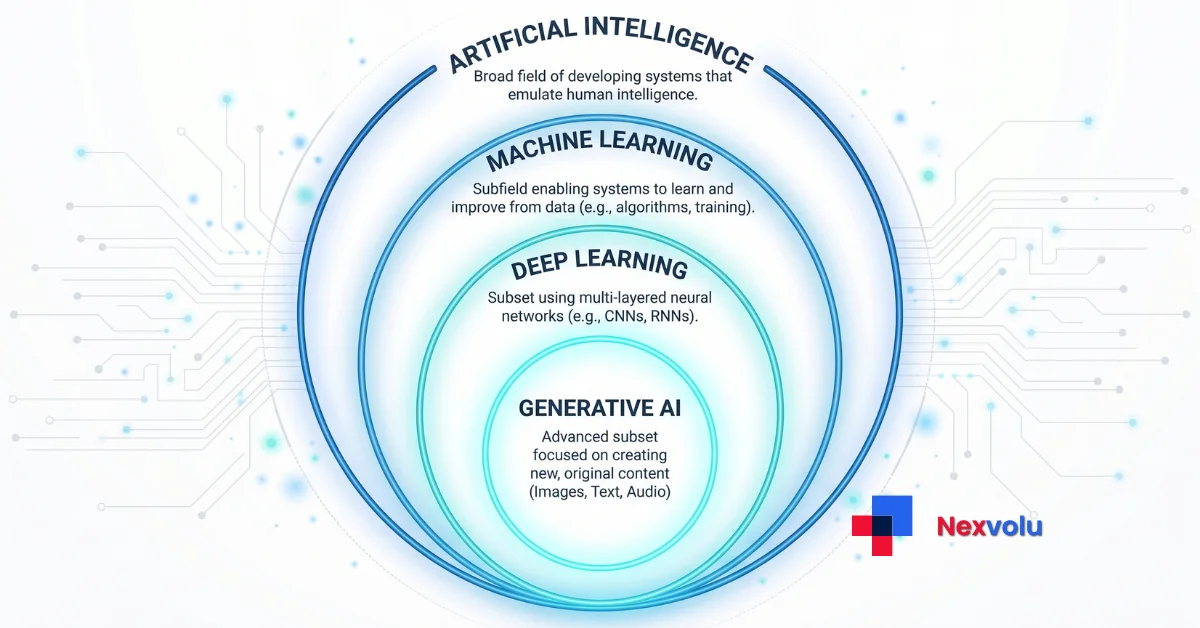
Here’s where most people get lost, because two more terms crash the party: deep learning and generative AI. Good news – they slot neatly inside the ones you already understand. Picture four nested boxes, each sitting inside the last.
┌─ ARTIFICIAL INTELLIGENCE - the whole field ────────────────────┐
│  rule-based systems · search · robotics · machine learning      │
│                                                                 │
│   ┌─ MACHINE LEARNING - learns patterns from data ─────────┐    │
│   │  decision trees · regression · clustering              │    │
│   │                                                        │    │
│   │   ┌─ DEEP LEARNING - many-layered neural networks ──┐  │    │
│   │   │  image recognition · speech · translation       │  │    │
│   │   │                                                 │  │    │
│   │   │   ┌─ GENERATIVE AI - creates new content ────┐  │  │    │
│   │   │   │  ChatGPT · Gemini · image + video makers │  │  │    │
│   │   │   └──────────────────────────────────────────┘  │  │    │
│   │   └─────────────────────────────────────────────────┘  │    │
│   └────────────────────────────────────────────────────────┘    │
└─────────────────────────────────────────────────────────────────┘
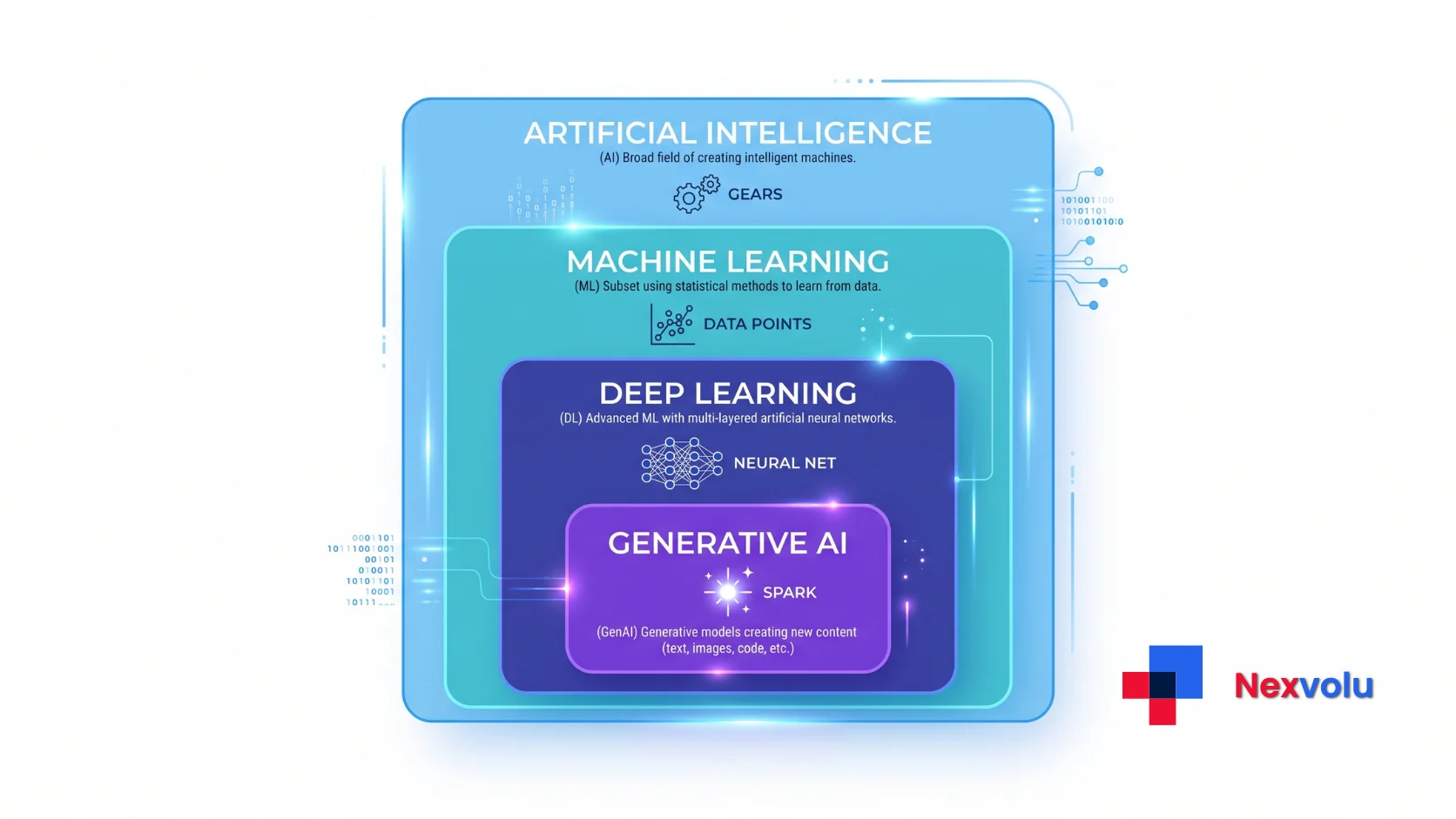
Deep learning is a subset of machine learning that uses neural networks with many stacked layers. As a result, those extra layers let it handle messy, high-dimensional data – photos, audio, raw language – that simpler ML struggles with. Every deep learning system is machine learning. Not every machine learning system is deep learning.
Generative AI sits one box deeper still. It’s a subset of deep learning built to create: text, images, music, code. When ChatGPT writes you an email or Midjourney paints a scene, that’s generative AI doing its thing. It runs on deep learning, which is a type of machine learning, which is a form of AI. Four boxes, one clean line of descent.
Machine learning vs artificial intelligence: side-by-side
When you need the contrast fast, this table does the job.
| Artificial Intelligence | Machine Learning | |
|---|---|---|
| What it is | The whole field of machine intelligence | A subset of AI that learns from data |
| Goal | Mimic human-like intelligence | Make accurate predictions from examples |
| How it works | Rules, logic, search, or learning | Algorithms trained on training data |
| Needs data to work? | Not always (rules can be hand-coded) | Yes – data is the fuel |
| Everyday example | A rules-based chess engine | A spam filter that keeps improving |
| Relationship | The umbrella | One method under the umbrella |
Machine learning vs artificial intelligence: which term do you need?
Most of the time you don’t need to say “machine learning” or “artificial intelligence” – you need the right one. Quick guide:
- Say “AI” when you’re talking about the big picture, capabilities, or impact (“AI is changing customer support”).
- Reach for “machine learning” when the point is that a system learns from data (“our machine learning model predicts churn”).
- Use “deep learning” when neural networks and messy data like images or audio are central.
- Pick “generative AI” when the system creates new content, not just sorts or scores existing data.
Ultimately, getting machine learning vs artificial intelligence right does more than make you sound sharp. It sets accurate expectations. Calling a simple rules engine “AI” oversells it; calling ChatGPT “just machine learning” undersells what generative models do. Precision is a form of honesty.
Found this useful? Share it with the person who keeps mixing up AI and ML – you’ll save them the same headache, and yourself the same explanation next time it comes up.
Nexvolu’s Verdict
The verdict: The machine-learning-vs-AI “debate” isn’t a debate at all – ML is a subset of AI, and once you see the nesting, the confusion evaporates for good.
Best for: Beginners, writers, founders, and anyone who has to use these words accurately in a meeting or a headline.
Skip it if: You already build models for a living – you know this cold.
Pros: The relationship never goes stale (it’s definitional) · a single geography analogy replaces ten jargon-heavy paragraphs · the four-box nesting map settles deep learning and generative AI in the same breath.
Cons: It’s foundational, so pros will find it basic · the terms will keep getting blurred by marketing no matter how clearly they’re defined.
Standout: The UK-and-England framing is the piece most explainers miss – they define the words but never give you a mental model you can actually recall a week later.
Nexvolu Editorial Score: 9/10 – as an evergreen explainer it’s about as durable and useful as tech writing gets; the one missing point is simply that experts won’t need it.
Frequently Asked Questions
Is machine learning the same as artificial intelligence?
No. Machine learning is a subset of artificial intelligence, not a synonym for it. AI is the broad goal of building intelligent machines; machine learning is one specific method that reaches that goal by learning patterns from data. Every machine learning system counts as AI, but plenty of AI – like hand-coded rule-based systems – involves no machine learning at all. Think of AI as the category and ML as one member of it. The terms get swapped so often because, in 2026, most of the AI people actually interact with happens to run on machine learning under the hood.
Is machine learning a subset of AI?
Yes, machine learning is a subset of artificial intelligence – this is the single most important relationship to remember. AI is the umbrella field covering any technique that makes machines act intelligently. Machine learning is the branch of that field where systems improve through data and experience rather than explicit programming. The nesting goes further: deep learning is a subset of machine learning, and generative AI is a subset of deep learning. So a tool like ChatGPT is generative AI, deep learning, machine learning, and AI all at once – each label sits inside the previous one.
Can you have AI without machine learning?
Yes, and it’s more common than people assume. Rule-based or “expert” systems are artificial intelligence with zero machine learning – a human writes every rule, and the system never learns on its own. Classic examples include early chess programs, thermostat logic, and many chatbots that follow scripted decision trees. These systems can look impressively smart while doing no learning whatsoever. For decades this hand-coded approach was mainstream AI. Machine learning only overtook it once cheap computing and huge datasets made learning-from-examples the more practical path for most complex tasks.
Is deep learning the same as machine learning?
Not quite – deep learning is a specialized subset of machine learning. It uses neural networks with many stacked layers, which lets it handle complex, unstructured data like images, audio, and natural language far better than traditional ML. All deep learning is machine learning, but plenty of machine learning (decision trees, linear regression, clustering) isn’t deep learning. The trade-off: deep learning usually needs much more data and computing power. That’s why a simple prediction task might use lightweight ML, while self-driving perception or voice assistants lean on deep learning.
Is ChatGPT AI or machine learning?
Both – and more precisely, it’s generative AI. ChatGPT is a generative AI system, which is a subset of deep learning, which is a subset of machine learning, which is a subset of artificial intelligence. So every one of those labels is technically correct; they just describe it at different zoom levels. Calling it “AI” is accurate but vague. Calling it “machine learning” is accurate but undersells the creative part. “Generative AI” is the most precise term, because its defining trait is producing new content – text, code, images – rather than only classifying or scoring existing data.
Should I learn AI or machine learning first?
Start with the concepts of AI broadly, then go deep on machine learning – that’s where nearly all the practical, in-demand work lives today. “Learning AI” as a whole is too vague to be a plan; machine learning gives you concrete, teachable skills like handling training data, choosing algorithms, and evaluating predictions. A sensible path: understand what AI is and isn’t, learn Python and statistics basics, then build small supervised-learning projects. Deep learning and generative AI come naturally after that foundation, since they’re specialized layers built on the same machine learning core.

The bottom line
Three things worth keeping:
- Machine learning is inside artificial intelligence, not next to it. AI is the country; ML is its biggest region.
- The nesting is the whole trick. AI contains machine learning, which contains deep learning, which contains generative AI – four boxes, one clean line.
- Pick the term that matches the zoom level. “AI” for the big picture, “machine learning” when data-driven learning is the point, “generative AI” when something is being created.
In the end, get machine learning vs artificial intelligence straight and you’ll read every AI headline with a sharper eye and never nod along to a term you can’t place again.
Bookmark Nexvolu and join our newsletter for plain-English tech explainers that skip the jargon and get to the point. Which term used to trip you up the most – AI, ML, or generative AI? Tell us in the comments.
References
- Stanford HAI – The 2026 AI Index Report (generative AI reached 53% of the global population within three years, faster than the PC or the internet).
- McKinsey – The State of AI (nearly nine in ten surveyed organizations report regularly using AI).
- IBM – The 2026 Guide to Machine Learning (ML defined as the subset of AI focused on learning patterns from training data).
- Google Cloud – AI vs. Machine Learning: How Do They Differ?
2 thoughts on “Machine Learning vs Artificial Intelligence, Explained”