
Bots outnumber humans online for the first time since the web went mainstream and remarkably, the crossover arrived years earlier than even the experts expected. Because automated traffic has now overtaken human traffic, anyone who buys ads, watches analytics, or reports on website performance should pay close attention. Yet here’s the question almost nobody asked when the headlines broke: if most of the “traffic” online isn’t human, how much of what fills your dashboards is actually real? Below, we cover what Cloudflare measured, why it hits marketers hardest, and exactly what to check in your own reports before your next spend decision.
Table of contents
- What Did Cloudflare Actually Report?
- Bots Outnumber Humans Online: Why It’s Bigger Than the “Dead Internet” Headline
- Now That Bots Outnumber Humans Online, Is Your Marketing Data Lying?
- What to Verify in GA4 and Your Ad Dashboards Right Now
- What Bots Outnumbering Humans Online Means for Your 2026 Strategy
- Frequently Asked Questions
What Did Cloudflare Actually Report?
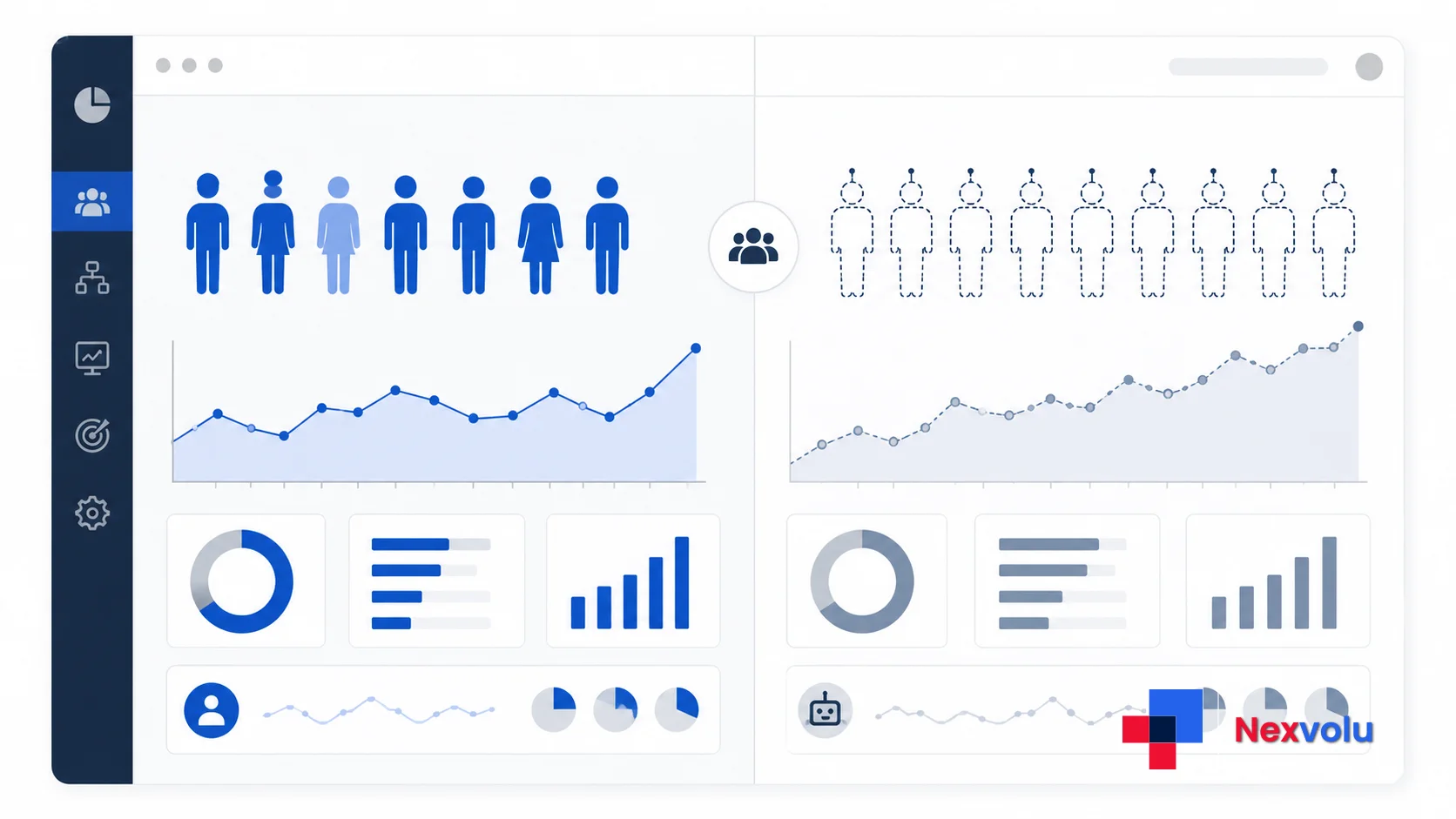
Cloudflare Radar reported that automated bots generated 57.5% of all HTML web requests in June 2026, while humans made up just 42.5% the first time machine traffic has formed the majority online. Put plainly, bots outnumber humans online for the first time in the web’s history. Notably, Cloudflare CEO Matthew Prince had predicted this crossover by late 2027 so it landed roughly 18 months early.
This isn’t a fringe estimate. Indeed, it comes from one of the largest networks on the planet, measuring real requests across millions of sites. Moreover, Cloudflare’s own dashboard shows the bot share swinging between 52% and 62% on any given day. Still, the direction of travel is what matters: bots climbing, humans shrinking.
Meanwhile, the makeup of those bots has changed. The old crowd was search crawlers and scrapers. By contrast, the new wave is agentic AI assistants that browse, click, and complete tasks for people. For example, Prince put it simply at SXSW: a human shopping for a camera might visit five sites, whereas an AI agent doing the same job visits 5,000.
Bots Outnumber Humans Online: Why It’s Bigger Than the “Dead Internet” Headline
The phrase trending alongside the stat is “dead internet theory” the once-dismissed idea that bots and machine-generated content have quietly overtaken real human activity. For years it sounded like a conspiracy. Now, however, it has receipts, because bots outnumber humans online and the data proves it.
The growth curve is the scary part. According to HUMAN Security’s 2026 State of AI Traffic report, automated traffic grew eight times faster than human traffic across 2025. Furthermore, traffic from AI agents and agentic browsers jumped a staggering 7,851% year over year. Similarly, Imperva’s 2026 Bad Bot Report put bots at 53% of all web traffic, up from 51% in 2024. In short, different methods reach the same conclusion: the human web is now the minority web.
Here’s the thing most of these machines aren’t villains. In fact, plenty are useful: search indexers, monitoring tools, and AI assistants that genuinely help people. However, useful or not, they don’t buy your product, click your ad with intent, or read your case study to the end. Instead, they just look like traffic. And as AI agents reshape how people browse, that gap between “traffic” and “customers” widens every month.
Now That Bots Outnumber Humans Online, Is Your Marketing Data Lying?
Every analytics and ad platform you rely on was built to measure one thing: human behavior. Now that bots outnumber humans, however, that core assumption is broken.
First, start with analytics. Google Analytics 4 automatically filters known bots using the IAB/ABC International Spiders and Bots List. Useful but limited. By Google’s own admission, you can’t even see how much it removed, and the filter only catches bots that are already on a list. The sophisticated ones the scripts that mimic scrolling, pauses, and clicks sail right past it. They inflate your sessions, drag down your conversion rate, and quietly poison the numbers you report upward.
Now consider the money side. MediaPost reported that roughly $63 billion in global ad spend was lost to invalid traffic in 2025, with about 8.51% of paid clicks flagged as invalid. Likewise, DoubleVerify’s fraud lab found that in unprotected media, AI bots accounted for up to 15% of all clicks. Picture the knock-on effect: if 15% of your “conversions” are bot-filled forms, then your automated bidding learns to chase more of them. As a result, you don’t just waste budget you train the algorithm to waste it faster.
That’s the uncomfortable truth behind the headline. In other words, the dead internet isn’t only a philosophical worry about fake comments. Rather, it’s a line item in your reporting that may not mean what you think it means.
💡 Key insight: Raw traffic and impression counts are now vanity metrics by default. Treat verified human engagement and downstream revenue as your real scoreboard.
What to Verify in GA4 and Your Ad Dashboards Right Now
You can’t block every bot. However, you can stop making decisions on dirty data. So run this audit before your next budget review.
In GA4:
- Confirm known-bot exclusion is active, then accept it isn’t enough on its own.
- Next, build an exploration that flags sub-second session durations and 100% bounce rates classic bot fingerprints.
- Also, filter out traffic from data-center locations (Ashburn, Virginia is a notorious one) that no real audience would produce.
- In addition, separate AI referral traffic visits from tools like ChatGPT and Perplexity often get lumped under “organic,” hiding a real shift in how people find you.
- Finally, investigate sudden direct-traffic spikes from a single device type, browser, or region.
In your ad dashboards:
| Signal to check | What it may mean | Where to look |
|---|---|---|
| High invalid-traffic (IVT/GIVT) rate | Bots are reaching your ads | Google Ads / DV360 traffic-quality reports |
| Conversions with zero engagement | Bot-filled forms inflating results | GA4 + CRM cross-check |
| Geo or device spikes | Automated click sources | Campaign geo / device breakdowns |
| Rising CPMs, flat revenue | Paying for non-human impressions | Platform spend vs. sales data |
Then tighten the defenses: enable each platform’s invalid-traffic filters, exclude data-center IP ranges, and consider a third-party verification tool if you spend at scale. Admittedly, none of this is glamorous. Still, all of it protects your budget.
🟢 Try this today: Pull a 28-day GA4 segment for sub-second, single-page sessions. If that bucket is large and growing, your headline traffic numbers need an asterisk and so does your next report. Want the deeper playbook? See our guide to protecting your ad budget from wasted spend.
What Bots Outnumbering Humans Online Means for Your 2026 Strategy
The fix isn’t panic. Instead, it’s a shift in what you measure and trust.
First, stop celebrating volume. After all, a traffic graph that only goes up tells you less than it used to. Move your KPIs toward verified human engagement, qualified leads, and revenue outcomes a bot can’t fake. Lean into first-party data, because your own customer signals are harder to pollute than open-web metrics. And take generative engine optimization seriously: when AI agents and answer engines increasingly sit between your brand and your audience, being the source they cite matters as much as ranking on a results page.
Ultimately, the internet didn’t die. It simply stopped being mostly human. Therefore, the marketers who win from here are the ones who measure what’s real instead of what’s merely large.
Frequently Asked Questions
What does it mean that bots now outnumber humans online?
It means more than half of all web requests come from software, not people. Cloudflare Radar measured bots at 57.5% of HTML traffic in June 2026. Most are crawlers, scrapers, and AI agents not buyers. For marketers, raw traffic counts no longer reflect genuine human demand.
Does bot traffic affect Google Analytics 4 data?
Yes. GA4 automatically filters known bots using the IAB/ABC International Spiders and Bots List, but it cannot catch sophisticated bots that mimic humans. Those slip through, inflating sessions, suppressing conversion rates, and skewing engagement metrics. You need manual filters and regular audits to keep your reporting trustworthy.
How much ad spend is wasted on bot traffic?
Estimates vary, but they’re large. MediaPost reported roughly $63 billion in global ad spend lost to invalid traffic in 2025, with about 8.51% of paid clicks flagged as invalid. DoubleVerify found AI bots made up to 15% of clicks in unprotected media. Verification tools meaningfully shrink that waste.
Wondering what bot traffic is actually costing you? We break the numbers down here: what bot traffic costs your marketing budget.
What is the dead internet theory?
The dead internet theory is the idea that bots and AI-generated content have quietly overtaken genuine human activity online. Once dismissed as a conspiracy, it gained credibility in 2026 when Cloudflare confirmed bots now generate most web traffic. Its core claim that machines dominate the web is now measurable.
How can marketers tell bot traffic from human traffic?
Watch for behavioral red flags: sub-second session durations, 100% bounce rates, traffic from data-center locations like Ashburn, Virginia, and sudden spikes from one source or device. Real users scroll, pause, and convert. Pair GA4 audits with ad-platform invalid-traffic reports and third-party verification for the clearest picture.
Should I block AI crawlers from my website?
Not always. Some AI crawlers send referral traffic or feed AI search results that surface your brand. Others only scrape with no return. Review your logs, separate training crawlers from AI-search bots, and block selectively. For most marketers, monitoring and managing crawlers beats blocking everything outright.

The Bottom Line: Bots Outnumber Humans Online
Three things to remember. First, bots outnumber humans online now, and the trend is only accelerating. Second, your analytics and ad platforms were built for a human-first web that no longer exists, so some of your numbers are inflated. Finally, the right response is a measurement shift toward verified human engagement and revenue, not raw volume.
Share this with a marketer who still reports traffic as a win and subscribe to Nexvolu for AI and marketing updates before everyone else catches on. So, when you look at your own dashboard tonight: how much of that traffic is actually human?
References
- Cloudflare Radar. “Bot vs. Human Traffic / 2025 Year in Review.” 2026. Radar Cloudflare
- HUMAN Security. “2026 State of AI Traffic & Cyberthreat Benchmark Report.” 2026. Human Security
- Imperva (Thales). “2026 Bad Bot Report: Bots in the Agentic Age.” 2026. Imperva
- MediaPost. “Ad Spend Wasted On Invalid Traffic Reaches $63B.” 2026. Media Post
- Google Analytics Help. “Known bot-traffic exclusion.” 2026. Support Google
2 thoughts on “Bots Outnumber Humans Online: What It Means”