
Bot Traffic Wasted Ad Spend: Inside the $63B Leak (2026)
Half the visitors on your website might not be people. For the first time in a decade, automation crossed a line most marketers never saw coming and your dashboard is quietly footing the bill. In 2025 alone, bot traffic wasted an estimated $63 billion in ad spend worldwide, and most of it was never even noticed.
This isn’t a doomsday post. It’s a reality check and a practical one. Below, you’ll see exactly what the bot takeover does to your analytics, your budget, and your content, plus how to start separating real humans from the noise this week.
Did Bot Traffic Really Overtake Humans Online?
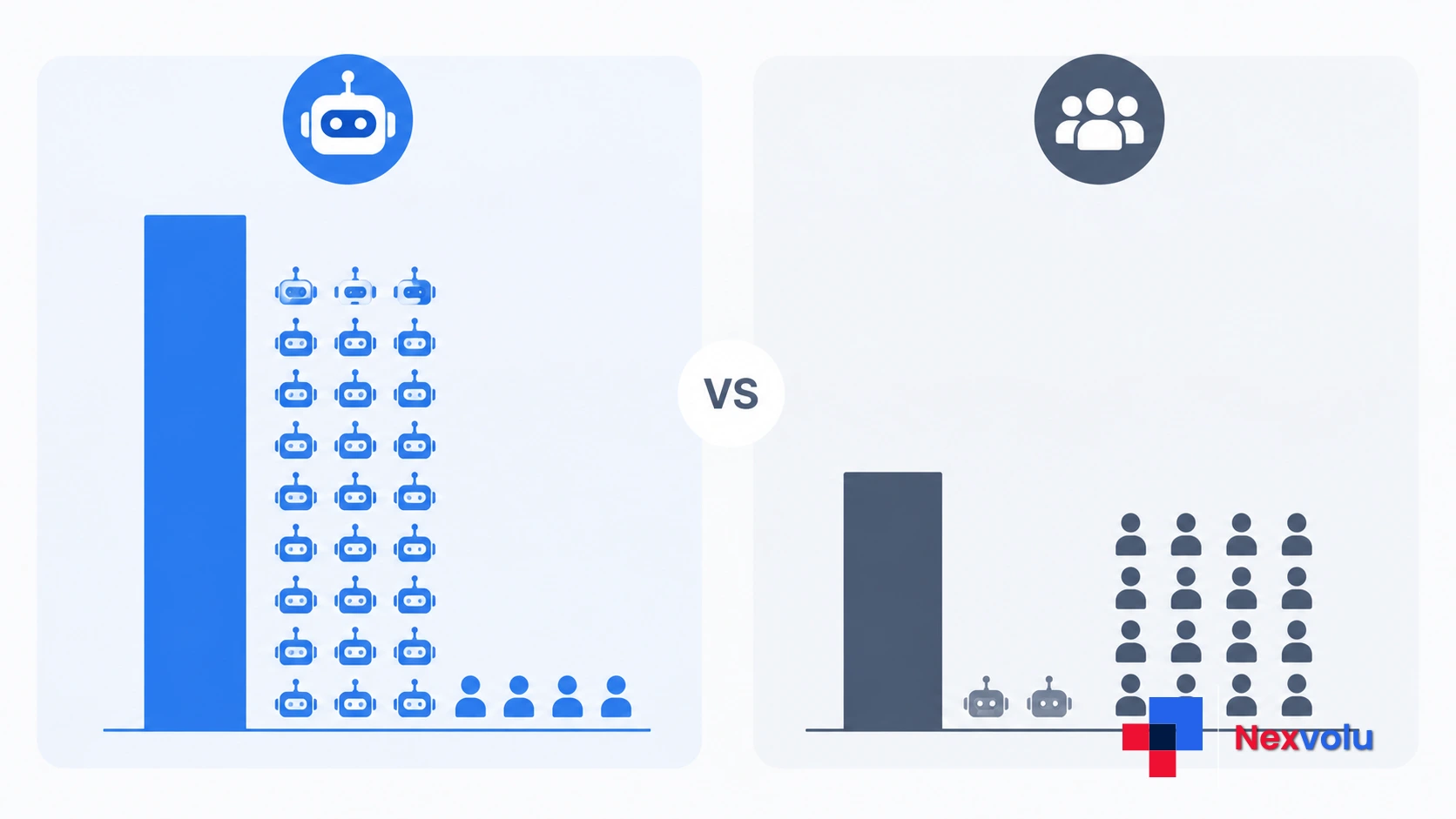
Yes. Automated traffic overtook human activity for the first time in a decade, reaching 51% of all web activity in 2024, according to Imperva’s 2025 Bad Bot Report. Then Cloudflare’s mid-2026 Radar data pushed the figure to roughly 57.5% of web content requests. Machines are now the majority online.
The driver is AI. Because cheap, capable models made bots trivial to build, they scaled fast from simple scrapers to “agentic” assistants that act on your behalf. As Cloudflare reported, a human might visit five sites to buy a camera while an AI agent visits 5,000. That asymmetry is the whole story. Your traffic graph isn’t measuring interest anymore. It’s measuring automation.
The full picture of the crossover is covered in our breakdown of what it means that bots now outnumber humans online. This piece, instead, is about what that traffic costs you.
Why Your Analytics Are Lying to You
Here’s the thing about bot traffic: bots don’t behave like customers, but they still get counted like them. They inflate pageviews, spike sessions, and pad “users” then vanish without buying, scrolling, or clicking. As a result, your dashboard looks healthy while telling you almost nothing true.
Watch for the tells. For example: a flood of direct traffic from two or three cities you don’t serve. Sessions lasting zero seconds. Conversion rates that quietly sink because fake clicks never convert. A/B tests that contradict each other because bot noise drowned the signal. One marketer in a popular GA4 tutorial discovered nearly 68% of their “direct” traffic was non-human.
Picture this. You report a 40% traffic jump to your boss on Monday. You celebrate. Then leads stay flat, sales stay flat, and nobody can explain the gap. That gap is often bots and when that same bot traffic clicks on your ad campaigns, skewed data turns into wasted spend.
The Hidden Tax: How Bot Traffic Wasted Ad Spend in 2026
This is where the takeover stops being abstract and starts costing real money especially for advertisers in the US and UK, who run the highest-RPM budgets on the planet.
According to Lunio’s Global Invalid Traffic Report 2026, 8.51% of all paid ad traffic is invalid. In other words, roughly one in every 12 clicks comes from something other than a real person with intent. On about $740 billion in global digital ad spend, that worked out to $63 billion wasted in 2025 alone.
So run the math on your own account. Here’s roughly how much ad spend bot traffic and other invalid clicks likely wasted on budgets like yours:
Monthly ad budget | Annual spend | Likely wasted at 8.51% |
$25,000 | $300,000 | ~$25,530 |
| $50,000 | $600,000 | ~$51,060 |
| £40,000 | £480,000 | ~£40,848 |
A mid-sized US team spending $50k a month is quietly burning more than fifty grand a year on clicks that will never convert. Meanwhile, a UK team on £40k a month loses roughly £41k. That’s not a rounding error. That’s a salary.
Worse, the damage compounds. Because invalid clicks train your bidding algorithms on fake signals, the platform “optimizes” toward more of the same junk. That’s how bot traffic quietly turns “performance marketing” into wasted ad spend on autopilot.
AI Crawlers Take Your Content and Send Nothing Back
For years, the deal was simple: search engines crawled your content and sent readers back through referrals. Then AI broke that bargain.
Today’s AI crawlers scrape your articles to answer questions inside ChatGPT, Perplexity, and Google’s AI summaries and most of those answers never link back. Cloudflare’s 2025 data found Anthropic’s crawler requested around 38,000 pages for every single referral it returned. Read that again. Tens of thousands of takes for one visit back.
Meanwhile, AI-driven traffic grew about 187% during 2025, per HUMAN Security’s 2026 report. So your costs (bandwidth, server load) rise while your reward (visitors, ad impressions, subscribers) shrinks. For content-funded marketing, that’s the real long-term threat, not the scary headline number, but the broken value exchange underneath it.
How to Cut Bot Traffic Wasted Ad Spend with GA4 Filters
You can’t block every bot. But you can stop letting them corrupt your decisions. Start here:
- Know GA4’s limits. Google Analytics auto-excludes known bots using the IAB/ABC list – but you can’t disable it, can’t see how much it removed, and it misses newer, sneakier bots.
- Hunt the anomalies. Segment by city, referrer, and session duration. If half your “users” sit in one data-center city with zero engagement, then that’s your culprit.
- Filter and exclude. Build GA4 audiences and filters to strip suspicious referrers and internal/dev traffic, then compare filtered vs unfiltered views.
- Move blocking upstream. A CDN or web application firewall (like Cloudflare) stops aggressive bots before they ever load your tags or your server.
- Consider pay-per-crawl. In July 2025, Cloudflare launched pay-per-crawl, letting publishers allow, block, or charge AI crawlers per request – turning a one-sided drain into a choice.
If you manage measurement for a team, start with our guide tobuilding a clean marketing dashboard and pair it with smarter PPC budget protection tactics. And if you publish content, auditing how AI bots use your site should be on this quarter’s road-map.
Go deeper with these guides:
- Building a clean marketing dashboard
- PPC budget protection tactics
- Auditing how AI bots use your site

Nexvolu’s Verdict
The bottom line: the bot crossover is real, measurable, and already taxing your budget treating your analytics as innocent-until-proven-guilty is now the most expensive default in marketing.
Act now if: you spend $10k+ a month on paid channels or rely on content for leads. The fixes take one afternoon and pay for themselves.
Can wait if: you run zero paid ads and publish no original content a shrinking club.
Pros of fighting back now:
- GA4 filtering and anomaly hunts are free and take hours, not weeks
- Upstream blocking (CDN/WAF) cuts waste before your tags even fire
- Pay-per-crawl turns AI scraping from a drain into a revenue decision
Cons:
- You’ll never catch 100% – sophisticated bots mimic humans well
- Filtered dashboards show smaller (if truer) numbers, a hard sell internally
- Pay-per-crawl is still young and currently favors Cloudflare publishers
Standout point: Anthropic’s crawler requesting ~38,000 pages per referral returned is the clearest picture yet of the new value exchange – content out, almost nothing back.
Nexvolu Editorial Score: 8/10 – the fight-back stack is high-impact and mostly free; it loses two points because detection is a moving target and the newest tools are still maturing. (Editorial opinion based on the cited reports, not hands-on testing.)
Frequently Asked Questions
How do I know if my website traffic is bots or real people?
Look for behavioral red flags: sessions lasting zero seconds, huge spikes from one unfamiliar city, no scrolling or clicks, and traffic that doesn’t match any campaign. Real humans leave varied, messy footprints. Bots cluster around identical, lifeless patterns that uniformity is usually your clearest signal.
In practice, open GA4’s Explore tab and build a simple table of city, session duration, and engagement rate. If one city you’ve never targeted shows thousands of sessions with near-zero engagement, for example, you’ve almost certainly found bots rather than a sudden fanbase. Cross-check any spike against your campaign UTMs before celebrating it.
Does bot traffic affect Google Analytics?
Yes. GA4 automatically filters known bots using the IAB/ABC list, but it can’t catch everything and won’t tell you how much it removed. Sophisticated or new bots still slip through, inflating sessions and users while deflating conversion rates and skewing the data you base decisions on.
The practical fix is comparison: keep one unfiltered view and one with your own filters for suspicious referrers, data-center cities, and internal traffic. If the two views diverge sharply month over month, then bots not customers are moving your numbers, and it’s time to tighten filters or block upstream.
What is an AI crawler and why does it matter for marketers?
An AI crawler is automated software that scrapes web content to train or power AI tools like ChatGPT and Gemini. It matters because these crawlers consume your content heavily while sending almost no referral traffic back, raising your costs and shrinking the audience your content was meant to attract.
For example, Cloudflare measured Anthropic’s crawler requesting around 38,000 pages for every referral visit it sent back in 2025. Common crawlers worth watching in your server logs include GPTBot (OpenAI), ClaudeBot (Anthropic), and Google-Extended each can be allowed or blocked individually in your robots.txt file.
What is Cloudflare’s pay-per-crawl?
Pay-per-crawl, launched by Cloudflare in July 2025, lets site owners control AI crawler access at the network level. Publishers can allow a crawler free access, block it entirely, or charge a set price per request creating a new way to monetize or restrict the AI bots scraping their content.
In practice, it works like a paywall for machines: the crawler receives an HTTP 402 “payment required” response until it agrees to your price. It’s still early you need Cloudflare in front of your site but it’s the first mainstream tool that turns scraping into a negotiation.
How much ad spend is wasted on bot traffic?
Lunio’s Global Invalid Traffic Report 2026 found that bot traffic and other invalid clicks wasted about $63 billion in ad spend globally in 2025 roughly 8.51% of all paid traffic. For a team spending $50,000 a month, that’s about $51,000 a year lost to clicks that never convert.
Because the waste hides inside averages, run the math on your own account: multiply annual spend by 0.0851 for a realistic starting estimate. Then compare that figure against what invalid-traffic filtering would cost you for most mid-sized advertisers, protection pays for itself several times over.
Can you recover ad spend wasted on bot traffic?
Partially. Google Ads automatically credits advertisers for clicks it flags as invalid you’ll see these as “invalid activity” adjustments on your billing page. However, those refunds only cover what Google’s own systems catch, and independent audits suggest plenty of sophisticated bot clicks slip past undetected.
For everything else, prevention beats recovery. Tighten campaign targeting, exclude data-center IPs and suspicious placements, and consider a dedicated invalid-traffic tool that blocks bad clicks before you pay for them. If you spot a clear fraud spike, you can also file an invalid click report with Google refunds aren’t guaranteed, but documented cases do get credited.
Bot Traffic Wasted Ad Spend: Your Plan to Stop It
The internet quietly flipped: machines now outnumber people online, and that single shift changes how you should read every report you own. Three things to remember: your raw traffic numbers are inflated, a real slice of your ad spend is being wasted on bot traffic, and AI crawlers are taking content without paying you back in visitors.
None of that means marketing is broken. It means the old scoreboard is. So audit your analytics, filter the fakes, and protect your spend before next quarter’s data fools you again.
Which metric on your dashboard do you trust least right now and have you ever caught bots hiding in it? Share this with a marketer who still trusts their traffic numbers, and subscribe to Nexvolu for the digital marketing shifts worth knowing early.
References
- Imperva. https://www.imperva.com/resources/resource-library/reports/2025-bad-bot-report/
- NBC News / Cloudflare Radar. https://www.nbcnews.com/tech/tech-news/bot-web-traffic-overtaken-human-web-traffic-data-shows-rcna348522
- Lunio (via MediaPost). https://www.mediapost.com/publications/article/412156/ad-spend-wasted-on-invalid-traffic-reaches-63b.html
- Cloudflare. https://blog.cloudflare.com/crawlers-click-ai-bots-training/
- Cloudflare. https://blog.cloudflare.com/introducing-pay-per-crawl/