


A small business with £500 a month to spend does not have the same choice as one with £5,000. Yet almost every guide on SEO vs PPC hands both of them the same answer: it depends, do both.
However, that answer is useless when the money only stretches one way.
So this SEO vs PPC guide does something different. First, it gives you a stated winner for each monthly budget band. Second, it runs the actual click arithmetic for US and UK cost-per-click rates. Finally, it hands you two rules – a payback period and a cash runway test that settle the decision when the budget alone doesn’t. In short, no fence-sitting.
Table of Contents
- SEO and PPC: How They Differ
- Which Channel Costs Less?
- How Long SEO Takes
- Budget-Based Decision Framework
- Calculate Your Payback Period
- US vs UK Advertising Costs
- When to Use Both Channels
- Nexvolu’s Verdict
- Frequently Asked Questions
- The Bottom Line
SEO vs PPC: what is the difference between them?
SEO earns clicks by improving your site so it ranks in unpaid search results. PPC, by contrast, buys clicks by bidding for ad placement above and around those results. In other words, SEO costs time and compounds, whereas PPC costs money per click and stops the moment you pause the budget. Ultimately, that trade – time versus money – is the entire SEO vs PPC decision.
Google frames the two as complementary rather than rival channels in its official guidance on SEO and PPC, and that’s fair from a platform’s point of view.
- Speed. A PPC campaign can begin serving ads after approval and setup, although results and conversions are not guaranteed. Organic rankings often take months to develop, especially for competitive keywords.
- Ownership. Organic rankings can continue bringing visitors without paying for each click, but rankings are never permanently owned and can change. Paid placements provide visibility while your campaigns are active and stop generating paid clicks when you pause them.
- Failure mode. Poor SEO work can consume months without producing useful visibility. Poorly managed PPC can waste advertising money quickly, particularly when campaigns attract irrelevant or invalid clicks. Read our guide on how bot traffic can drain advertising budgets.
Above all, keep those three in mind, because every recommendation below traces back to one of them.
Which is cheaper for a small business, SEO or PPC?
Neither is cheap any more. However, what’s changed is that paid search now has a published price, whereas organic search doesn’t.
What does PPC cost per click in 2026?
According to WordStream and LocaliQ’s 2026 search advertising benchmark, the average cost per click is $5.42, the average conversion rate is 8.18%, and the average cost per lead is $66.69. The study analysed more than 13,000 search advertising campaigns across Google Ads and Microsoft Ads in 23 industries, running from April 2025 through March 2026.
These are US-wide benchmarks, not guaranteed prices for every business or keyword. The report also found that conversion rates increased in 87% of industries, while overall advertising metrics remained relatively stable year over year. Average cost per lead actually declined for the first time in five years.
What does SEO cost a small business?
SEO pricing is less standardized because businesses pay for expertise, content, technical work, tools, and ongoing maintenance rather than individual clicks. In a 2025 survey of 260 SEO agencies conducted by SE Ranking and Duda, the most common monthly retainer range was $500-$1,000, while 64% of surveyed agencies charged below $1,000 per month. These figures represent agency pricing offers, not a fixed market rate or the budget every small business needs.
Doing SEO in-house replaces some agency fees with your own time and resources. That can reduce direct spending, but it does not make the work cost-free.
SEO vs PPC cost comparison at a glance
Here’s how the two spends actually behave once you compare like with like.
| Factor | SEO | PPC |
|---|---|---|
| Typical small-business cost | Labour, content, tools, and agency or freelancer fees. | Variable advertising spend plus optional campaign management fees. |
| Time to first meaningful result | Often several months; competitive keywords can take longer. | Ads can start serving after approval and setup; profitability takes testing. |
| Cost per click | No direct media charge per organic click, but SEO work still costs money. | Auction-based CPC that varies by keyword, industry, location, and competition. |
| What happens when you stop paying | Existing rankings may continue, but traffic can decline without maintenance. | Paid traffic from the campaign stops when ads are paused. |
| Predictability | Low initially; depends on competition, content quality, and search demand. | Spend and targeting are controllable; clicks and conversions are not guaranteed. |
| Best at | Building long-term visibility and capturing ongoing organic demand. | Testing demand, reaching high-intent searches, and promoting time-sensitive offers. |
| Main risk | Investing time and money without achieving meaningful rankings or leads. | Spending on clicks that do not produce profitable conversions. |
The row that decides most arguments is the second-to-last one. PPC is predictable. Therefore, for a business that needs to know what next month looks like, predictability is worth paying a premium for.
Work out your own numbers before you commit
Before committing money, open Google Keyword Planner and check the estimated CPC for five high-intent keywords your potential customers actually search for. Divide your available advertising budget by the estimated CPC to calculate how many clicks you could afford. Then estimate potential conversions using your own website conversion rate.
There is no universal minimum number of clicks that makes a campaign viable. Your actual test budget depends on keyword competition, conversion tracking, customer value, and how much you can afford to spend while gathering useful data.
How long does SEO take to work?
SEO does not have a guaranteed ranking timeline. Google explains that some website improvements can affect search results within days, while others may take several months. Results depend on competition, website quality, technical health, content relevance, and other factors.
Ahrefs’ 2025 research illustrates how difficult competitive rankings can be. In its study, only 1.74% of one million randomly selected URLs reached Google’s top 10 within one year. When the researchers filtered a separate sample of two million URLs to include non-empty English content, 6.11% reached the top 10 within a year. In another sample of top-ranking pages, 72.9% were more than three years old.
These findings are not a guaranteed timeline for your website. They do show why businesses should approach SEO as an ongoing investment rather than expecting immediate rankings.
| Period | What May Happen |
|---|---|
| Month 0-1 | Technical improvements, keyword research, content planning, and indexing checks. |
| Months 2-3 | Search impressions and early visibility may appear, particularly for less competitive queries. |
| Months 4-6 | Review Search Console data, improve pages, and identify keywords producing relevant impressions and clicks. |
| Months 7-12 | Relevant pages may build stronger visibility and attract more consistent organic traffic. |
| Month 12+ | Continue improving content, technical SEO, and authority. Competitive searches may require a longer investment. |
This time difference is central to the SEO vs PPC decision: SEO builds visibility over months, while paid search can buy exposure sooner when campaigns are approved and funded.
How zero-click search changes the SEO vs PPC timeline
There is another important consideration in 2026: zero-click search. SparkToro’s analysis of US Google searches from January through April 2026 found that 68.01% ended without a click, based on Similarweb clickstream data. This includes searches that ended on Google rather than sending visitors to external websites.
Seer Interactive’s separate study of 53 brands and 5.47 million tracked queries also found that organic click-through rates on searches showing AI Overviews reached a low of 1.3% in December 2025 before recovering to 2.4% in February 2026.
These figures do not mean organic search has stopped working. They mean businesses should pay closer attention to search intent and the commercial value of the traffic they attract. Content that helps people compare solutions, evaluate prices, and make purchase decisions can still serve an important role.
So what does that mean practically? Organic visibility is still worth chasing. Nevertheless, you should plan for fewer clicks per ranking than the 2019-era case studies promised. Rank for questions that require a purchase decision, not questions an AI summary can close on your behalf.
To monitor how your organic pages appear in Google’s AI-powered search experiences, read our guide to Google Search Console’s generative AI report, which explains how to track AI impressions and visibility by page.
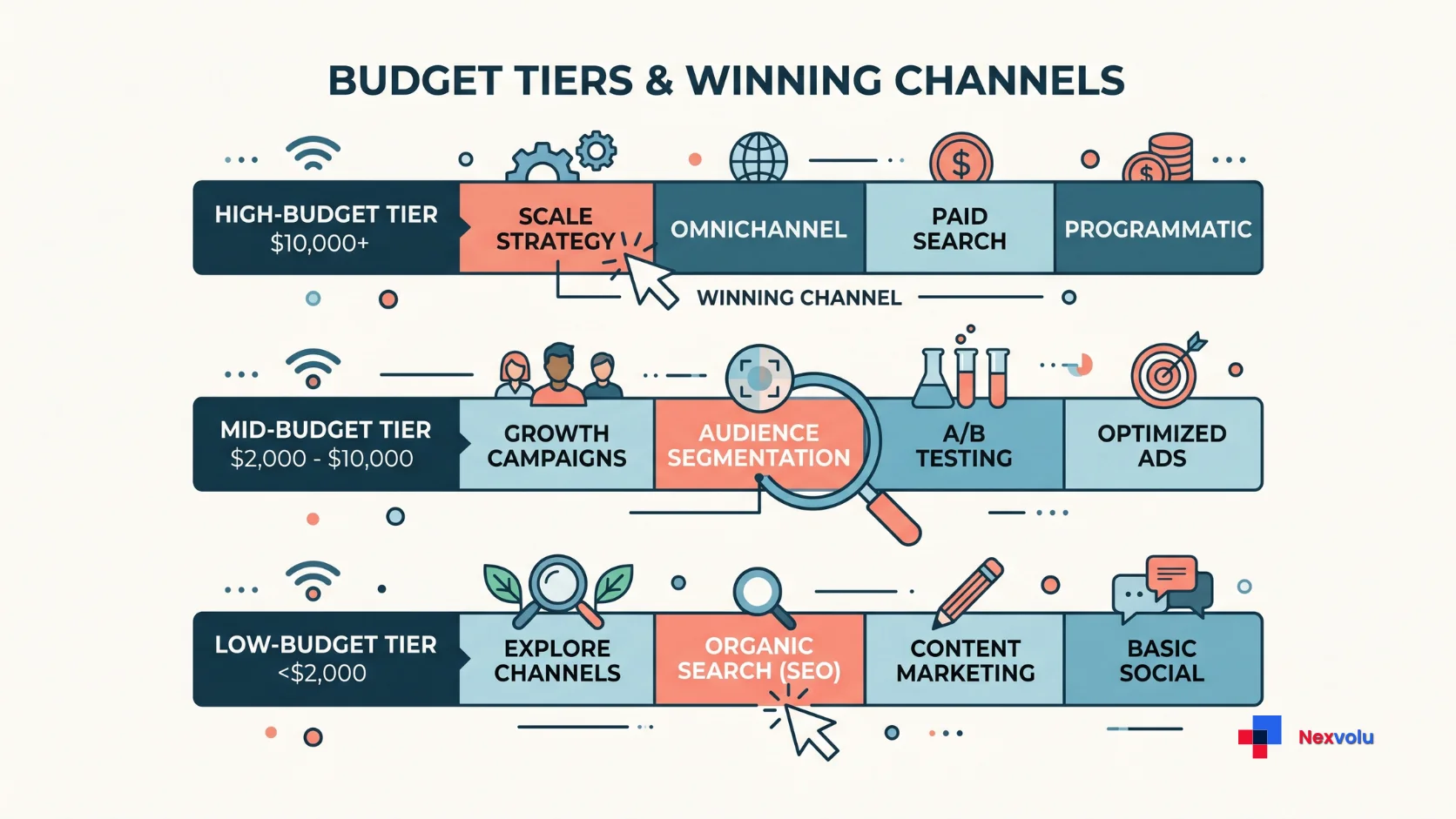
SEO vs PPC: the decision table by monthly budget
This is the part every other guide skips. Below, each band gets one winner, not a shrug.
How the budget bands were calculated
The calculation is straightforward. Divide your advertising budget by the estimated CPC to calculate potential clicks. Multiply those clicks by your expected conversion rate to estimate leads, then apply your lead-to-customer conversion rate to estimate new customers.
Finally, divide your advertising spend by the estimated number of customers to calculate your advertising cost per acquisition. There is no universal minimum of 20 leads per month. Smaller campaigns can still provide useful insights, but low conversion volumes make results less reliable and may require longer testing.
| Monthly Budget | Recommended Starting Point | Why | What to Do |
|---|---|---|---|
| Under 500 Local currency | SEO first | Limited funds can make broad paid-search testing difficult, especially in expensive markets. | Improve essential service pages, technical SEO, local visibility, and conversion tracking. Consider a small paid test only when CPC and customer economics justify it. |
| 500–2,000 Local currency | Focused PPC test with SEO foundations | A focused campaign may generate useful keyword and conversion data, depending on competition and conversion rates. | Test a narrow group of high-intent keywords with a fixed spending limit. Use search-term and conversion data to improve organic pages. |
| 2,000+ Local currency | Consider both | A larger budget may support paid acquisition while longer-term organic work develops. | Run profitable paid campaigns alongside SEO. Allocate spending according to actual customer acquisition costs, margins, and conversion performance. |
These are illustrative monthly budget bands in your local currency, not exchange-rate equivalents. The same numerical budget can produce very different results in the US and UK because advertising costs vary by market and keyword.
Two tiebreakers that override the table
Admittedly, two tiebreakers override the table.
The runway rule.
A short cash runway does not automatically make PPC the better choice. Paid search may produce leads faster, but only choose it when your offer, tracking, conversion process, and customer economics are sufficiently proven. If the expected acquisition cost exceeds your available cash or the payback period is too long, spending more on ads could make the problem worse. With a longer runway, you have more room to develop organic visibility and test both channels.
The margin rule.
Do not judge PPC by gross margin alone or compare customer margin directly with cost per lead. First calculate customer acquisition cost by dividing cost per lead by your lead-to-customer conversion rate. For example, a $66.69 cost per lead and a 20% close rate produce an estimated acquisition cost of about $333 per customer. Compare that figure with the gross profit you expect from the customer over the relationship, not just the first sale.
How do you calculate your payback period first?
A useful SEO vs PPC comparison measures both channels against the same customer value, gross profit, and expected payback period.
Payback period is how long a channel takes to return the money it consumed. It’s the number that settles arguments, and you can work it out on the back of an envelope.
Payback period (months) = Fully loaded customer acquisition cost ÷ Monthly gross profit per customer
Work through a $1,000 paid budget in the US using the 2026 benchmark CPC:
- $1,000 ÷ $5.42 CPC = approximately 185 clicks.
- 185 clicks × 8.18% conversion rate = approximately 15 conversions, assuming the tracked conversion is a lead.
- 15 leads × 20% close rate = approximately 3 customers.
- $1,000 ÷ 3 customers = approximately $333 advertising cost per customer.
This is an illustrative calculation, not a predicted result. The 8.18% benchmark includes different conversion actions across advertisers, and the 20% lead-to-customer rate is a hypothetical assumption.
The $333 figure also excludes agency management fees, creative production, landing-page development, and other acquisition costs. Your fully loaded customer acquisition cost may therefore be higher.
Paid search makes financial sense when the expected gross profit contribution from an acquired customer exceeds the fully loaded acquisition cost. You should also check whether that profit returns within the period your business can afford to wait. Revenue alone is not enough to determine profitability. A dentist or a roofer clears that on one job. A £25-a-month subscription needs fourteen months just to break even, and startup benchmarks generally place paid search payback in the 3-9 month window anything past that is a cash-flow problem dressed up as a marketing plan.
Comparing payback period for SEO vs PPC
Use the same approach for SEO, but include all relevant costs: agency fees, content production, tools, technical work, and your own time. Compare the total investment with the gross profit generated by customers attributed to organic search.
SEO can continue generating visits after the initial content work, which is one reason it may become more cost-efficient over time. However, rankings and traffic are not guaranteed to last, and ongoing maintenance still has a cost. Compare both channels over consistent measurement periods rather than assuming one will always outperform the other.
Do the two sums for your own business before you read another comparison article. Whichever channel pays back inside your cash runway is the one to start with and that’s a decision no generic guide can make for you.
Does the answer change in the US versus the UK?
Yes. Advertising costs differ substantially between the US and UK, and local keyword competition matters more than a single international average.
PPC Chief’s 2026 UK benchmark estimates an average Search CPC of £1.95 across its sampled industries. Whito’s separate Q1 2026 research highlights industry differences: approximately £0.95 for retail and e-commerce, £3.65 for B2B SaaS, and £8.25 for legal services.
These figures come from different publishers and methodologies, so they should be treated as indicative benchmarks rather than a direct head-to-head experiment. Your own Google Keyword Planner estimates and campaign data should determine the budget you need.
| Measure | United States | United Kingdom |
|---|---|---|
| Average search CPC | Approximately $5.42 | Approximately £1.95 |
| Illustrative clicks from a 500 local-currency budget | Approximately 92 clicks from $500 | Approximately 256 clicks from £500 |
| Industry variation | Legal, insurance, and business services can have considerably higher CPCs. | Examples include £0.95 for retail, £3.65 for B2B SaaS, and £8.25 for legal services. |
| Practical implication | Higher average CPCs can limit the number of clicks available on smaller budgets. | Lower average CPCs may allow more clicks, depending on the industry and keyword. |
Note: The $500 and £500 examples are separate local-currency budgets, not equivalent amounts after currency conversion. The US and UK benchmarks also come from different datasets, so the calculated clicks are illustrative rather than a direct performance comparison.
The takeaway is that identical numerical budgets can buy different amounts of traffic in different markets. However, cheaper clicks do not automatically produce cheaper customers or better returns. Conversion rates, lead quality, close rates, and customer margins still determine whether paid advertising is worthwhile. Do not move into a higher budget band simply because your local CPC is lower.
When should you run both at once?
Running both channels can make sense, but the decision should depend on performance rather than a fixed budget threshold. PPC can reveal which search terms generate leads and customers, while SEO can help build visibility around proven search demand.
Consider running both when these three conditions are met:
- Your budget can support both channels without making either campaign ineffective.
- You have reliable keyword, conversion, and customer acquisition data to guide decisions.
- Someone is responsible for sharing paid search findings with the person managing organic content and SEO.
There’s a defensive argument too. A February 2026 Search Engine Land report covering Similarweb data compared US search activity in January 2025 and January 2026 across headphones, jeans, greeting cards, and online games. Text ads gained click share across all four categories, while paid listings captured roughly one-third of clicks in some product categories. This is evidence of changing search-result competition in those sampled categories, not a universal result for every industry.
That said, don’t run both simply to feel safe. Underfunding two channels is how small businesses end up with a mediocre ad account and a blog nobody reads.
Nexvolu’s Verdict
One-line verdict: For most small businesses with limited budgets, start by building organic foundations. Introduce PPC when you can track conversions, estimate customer acquisition costs, and afford to test paid demand.
Best for SEO: Businesses with a longer investment horizon, limited advertising budgets, useful content opportunities, and the ability to build organic visibility consistently.
Best for PPC: Businesses with high-intent search demand, measurable conversion paths, sufficient customer margins, and a need to generate leads more quickly.
When to consider both: Businesses that can fund paid campaigns without neglecting SEO and have enough conversion data to make informed allocation decisions.
Advantages of leading with PPC
- Campaigns can start generating clicks after approval and setup.
- Search-term reports reveal queries that may be valuable for SEO.
- Spending and targeting can be adjusted quickly.
Limitations of leading with PPC
- Click costs vary significantly by industry and competition.
- Paid traffic stops when campaigns are paused.
- Clicks do not guarantee qualified leads or profitable customers.
Standout point: Market location changes the advertising calculation. The published US and UK CPC benchmarks show why businesses should use local keyword estimates rather than apply the same budget recommendation everywhere.
The best starting channel is the one that fits your available resources, customer economics, and business timeline. Neither SEO nor PPC guarantees results, and both need ongoing measurement.
Frequently asked questions
Is SEO or PPC better for a brand new website?
PPC can be useful for a brand new website when you need faster visibility and have a landing page that is ready to convert visitors. SEO is more appropriate when you can invest in content, technical improvements, and organic visibility over a longer period.
Ahrefs’ 2025 study found that only 6.11% of a filtered sample of two million URLs with non-empty English content reached Google’s top 10 within one year. This demonstrates how competitive organic search can be, but it does not predict the ranking timeline of every new website.
A practical approach is to fix your website’s technical foundations, create genuinely useful commercial pages, and consider a narrowly targeted paid campaign if its economics make sense. Never send paid traffic to an untested or broken conversion path.
How much should a small business spend on SEO per month?
SEO budgets vary depending on the website’s condition, market competition, content requirements, and whether you hire an agency or do the work in-house.
SE Ranking’s 2025 survey of 260 agencies found that the most common monthly retainer range was $500-$1,000, while 64% of surveyed agencies charged below $1,000 per month. These are agency pricing figures, not a recommended budget or a measure of what every small business actually spends.
Before hiring an SEO provider, ask for a clear breakdown of deliverables, expected work, reporting, and how success will be measured. Your budget should reflect what the business can sustain while allowing sufficient time to evaluate meaningful results.
Can you do SEO and PPC at the same time on a small budget?
Yes, but a small budget requires prioritization. Trying to fund several paid campaigns and multiple SEO projects simultaneously can spread resources too thin.
Start with essential organic foundations, including useful service pages, technical fixes, keyword research, and local visibility where relevant. Then consider one narrowly targeted paid campaign if you have enough budget to test it without compromising essential business expenses.
You do not need to divide your budget into a fixed SEO-to-PPC ratio. Let actual conversion results, customer acquisition costs, and available resources guide the allocation.
Does PPC help SEO rankings?
No. Paid clicks are not a ranking factor, and running Google Ads gives your site no direct organic advantage. Google treats the two systems separately, and paying for ads never buys a better organic position.
The indirect benefits are real, though, and they’re worth having. Ad campaigns reveal which keywords convert, which headlines get clicked, and which landing pages hold attention all of which make your SEO targeting sharper. Ads also let you occupy the results page while a page is still climbing. Just don’t expect a ranking lift, and be sceptical of anyone who promises one.
How long before Google Ads becomes profitable?
There is no universal timeframe for making Google Ads profitable. Results depend on your cost per click, conversion rate, lead quality, sales close rate, and customer value. Some campaigns become profitable relatively quickly, while others continue spending without producing a positive return.
The 2026 WordStream benchmark reports an average cost per lead of $66.69, but your actual cost may be very different. At a 10% lead-to-customer conversion rate, that CPL produces an estimated acquisition cost of approximately $667 per customer. At a 30% close rate, it falls to approximately $222.
This is why improving the quality of leads and your sales follow-up process can matter as much as optimizing bids. Measure actual acquisition cost and gross profit rather than judging a campaign by clicks or impressions alone.
Is SEO still worth it with AI Overviews and zero-click search?
SEO is still worth considering, but organic visibility needs to be evaluated alongside actual clicks, leads, and business results. SparkToro’s 2026 analysis found that 68.01% of US Google searches ended without a click during the first four months of the year. Its findings also showed that zero-click behaviour is not caused by AI Overviews alone.
Seer Interactive’s 2026 research found that organic click-through rates on searches displaying AI Overviews recovered from 1.3% in December 2025 to 2.4% in February 2026. This shows that performance can change and should not be judged using a single snapshot.
For small businesses, the practical response is to create useful content that helps customers compare services, understand pricing, evaluate options, and make purchasing decisions. Measure whether that content attracts qualified visitors and contributes to business outcomes rather than focusing only on rankings.

The bottom line
Three things to take away. First, your monthly budget band settles the SEO vs PPC question more reliably than any pros-and-cons list. Second, payback period and cash runway break the tie whenever the band is ambiguous. Third, where you advertise changes the math – the UK’s lower cost per click can flip the same business from SEO-first to paid-first.
Above all, your next action is small: run the four-line payback sum on your own numbers before you spend anything on either channel. It takes ten minutes and it’ll tell you more than another comparison of organic traffic versus paid search ever will.
If this helped, share it with the business owner in your life who’s about to spend £500 on the wrong channel.
Which one did you start with and would you make the same call again? Tell us in the comments.