


Claude vs ChatGPT for business writing comes down to a plain split. However, Claude writes drafts that sound closer to a person. ChatGPT writes drafts that stay closer to the brief. That split showed up again and again in published side by side tests during 2026, and it matters more than any feature list.
A sales email that reads like a template costs you a reply, and a proposal that reads like a template costs you a deal, because buyers judge the thinking behind the words before they judge the offer itself. Pick Claude when the writing carries your name. Pick ChatGPT when the facts carry the risk.
Claude vs ChatGPT for business writing: how the test was set up
I did not run Claude and ChatGPT myself for this article. However, I cannot run either tool from here, so I will not pretend I did. I built this comparison from published tests where other writers gave both tools the same prompts and printed what came back.
Three published tests carry most of the weight. AITomation Academy ran five tests in spring 2026 on a blog post and an email and a proposal and brand copy and an edit of a 600 word draft. Meikuio ran three identical prompts through GPT-5.5 and Claude Sonnet 4.6. HumanizeThisAI ran a blind test with 134 participants across eight writing tasks.
Read the dates with the results. AITomation Academy warned that its tests ran in spring 2026 and that both companies shipped new models in September 2026. HumanizeThisAI said its model versions were current as of March 2026. Treat the excerpts below as evidence of each tool’s habits, not as a benchmark of the exact model you will meet today.
One more caution. HumanizeThisAI sells a tool that rewrites AI text, so its detection numbers serve its own product. I use them because the method is stated in plain terms, 134 participants and eight tasks. Even its favoured tool, Claude, still got flagged most of the time.
Test 1: The sales email that had to sound like a person
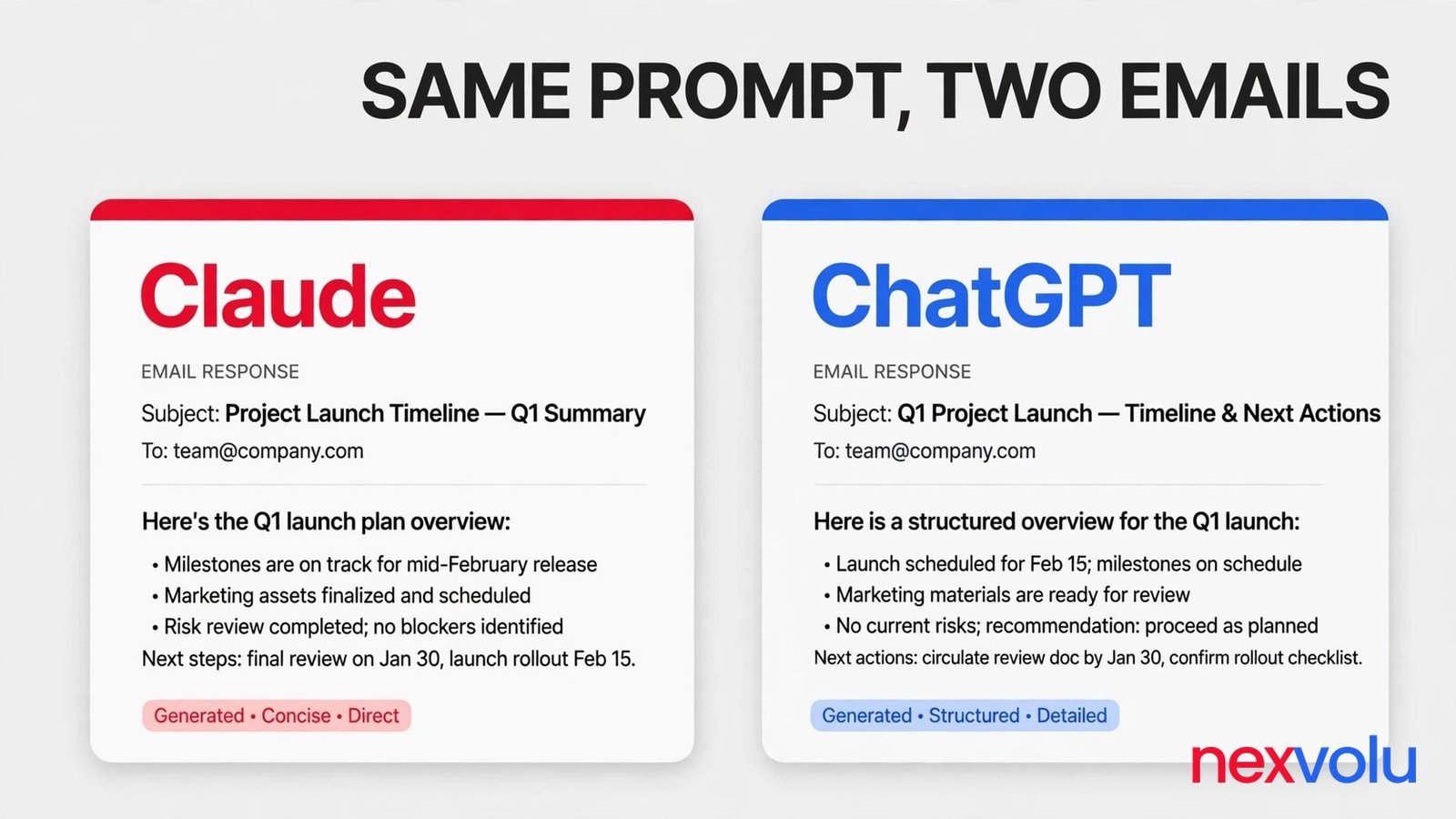
A project update email is a small test with a large tell. You write the same news two ways, once to a board and once to a colleague, and the tone has to shift.
Claude wrote to the board like an executive who had the numbers in front of her.
Its opening lines read: “The platform migration is tracking two weeks ahead of the revised timeline. We’ve completed the data validation phase with a 99.7% accuracy rate, which positions us well for the soft launch in Q3. The remaining risk is vendor capacity during the July migration window. I’ve scheduled a contingency review with their team for next Tuesday.”
ChatGPT wrote to the same board like a polite press release. Its version read: “I am pleased to provide you with an update on our platform migration project. I am happy to report that we are making excellent progress and are currently ahead of schedule. Our team has been working diligently to ensure a smooth transition, and we are confident in our ability to deliver on time.”
Spot the gap. Claude names a date and a rate and a risk and a meeting. ChatGPT names a feeling. “Pleased to provide” and “happy to report” and “working diligently” fill space where facts should sit.
The colleague version widened the gap further. AITomation Academy reported that Claude shifted into a direct and slightly informal register, the way a person fires off a quick message to a colleague. ChatGPT produced a slightly shorter version of the same corporate tone. It changed no register.
Score this round on one question only. Which email could you send without rewriting it first? For the board email, Claude wins by a clear margin. For a quick internal note, the gap narrows.
Test 2: The proposal where template language costs money
A proposal is where this comparison stops being about style and starts being about revenue. AITomation Academy gave both tools the same brief for a mid-market software company that wanted go-to-market consulting, with real details about its situation and its limits. A proposal that ignores those details reads like a form letter with a new logo pasted on top.
Claude used the details. Its excerpt opened on the client’s own numbers: “The bottleneck is the handoff between marketing-qualified and sales-accepted leads, where your 34% drop-off rate is nearly double the SaaS benchmark for your ACR range. We’d focus the first 60 days on diagnosing and fixing that specific conversion gap before addressing top-of-funnel volume.”
Read that again and note what it does. For example, it names the bottleneck. It quotes the drop-off rate. It picks a first move and a time frame.
In contrast, ChatGPT used the brief as decoration. Its excerpt read: “Our comprehensive go-to-market strategy will help your company reach its full potential.” That sentence could open a proposal for any company in any industry. It names no bottleneck and no rate and no time frame. It promises a full potential that no buyer can measure.
AITomation Academy put it plainly in its own notes. Claude’s proposal read like a consultant who had listened. ChatGPT’s read like a template with the company name swapped in. Claude kept the client’s own terms, which makes a buyer feel heard.
ChatGPT fell back on its own stock terms, which makes a buyer feel processed.
This round goes to Claude by more than the other rounds did. ChatGPT can still draft a proposal outline fast, but a tidy outline that says nothing specific is a worse starting point than a rough draft that says one true thing about the client.
Test 3: The blog intro, 150 words, one specific scene
Blog intros expose a writer fast. You have about 150 words to earn the next paragraph, and a generic opening spends them all. Meikuio gave both tools the same prompt for a blog post about stopping procrastination while working from home. The prompt asked for an engaging and conversational intro that avoided cliches.
ChatGPT opened with a competent line: “Working from home sounds like a dream until you realize how easy it is to drift through a morning.” It reads well, yet it also reads like a hundred other openings you have already seen this month, and nothing in it could belong only to this article, which is why a reader who has skimmed three work-from-home posts this week will skim this one too.
In contrast, Claude opened with a scene: “it’s 4pm and you’ve deep-cleaned the kitchen, watched three ‘educational’ YouTube videos, and reorganized your desktop icons. Again.” That last word does the work. “Again” turns a list of chores into a confession. The reader recognises the afternoon.
In addition, Meikuio noted a second difference in how the two intros were built. ChatGPT delivered two smooth and even paragraphs and closed on a stock promise. Claude broke its intro into three shorter paragraphs and used short punches, including the line “The couch is right there. Nobody’s watching.”
Then Claude reframed the problem itself, calling procrastination an environment and systems issue rather than a willpower issue. That reframe hands the article an angle instead of a setup.
AITomation Academy ran the longer version of this test, a 2,000 word blog post for small consulting firms about productizing their services. Its ratings tell the same story in numbers. Claude scored 9 out of 10 for voice consistency and 9 out of 10 for argument structure. ChatGPT scored 5 out of 10 for voice consistency and 6 out of 10 for argument structure.
On usable without heavy editing, Claude scored 8 out of 10 and ChatGPT scored 4 out of 10. Those ratings are editorial, not lab measurements. Still, the pattern matches the short test. Claude holds one voice across a long piece.
ChatGPT drifts toward generic phrasing by the middle.
This round goes to Claude as well. It wins on the opening line and on the long haul.
Test 4: The edit that kept your voice, or erased it
Most business writing starts with a draft you already wrote, and you want it shorter and tighter without losing the sound of you. AITomation Academy gave both tools a 600 word draft and one instruction: make it 40% shorter while keeping all key points, and maintain the author’s voice.
Claude cut the piece to 370 words. It removed redundant examples and tightened sentences and kept the original voice and the argument flow. AITomation Academy described the result as a good editor at work: tighter and cleaner and still recognisably the author’s.
In contrast, ChatGPT cut it to 340 words. That sounds better on paper, a shorter cut, until you read it. It rewrote sentences in its own voice rather than preserving the original. Key points stayed present in a technical sense, but the personality left the page.
AITomation Academy called it over-editing, and the word fits. The result was shorter, but it did not sound like the author any more. The ratings back that reading. Claude scored 9 out of 10 for voice preservation and 9 out of 10 for key point retention and 8 out of 10 for restraint.
ChatGPT scored 4 out of 10 for voice preservation and 7 out of 10 for key point retention and 4 out of 10 for restraint.
Restraint is the telling score. A good editor knows when to stop. ChatGPT kept going until the draft sounded like itself. Your voice is an asset.
In fact, clients hire a person, not a template.
If you write in your own voice already, Claude is the safer editor. If you have no voice yet, ChatGPT will give you a clean and neutral draft fast.
Claude vs ChatGPT for business writing: what the blind test found
Individual tests tell you how each tool writes. A blind test tells you how readers hear it. HumanizeThisAI ran a blind test with 134 participants across eight writing tasks, from blog posts to cover letters. Participants did not know which output came from which model.
Claude won 4 out of 8 rounds. ChatGPT won 1 out of 8 rounds. Gemini took the other 3 rounds. Claude was also the model most often picked as the one that could be human.
In contrast, ChatGPT won its single round on a product description, where its polished feature and benefit structure works well.
In the faculty blind test reported by HumanizeThisAI, ChatGPT was identified 68% of the time and Claude 23% of the time and Gemini 61% of the time.
Automated detectors showed a similar spread. GPTZero flagged ChatGPT 72% of the time and Claude 28% of the time. Originality flagged ChatGPT 85% of the time and Claude 35% of the time.
Read those numbers as a ranking, not as a pass mark. Claude at 23% identified still means 77% of its output got flagged, so picking Claude will not make AI text pass as human text on its own, though it does start you closer to human text, with more sentence variation and fewer stock phrases to clean up.
A 2024 study from the University of Tübingen adds weight to that ranking. It analysed 14 million PubMed abstracts and found that at least 10% of 2024 academic abstracts showed signs of LLM processing, with ChatGPT’s vocabulary fingerprint among the markers. Claude’s output varies more in sentence length, and that variation pushes its writing closer to human rhythm.
Claude vs ChatGPT for business writing: where ChatGPT still wins
For example, Claude wins most writing rounds here. ChatGPT still wins the rounds where facts matter more than flair, and a business that ignores that will pay for it.
Meikuio caught the clearest example. Both tools wrote Instagram captions for a fictional productivity app called FocusFlow. Claude organised its three captions by strategy and wrote sharper lines. Then it added a claim that users get 3 times more deep work hours.
That number came from nowhere.
The app does not exist. No study backs the claim. Meikuio wrote that it nearly dropped the line straight into a brief before it caught the invented number. ChatGPT stayed inside what it actually knew.
Its calls to action were forgettable, “Try it today” and “Start now”, but none of them invented a fact.
For a real campaign, a flat line you can publish beats a sharp line you have to delete, and the same rule holds for a regulated claim or a client report or a price promise, so check every number Claude gives you, even when the sentence around it reads beautifully.
ChatGPT also holds its own on rigid briefs. Meikuio’s third prompt asked for a 400 word Pomodoro explainer with exactly three subheadings and one numbered list and a single practical tip at the end. Both tools hit every requirement. Claude turned its third subheading into a section on common mistakes that kill results, which helps the reader more, but it also shows the same habit as the invented stat.
A separate editorial scorecard from SolutionHow, based on the LMArena human preference leaderboard tracked in July 2026, splits the same way. Claude scored 94 for natural prose and voice against ChatGPT at 80. ChatGPT scored 92 for SEO structure against Claude at 85. ChatGPT scored 93 for following a strict template against Claude at 82.
If your work is a template you must follow to the letter, ChatGPT is the steadier hand. If your work is prose a reader must enjoy, Claude is the stronger writer.
Claude vs ChatGPT for business writing: pick one in 15 minutes
Use this framework on your own writing, not on a demo prompt from a review. It takes 15 minutes.
- List the three writing jobs you do most each week. Write them as jobs, not as tools. A sales follow-up after a call is a job. A client report is a job. A newsletter intro is a job.
- Write one prompt for each job, with a real detail from your work in it. Use a client name you can share and a real number from a real project. Do not use a made-up example. A made-up example hides the exact weakness you need to see.
- Run the same three prompts in both tools on the same day, on the paid plan you would actually buy. Free tiers run different models, so a free test will mislead you about paid quality.
- Score each draft on edits, not on first impressions. Count the sentences you would change before sending. The tool with fewer edits wins that job, even if the other draft looked prettier at first glance.
- Check every number and every claim in both drafts against your own records. Give a point to the tool that invented nothing. Take a point away from any draft that added a stat you cannot source.
- Pick one default tool for client-facing writing and one default for internal drafts. Write the choice down where your team can see it. A default you have to re-decide each morning is not a default.
| Business type | Pick first | Why it fits |
|---|---|---|
| Consultancy or agency | Claude | Client-facing drafts need your voice |
| Sales team | Claude for emails, ChatGPT for scripts | Voice wins emails, structure wins scripts |
| Regulated or finance work | ChatGPT first, Claude for edits | Facts stay inside the brief |
| Solo creator | Claude | Long posts hold one voice |
If your scores split by job, use both. That is a normal result, not a failure of the test. Many teams draft client work in Claude and run research and image work in ChatGPT, because each tool earns its keep on a different job. The mistake is to pay for both and use neither with a system.
Pick a default and review it after one month of real work.
Questions readers keep asking
Is Claude better than ChatGPT for writing?
For most business writing, yes. Claude wins on voice and long-form consistency and editing in the published tests cited here. ChatGPT wins on strict templates and factual restraint and images in the same chat. The job decides, not the brand.
Will Claude make my writing pass AI detection?
Claude will not make your writing pass AI detection on its own. In the blind test cited here, Claude was identified 23% of the time, which still leaves 77% flagged. Use Claude for a better first draft, then edit it like a human wrote it. That edit is what moves the text, not the model name.
Can I use ChatGPT for client proposals?
You can, and many teams do. Give it the client facts in the prompt, ask it to quote those facts back before it drafts, and check every claim before you send. Either way, a human signs it.
How much does each tool cost?
Claude Pro costs $20 a month, or $17 a month on annual billing, as of October 2026. ChatGPT Plus costs $20 a month. Both have free plans. Team tiers cost more per seat, so check the provider page for your team size before you budget.
Your first test, this week
Run the framework above on Friday, with three real prompts from work you already did this week. Score the drafts on edits and on invented facts. Pick your default by the end of that session. Then use that default for two weeks before you judge it.
Claude vs ChatGPT for business writing is a close call on paper, and a clear call once you count your own edits.
If you want to keep up with new AI tools for small business, Hustle AI covers practical AI tools, and SaaS Mega News covers new SaaS products and launches.
Related reading
Sources
AITomation Academy, Claude vs ChatGPT for Writing: 5 Real Tests
HumanizeThisAI, ChatGPT vs Claude vs Gemini: Writing Quality Compared
SolutionHow, Claude.AI Vs ChatGPT: Which is Better For Content Writing
Justin McKelvey, Claude vs ChatGPT for Small Business (2026 Honest Comparison)
RuneLab, Claude Pricing 2026: Pro, Max, Ultra and Team Plans Compared
Sobia Aslam writes about AI tools and digital marketing at nexvolu.com. She tests AI tools on real business writing tasks and reports what actually works, with sources you can check.