
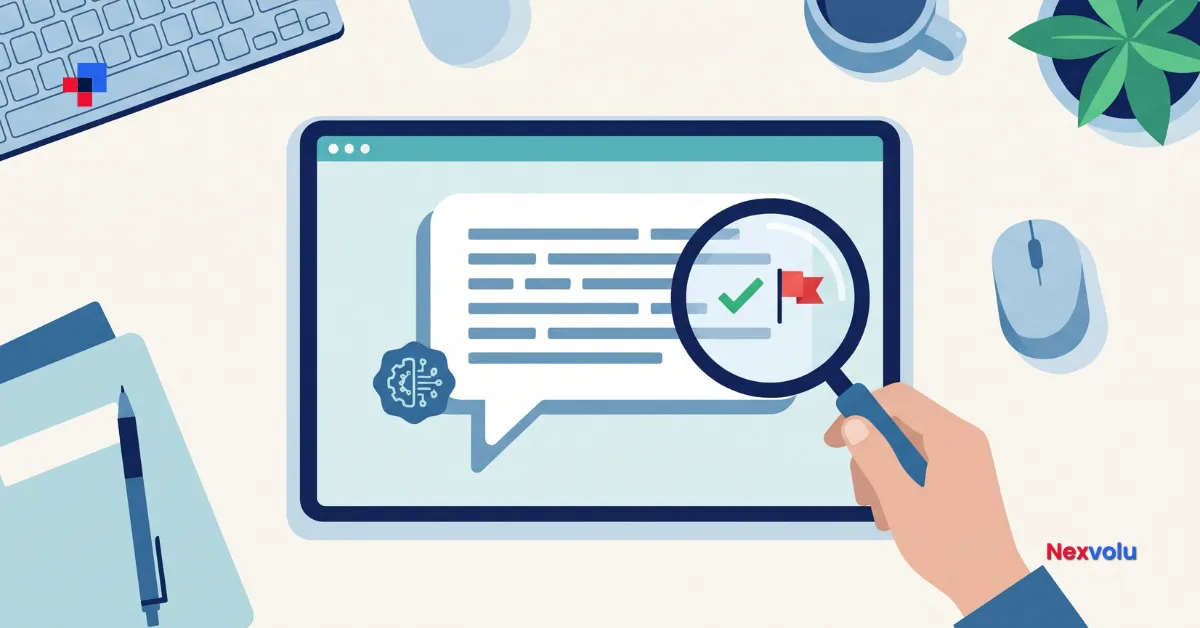
Knowing how to fact-check AI answers matters because a chatbot can sound confident even when it is wrong. A fabricated statistic, a misremembered date, or an invented citation can arrive in the same polished sentences as a correct fact, with nothing on screen warning you that something is off.
This guide gives you a repeatable way to check an answer before you rely on it, whether it came from ChatGPT, Gemini, Claude, or Copilot. You will learn why these tools produce confident errors, a six-step workflow, and a printable checklist. Allow more time when the stakes or complexity are high.
Table Of Contents
- The short answer: how to fact-check AI answers
- Why AI gets confident things wrong
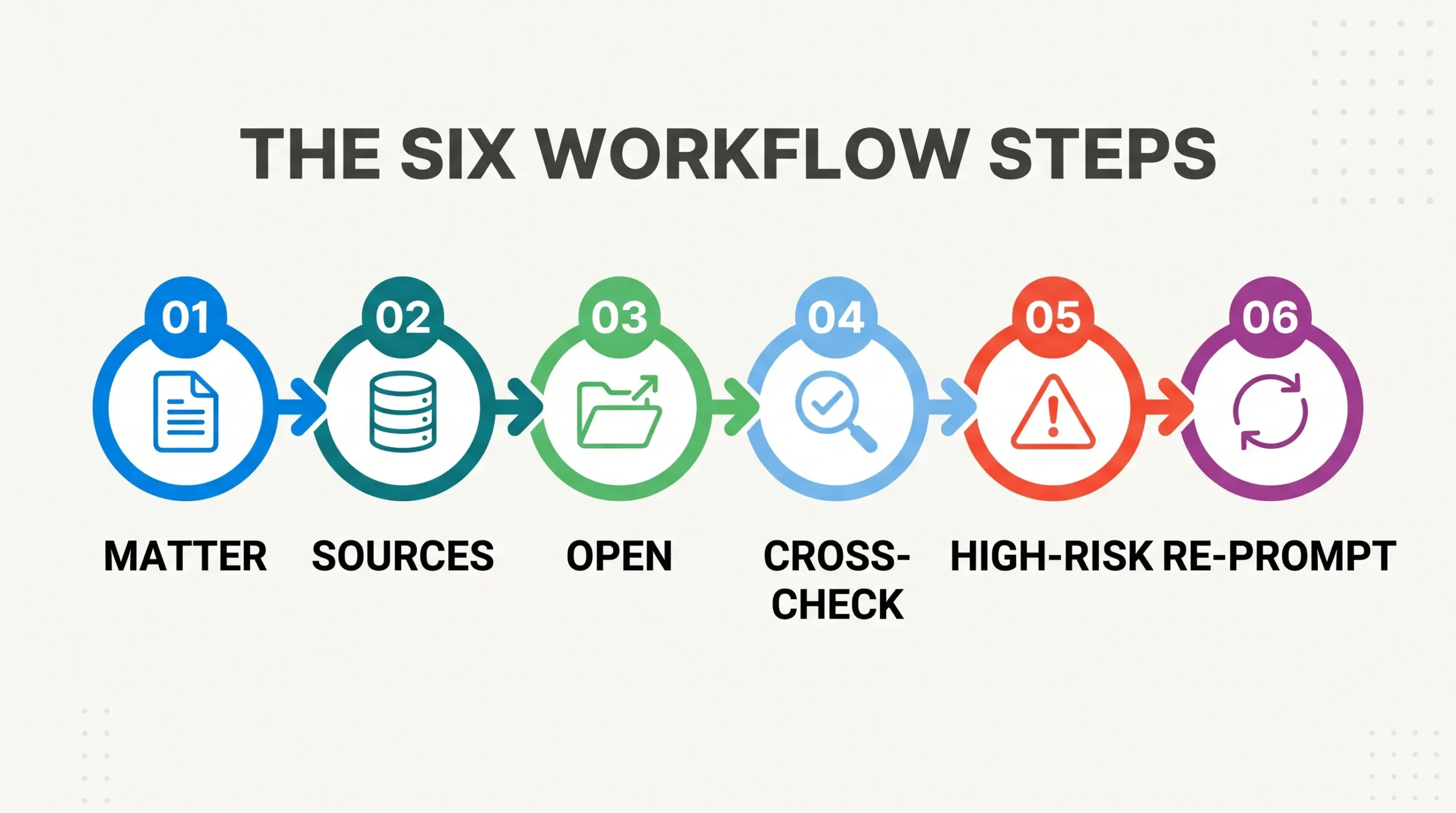
- How to fact-check AI answers: the 6-step workflow
- How to fact-check AI answers: which claims need the most checking
- How to fact-check AI answers: a printable checklist
- How to fact-check AI answers and what verification cannot do
- Frequently asked questions
- Nexvolu’s verdict
The short answer: how to fact-check AI answers
Treat every AI answer as a draft, not a fact. Judge how much the claim matters, ask the tool for its sources, open those sources yourself to confirm they exist and actually say what was claimed, and cross-check the key facts against one independent, authoritative source. Numbers, dates, quotes, citations, and anything legal, medical, or financial deserve the most scrutiny, because mistakes in those details can be hard to spot or have serious consequences.
Why AI gets confident things wrong
How language models produce plausible errors
The polite industry term is a hallucination. OpenAI defines it plainly as a case where “a model confidently generates an answer that isn’t true” – a plausible but false statement. These are not rare glitches; they are a predictable side effect of how the tools work.
A language model generates text by predicting likely next tokens based on patterns learned during training. On its own, it does not automatically consult a live, authoritative database to verify each claim. Some chatbots can also search the web or retrieve documents, but those tools can still return incomplete, outdated, or misinterpreted information.
During pretraining, models learn from examples of text rather than a complete set of true-or-false labels for every statement. As OpenAI explains in its research, arbitrary or low-frequency facts, such as a specific person’s birthday, can be difficult to infer from patterns alone. When reliable information is missing, a model may generate a plausible-sounding answer instead of acknowledging uncertainty.
OpenAI’s research adds a second reason the guessing persists: the way models are tested rewards it. Think of a multiple-choice exam. If you guess, you might get lucky; if you leave the answer blank, you score zero. Because most benchmarks grade only on accuracy, a model that always guesses scores better than one that admits “I don’t know.” The result is a tool trained to sound certain rather than to flag doubt. In OpenAI’s own example, a chatbot asked for one researcher’s PhD dissertation title confidently produced three different answers, all wrong.
What a study of AI search tools found
Connecting a chatbot to live web search can help, but it does not remove the need to verify its sources. In a March 2025 study, Columbia Journalism Review’s Tow Center tested eight AI search tools using 1,600 queries. Researchers provided excerpts from 200 news articles and asked the tools to identify the original article, publisher, publication date, and URL.
The tools returned incorrect answers to more than 60% of the queries. The reported error rates included 37% for Perplexity, 67% for ChatGPT Search, and 94% for Grok 3. These figures relate specifically to the study’s news-article identification task, not the general accuracy of every AI-generated answer.
The researchers also cautioned against generalising their findings to all AI models or publishers, noting that results can vary between attempts. You can read the original Tow Center study.
OpenAI’s help documentation also warns that ChatGPT can produce fabricated quotes, studies, citations, or references to non-existent sources.
The takeaway is not that AI is useless. It is that confidence is not evidence. The fix is a habit, not a tool.
How to fact-check AI answers: the 6-step workflow
1. Decide how much the answer matters
Not every answer needs the same scrutiny. Brainstorming a birthday-party theme carries no risk; a medication dose, a tax rule, a contract clause, or a figure you are about to put in front of a client does. Before you verify, ask what happens if this is wrong. The higher the stakes, the more independent confirmation you need and for legal, medical, or financial decisions, a qualified professional, not a chatbot, is the real source.
2. Ask the AI for its sources, then distrust them
Ask the tool to list the sources behind its key claims, with links. This is useful as a starting point, but a citation from an AI is a lead to check, not proof. Models fabricate plausible-looking references, and even when AI search tools link out, the Tow Center found many links were syndicated copies or broken URLs – more than half of the citations from Gemini and Grok 3 led to fabricated or error pages. A source you have not opened does not count.
3. How to fact-check AI answers against the original source
Click through and read the relevant part. Confirm three things: the source genuinely exists, it is credible for this topic, and it actually contains the claim the AI attributed to it. A real page that does not support the statement is just as misleading as an invented one. Pay attention to the publication date, because AI answers frequently mix up current and outdated information.
4. Cross-check the key fact against one independent source
For anything that matters, confirm the central fact with a second, independent, authoritative source – ideally the primary one. To check a statistic, trace it to the original dataset or report, not a blog summarising it. Check product prices and specifications on the vendor’s official page on the day you use them. One good primary source beats three pages quoting each other.
5. Give the high-risk answer types extra scrutiny
Some claims deserve more verification because mistakes can be difficult to detect or have serious consequences. Numbers, dates, quotes, citations, and legal, medical, or financial information should receive particular attention. The following table is a practical verification guide, not a measured ranking of hallucination rates across AI tools.
6. Re-prompt to surface uncertainty
The same tool can help you pressure-test its own answer. Ask it: “Which parts of this are you least certain about?”, “What would change this answer?”, or “Give me the single primary source for this specific number.” Models may acknowledge uncertainty when asked directly, but their follow-up answers can also be wrong. If an answer changes or cannot be supported, treat that as a signal to investigate further. A consistent answer is not proof of accuracy. This does not replace an independent check; it helps you identify claims that need closer attention.
How to fact-check AI answers: which claims need the most checking
Use this as a practical verification-priority guide. The priorities reflect the potential consequences of mistakes and the care needed to check them; they are not measured error rates or scores for your specific question.
| Answer type | Verification priority | How to verify |
|---|---|---|
| Statistics and numbers | High | Trace to the original dataset or report; confirm the figure and its date |
| Dates and timelines | High | Check against an official or primary record |
| Quotes and citations | Very high | Open the source; confirm it exists and contains the exact wording |
| Legal, medical, financial guidance | Very high | Confirm with a qualified professional or an official/regulatory source |
| Current prices, specs, availability | High | Check the vendor’s official page on the day you use it |
| Summaries of text you supplied | Low–medium | Re-read the original passage for accuracy and omissions |
| Well-established general facts | Lower | Spot-check one independent source |
How to fact-check AI answers: a printable checklist
Use this checklist as a reminder of how to fact-check AI answers before you rely on, publish, or forward them:
- [ ] Consider how much the answer matters and what happens if it is wrong.
- [ ] Ask the tool for its sources without taking them at face value.
- [ ] Open each key source and confirm it exists and is credible.
- [ ] Check that the source supports the specific claim attributed to it.
- [ ] Note the date of the source and the information.
- [ ] Cross-check the central fact against an independent, authoritative source.
- [ ] Verify numbers, dates, quotes, and citations individually.
- [ ] Consult a qualified professional about legal, medical, or financial points.
- [ ] Re-prompt the tool to flag its least certain claims.
- [ ] Remove anything unverified or clearly mark it as unconfirmed.
How to fact-check AI answers and what verification cannot do
Verification lowers your risk; it does not guarantee truth. Confirming that a source exists and supports a claim is strong evidence, but sources can themselves be outdated or wrong, which is why a single authoritative primary source beats several pages echoing each other.
It also helps to know the limits of the tools people reach for. AI-detection tools cannot reliably prove that a given answer is true or false, and content-provenance signals describe where a file came from, not whether a statement is accurate, a distinction worth understanding if you also need to spot AI-generated content. And if you are checking AI output in a work setting, remember that verification is about accuracy, not permission: review your employer’s rules on using AI at work before any sensitive output leaves your hands.
Frequently asked questions
Are AI answers usually accurate?
AI answers can be useful, but they are not reliably accurate enough to trust without checking important claims. Specific details such as dates, statistics, and citations should be verified against their original sources. Treat an AI answer as a starting point, not established fact.
How do I know if ChatGPT is making something up?
You usually can’t tell from the wording alone that is the problem. The reliable signal is external: ask for sources, open them, and check whether they exist and support the claim. Invented citations and broken links are common giveaways.
Does connecting AI to the web stop hallucinations?
Web access can help with some errors, but it does not remove them. The Tow Center found AI search tools misattributed sources in most queries, and paid tiers were often more confidently wrong because they rarely declined to answer.
How to fact-check AI answers when you only need one fact
Ask for the one primary source behind that specific claim, open it, and confirm the detail. If the tool can’t produce a real, checkable source, treat the fact as unverified.
Can I trust AI with medical, legal, or financial questions?
Use it to understand terms or frame questions, never as the final authority. Confirm anything that affects your health, money, or legal position with a qualified professional or an official source.
Nexvolu’s verdict
AI tools are genuinely useful, but they are built to sound certain, not to be right. The single habit that protects you is simple: treat every answer as a draft, scale your checking to how much the answer matters, and confirm the facts that count against a real source you have opened yourself. Confidence is not evidence, verification is.