
Introduction
The short answer to the Zelle scam refund question is: it depends on who pressed send.
If someone else moved the money out of your account, federal law is on your side. Your bank must investigate the transfer and, in most cases, give the money back. If you sent the payment yourself because a scammer lied to you, the law does not require a refund. There is one important exception, a Zelle network policy that has covered certain impostor scams since 30 June 2023, and it may apply to your case.
This article explains that rule in plain English, what changed in 2023, and what to do in the first hour. A Zelle scam refund is possible in many cases, but it is never automatic.
How a Zelle scam usually works
Most Zelle scams start with a call, text, or email that looks like it comes from your bank. The caller says there is suspicious activity on your account, or that your account will be locked. They sound calm and urgent, and they may already know your name.
Then comes the trick. They tell you to move your money to a “safe account” while they fix the problem, or they ask you to read back a one-time code that just arrived. That code is real: it is the verification code your bank sends when someone tries to log in or enroll a new recipient. The moment you read it out, the scammer can finish that step. In the “safe account” version, the account they give you belongs to them.
Zelle makes these scams work because it is fast. A payment to an enrolled recipient usually arrives within minutes, and no one can cancel or reverse it once it lands. Zelle does not offer purchase protection for authorized payments, the way a credit card does. Note: the standalone Zelle app stopped sending and receiving payments on 1 April 2025, so Zelle now lives inside your bank’s app, and your bank handles your claim.
Zelle scam refund: authorized vs unauthorized under Regulation E
Regulation E is the federal rule that implements the Electronic Fund Transfer Act. It covers electronic transfers from consumer bank accounts, including Zelle payments. The whole Zelle scam refund question turns on one definition in that rule, at 12 CFR 1005.2(m).
An unauthorized electronic fund transfer is a transfer that someone other than you started, without your actual authority, from which you receive no benefit. If your transfer fits that definition, your bank must investigate it and the law limits your losses. If it does not fit, Regulation E does not require your bank to refund you.
Zelle scam refund: three cases, depending on who sent the money
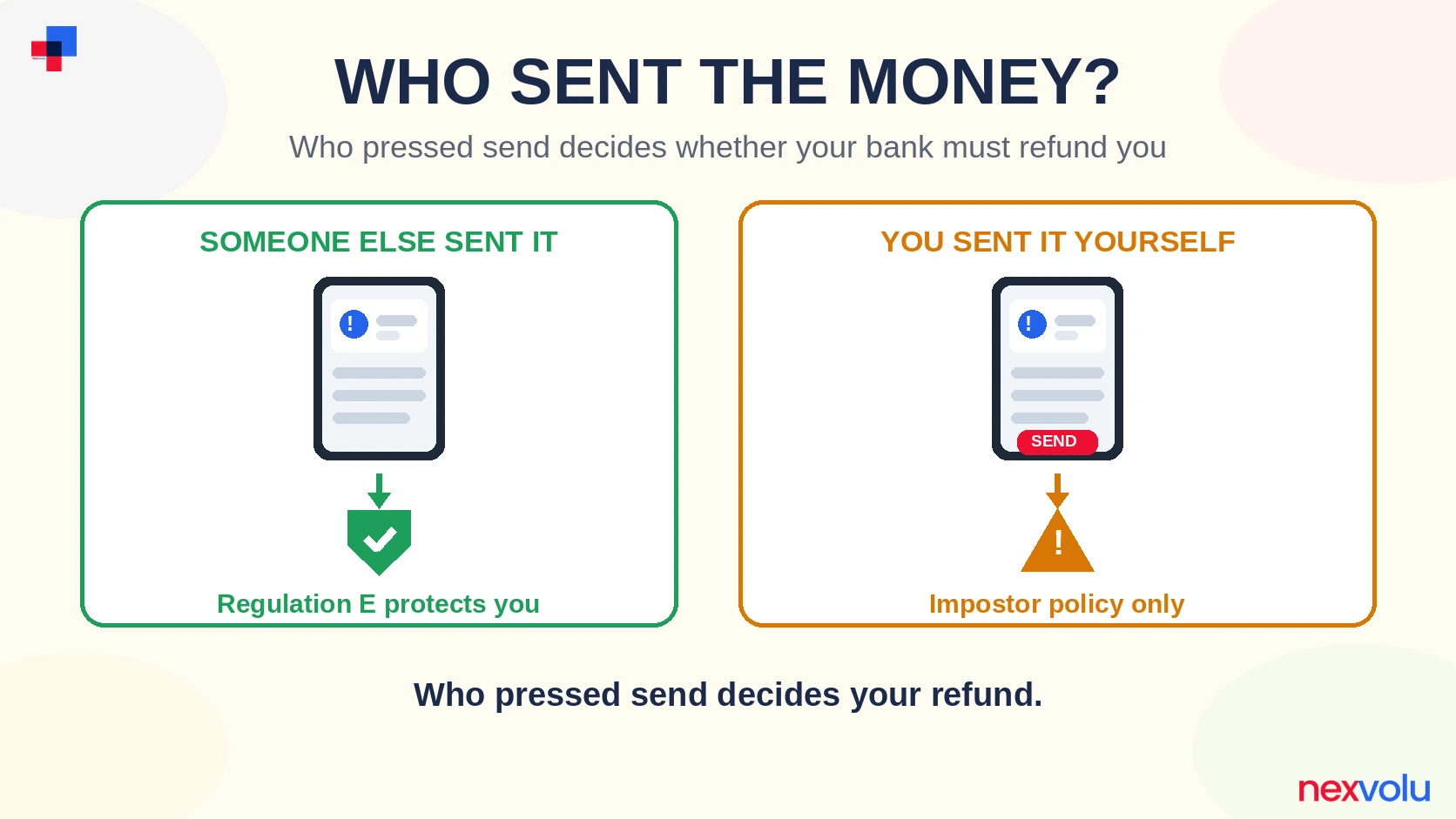
Someone else sent the money. A scammer got into your account and sent a Zelle payment without your knowledge. This is unauthorized, and your bank must investigate it.
A caller tricked you into sharing a code, and they sent the money. A caller pretending to be your bank talked you into reading out a texted code, then used it to send the payment themselves. This still counts as unauthorized. The Consumer Financial Protection Bureau (CFPB) has said so in its Electronic Fund Transfers FAQs: a transfer that uses fraudulently obtained access information is unauthorized under Regulation E. The fact that you read out the code does not make it your transfer. Who pressed send is what matters.
You sent the money yourself after being lied to. A scammer convinced you to send a payment for concert tickets that did not exist, a puppy that was never shipped, or a fake investment. You authorized the transfer, even though the reason was a lie. Regulation E does not require your bank to refund it. Your only path here is the Zelle impostor policy, covered in the next section.
How much you can lose
For unauthorized transfers, the law limits your liability, and the limits depend on how fast you report. These limits apply when someone loses or steals an access device, such as a card, a code, or your login.
- Within 2 business days of learning about the loss or theft, and the law caps your liability at $50.
- After 2 business days but within 60 days of the statement showing the transfer, and your liability can rise to $500.
- More than 60 days after the statement, and you can be liable for later transfers, if the bank can show it could have stopped them.
If nobody lost or stole an access device, the 60-day statement rule matters most, and the bank cannot raise your liability just because you were careless.
The bank has a deadline too
Once you report an error, Regulation E gives your bank a clock of its own, at 12 CFR 1005.11. The bank must investigate and decide within 10 business days. If it needs longer, it may take up to 45 calendar days, but only if it provisionally credits your account within those first 10 business days. A provisional credit is temporary, and you can use the money while the bank investigates. If the bank later decides no error occurred, it can take the credit back. Reporting by phone may mean the bank asks you to confirm in writing within 10 business days. If you do not, the bank may not have to give you provisional credit. Send the letter.
What the 30 June 2023 impostor policy changed
On 30 June 2023, Early Warning Services, the company that operates Zelle on behalf of its owner banks, changed its network rules. Since that date, participating banks and credit unions must reimburse customers for qualifying impostor scams. This is the one path to a Zelle scam refund when you sent the payment yourself.
A qualifying impostor scam is one where the scammer pretended to be one of three things: your bank, a government agency, or an existing service provider, a company you already do business with. The classic examples are a fake “fraud department” call telling you to move money to a safe account, and a fake government agent demanding payment. The “me-to-me” safe-account scheme counts too.
What does not qualify matters just as much. Romance scams, fake marketplace sales, crypto investment schemes, and payments for goods that never arrived are outside the policy.
Three honest caveats. First, this is a network policy, not a legal right. The rulebook is not public, and your bank decides case by case. Second, no one can tell you in advance that your case will qualify. Third, courts are still testing the policy: the CFPB sued Early Warning Services and three large banks in December 2024, and that case was dismissed in March 2025. New York’s attorney general filed a separate case in August 2025.
How often the Zelle scam refund policy pays out
The numbers show how narrow it is. A July 2024 staff report from the US Senate Permanent Subcommittee on Investigations says banks reported about 54,000 impostor-scam disputes between 30 June and 31 December 2023. Banks deemed about 24,000 of them, or 44 percent, eligible, with $18.3 million in eligible claims. More than half did not qualify, most often because the scammer had impersonated someone other than a bank, a government agency, or a service provider. That is why the words you use on the call matter: say “impostor scam” and “qualifying impostor scam under the Zelle network policy”. It will not guarantee a refund, but it makes sure your bank reviews your claim under the right rule.
Zelle scam refund: what to do in the first hour
Speed matters more than anything else right now. Work through these steps in order.
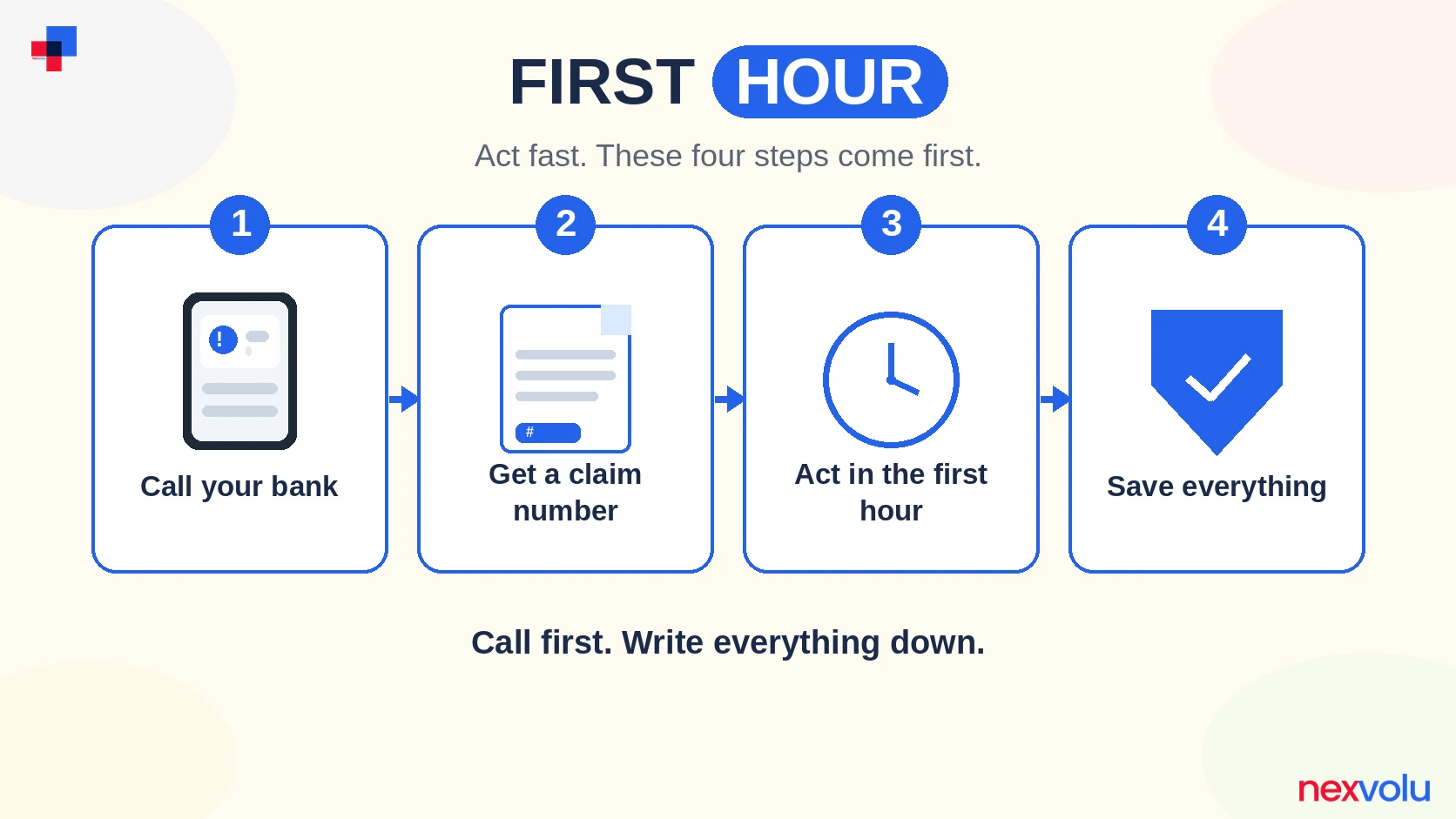
Call your bank’s fraud line now. Use the number on the back of your debit card or in your bank’s official app. Do not call a number from the text, email, or call that scammed you.
Say which kind of case it is. If someone else sent the money, say “unauthorized transfer” and ask to dispute it under Regulation E. If you sent it yourself because someone pretended to be your bank, a government agency, or a company you use, say “impostor scam” and ask whether it qualifies under the Zelle network’s impostor scam policy. Using the right words improves your Zelle scam refund case from the first minute.
Ask whether the payment can still be stopped. You can only cancel a Zelle payment while it is pending, which usually means the recipient has not enrolled yet. If the recipient never enrolls, the payment generally expires after 14 days and the money comes back.
After the call: secure your accounts and save the evidence
Get a claim or case number, and the name of the person you spoke to. Write both down, with the date and time of the call.
Change your passwords and turn on app-based two-factor authentication for your bank, your email, and any account that shares the same password. Do it from a device you trust, not from a link anyone sent you.
Save everything. Screenshot the scammer’s messages, the payment confirmation, and your call log. Keep the phone number, the recipient’s name or email, and the exact amounts and times.
Do not send a second payment. Scammers often come back pretending to be the bank again, asking for another payment to “unlock” or “reverse” the first one. That is the same scam, repeated. Do not pay anyone who offers to get it back for a fee.
How to file your Zelle scam refund claim with your bank
Your phone call starts the claim, but the written record is what protects you. Start with the fraud department, not general customer service, and say you are reporting an error on an electronic fund transfer.
Give them the date, the amount, the recipient’s name, email, or phone number, and a short account of what happened. Be specific about the key fact: did you send the payment, or did someone else send it using your account? If you shared a code, say exactly what the caller told you and what you shared. The CFPB’s guidance makes that fact central to your case.
Ask the bank to confirm, in writing, that it has opened a claim and what the claim number is. If the bank asks you to confirm your report in writing within 10 business days, do it, and keep a copy. Skipping that step can cost you the provisional credit. Then watch the clock: the bank has 10 business days to decide, or to provisionally credit your account and take up to 45 calendar days to finish. When it finishes, it must tell you the result in writing within 3 business days.
What to do if the bank says no to your Zelle scam refund
A denial is not the end of the road, but you need to know what kind of denial it is. Banks usually deny for one of two reasons: they decided the transfer was authorized, so Regulation E does not apply, or they decided it was not a qualifying impostor scam under the Zelle policy. Your next step depends on which one it is.
First, ask the bank to review the decision. Call back, refer to your claim number, and ask for the denial in writing. If your case involved a code you were tricked into sharing, point the bank to the CFPB’s Electronic Fund Transfers FAQs. If your case was an impostor scam, ask the bank to confirm that it reviewed the claim under the Zelle impostor policy specifically.
When the bank still says no, file a complaint with the Consumer Financial Protection Bureau. Filing is free and takes about ten minutes online, at consumerfinance.gov/complaint. The CFPB forwards your complaint to the bank, and most companies respond within 15 days, with a final response within 60 days. It does not decide your case, and a complaint does not guarantee a refund. What it does is put your Zelle scam refund request on a formal, tracked record that the bank must answer.
Also report the scam to the Federal Trade Commission at ReportFraud.ftc.gov and to the FBI’s Internet Crime Complaint Center at ic3.gov. These reports do not usually get your money back, but they create the official record that investigators use to spot patterns. As a last resort, consider your state attorney general’s consumer protection office or small claims court. This article is general information, not legal advice.
How to protect yourself next time
The best protection is a habit, not a product. Zelle works best for sending money to people you know and trust, and the safest way to use it is to keep it that way.
Never read a one-time code to anyone on the phone, in a text, or in an email. Your bank will never ask you for it. If someone who claims to be from your bank asks for a code, hang up.
If you get a worrying message about your account, do not use the number or link in the message. Open your banking app yourself, or call the number on the back of your card.
Turn on transaction alerts for every payment, and use an authenticator app for two-factor authentication instead of texted codes where your bank offers it. A caller can steal a texted code by talking you into reading it out. An authenticator app code changes every 30 seconds and lives on your device.
Finally, slow down. Urgency is the scammer’s main tool. A real bank will never tell you that you have minutes to move your money or lose it. If you feel rushed, that is the moment to stop, hang up, and call your bank yourself.
Frequently asked questions
Can Zelle reverse a payment I already sent?
No, not once the recipient has enrolled and the payment has landed. A Zelle payment to an enrolled recipient usually arrives within minutes, and no one can cancel or reverse it. You can only cancel a payment while it is still pending. After that, your only path is a claim with your bank.
Will my bank approve a Zelle scam refund if I sent the money myself?
It depends on the facts. If someone else sent the payment using your account, Regulation E treats it as unauthorized and your bank must investigate it. If you sent it yourself, the law does not require a refund, but the Zelle network’s impostor policy may cover it if the scammer pretended to be your bank, a government agency, or a company you already use. Romance scams, fake marketplace sales, and crypto investment schemes are not covered.
I read a one-time code out to someone pretending to be my bank. Does that ruin my claim?
No. The CFPB has said that a transfer that uses fraudulently obtained access information is unauthorized under Regulation E. What matters is who initiated the transfer, not who read out the code. Tell your bank exactly what happened, and ask for the claim to be reviewed as an unauthorized transfer.
How long does my bank have to decide my Zelle scam refund claim?
The bank has 10 business days to decide, or to provisionally credit your account and take up to 45 calendar days to finish. After it finishes, the bank must report the result to you in writing within 3 business days. If you reported by phone, the bank may ask you to confirm in writing within 10 business days.
The scammer used my account to send Zelle payments to themselves. What should I report?
Report it as an unauthorized electronic fund transfer, and ask your bank to open a Regulation E claim. Change your passwords, turn on app-based two-factor authentication, and report the scam to the FTC at ReportFraud.ftc.gov and to the FBI at ic3.gov.
Conclusion
A Zelle scam refund comes down to one question, and it is the question your bank will ask first: who sent the money?
If someone else sent it, Regulation E is on your side, and your bank must investigate, with your liability limited by how quickly you reported it. If you sent it yourself after being deceived, the law does not require a refund, but the Zelle impostor policy may still help. Either way, the first hour is when you have the most power: call your bank, use the right words, get a claim number, and save everything.
Do not pay anyone who promises to recover the money for a fee, and do not send a second payment to “fix” the first one. Report the scam, keep your records, and if the bank says no, use the CFPB complaint process.
This article is general information about US consumer protection rules, not legal or financial advice. Check the current version of Regulation E and your bank’s terms before relying on any deadline or figure here.
Related reading
- How to Spot a Phishing Email: 7 Checks Before You Click
- AI Voice Scam: How to Spot a Deepfake Call
- Where Should You Store 2FA Backup Codes?
- Are Password Managers Safe? The Honest Threat Model