










Student Loan Changes 2026 Which Repayment Plan to Pick
Student Loan Changes July 1, 2026: Which Plan to Pick
Quick disclaimer first: the student loan changes 2026 brings affect real money. This guide is for informational purposes only and does not constitute financial advice. Consult a qualified financial advisor before making decisions about your student loans.
Here’s the short version: the student loan changes 2026 brings are the biggest shake-up to federal borrowing in a generation. Most of these changes take effect on July 1, 2026, and they land on three groups of people in completely different ways. Big outlets keep explaining what changed. However, almost nobody tells you the part that actually matters which plan you should pick, and what happens if you do nothing before the date. So that’s exactly what this guide fixes. First, find your group; then follow the checklist; and finally, take the 10-minute action at the end.
Table of Contents
- What changes for student loans on July 1, 2026?
- Student loan changes for existing borrowers in 2026
- Student loan changes for new borrowers after July 1, 2026
- Student loan changes for Parent PLUS borrowers in 2026
- What happens if you do nothing before July 1?
- The exact 10-minute StudentAid.gov action to take before July 1
- Frequently Asked Questions
Why loans changes ?
Two new federal repayment options launch on July 1, 2026: the income-driven Repayment Assistance Plan (RAP) and a new Tiered Standard plan. Meanwhile, new borrowers lose access to older income-driven plans, Parent PLUS borrowing gets capped at $20,000 a year, and borrowers still tied to SAVE must switch within 90 days.
All of this flows from the One Big Beautiful Bill Act (also called the Working Families Tax Cuts Act), signed into law on July 4, 2025. Ultimately, one question decides almost everything for you: did you take out your loan before July 1, 2026, or on or after it? So hold onto that date. It’s the line that sorts you into one of the three groups below.
Student loan changes for existing borrowers in 2026
Good news first. If all your loans were taken out before July 1, 2026, then nothing disappears overnight. According to the U.S. Department of Education, you keep the legacy plans — the 10-year Standard, Graduated, and Extended plans, plus the income-driven ICR, PAYE, and IBR until July 1, 2028.
Here’s the catch. On that 2028 date, ICR, PAYE, and SAVE vanish for good. The only income-driven plan left standing for existing borrowers will be IBR. So your decision tree stays simple:
- Chasing forgiveness or PSLF? Therefore, move toward IBR sooner rather than later. After all, every month spent on an expiring plan is a month that may not count.
- Want the lowest payment for now? You can stay put until 2028 but plan your switch to IBR before the deadline so a servicer doesn’t choose for you.
- Tempted to borrow again? Remember, any new loan taken on or after July 1, 2026 drops you into the new-borrower rules below. So think twice first.
⚠️ If you drift toward 2028 without choosing, you’ll be moved off your plan automatically usually onto something pricier. Picking your own plan always beats letting the system pick for you.
Student loan changes for new borrowers after July 1, 2026
By contrast, borrow your first federal loan on or after July 1, 2026, and your menu shrinks to two choices: RAP or the Tiered Standard plan.
RAP bases your monthly payment on your adjusted gross income (AGI) — not the “discretionary income” older plans used. According to the Congressional Research Service, the rate climbs on a sliding scale from 1% to 10% of AGI, you subtract $50 a month for each dependent, and there’s a $10 minimum. Forgiveness arrives after 360 payments that’s 30 years. RAP also waives unpaid interest and adds a principal match of up to $50 a month, so the balance won’t spiral.
Here’s how RAP actually works, bracket by bracket:
| Adjusted gross income (AGI) | Share of AGI you pay |
|---|---|
| $10,000 or less | $10/month (flat) |
| $10,001–$20,000 | 1% |
| $20,001–$30,000 | 2% |
| $30,001–$50,000 | 3%-4% |
| $50,001–$70,000 | 5%-6% |
| $70,001–$90,000 | 7%-8% |
| $90,001–$100,000 | 9% |
| Over $100,000 | 10% |
Then subtract $50 per dependent; the floor is $10 a month. On a $101,000 AGI with no dependents, that’s roughly $842 a month.
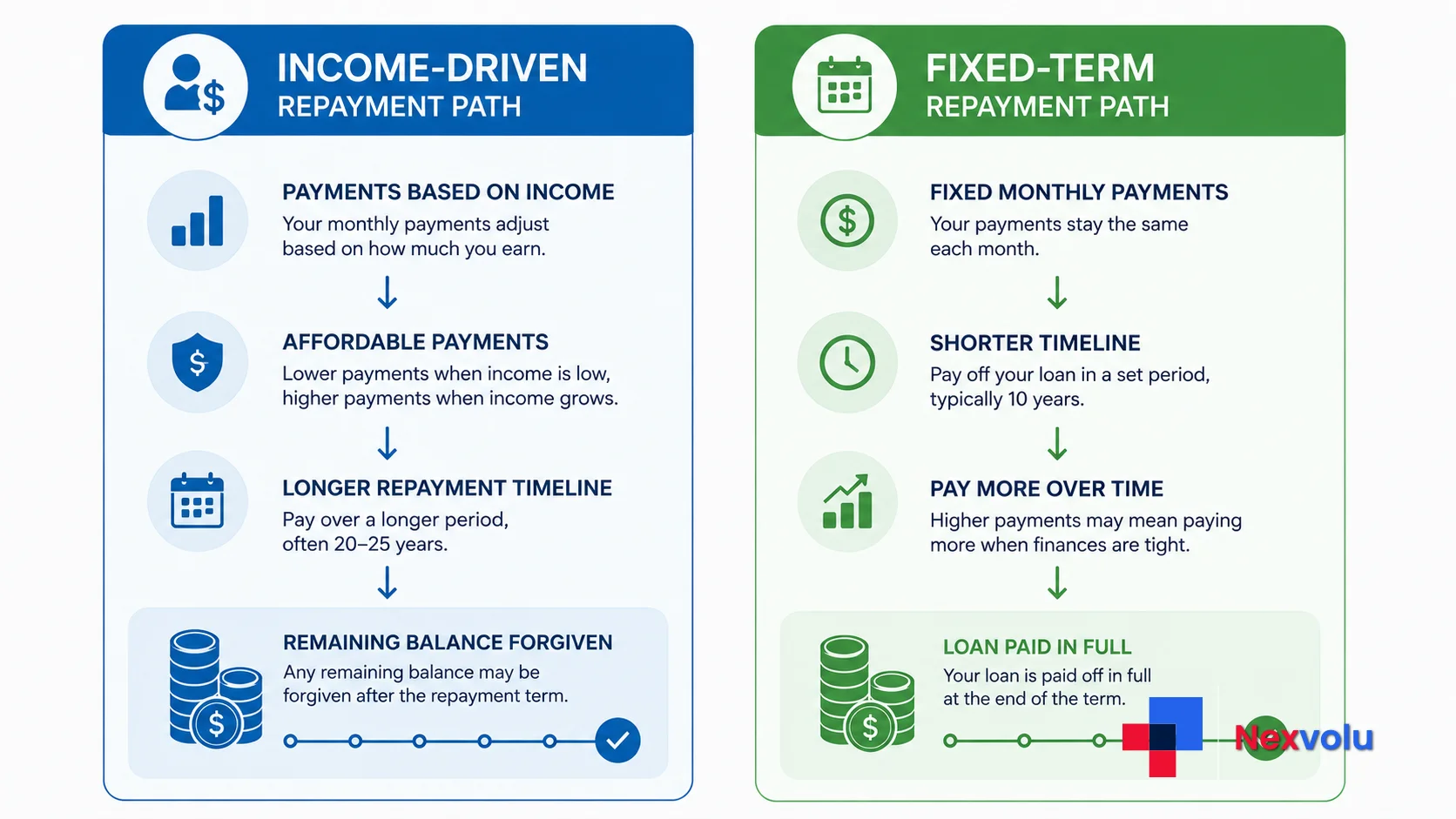
By contrast, the Tiered Standard plan works on a fixed term set by what you owe:
| Balance | Repayment term |
|---|---|
| $0–$25,000 | 10 years |
| $25,001–$50,000 | 15 years |
| $50,001–$100,000 | 20 years |
| Over $100,000 | 25 years |
Above all, remember one hard rule: once you start RAP, you can’t switch back to Standard. So run the numbers before you commit.
Student loan changes for Parent PLUS borrowers in 2026
Parents, this is where it gets sharp. Starting July 1, 2026, Parent PLUS borrowing is capped at $20,000 per dependent student each year, with a $65,000 lifetime cap per child a steep drop from the old “up to the full cost of attendance” rule, as NPR reported. The full Parent PLUS loan changes for 2026 go further than the limits, though.
Repayment changes too. In fact, a Parent PLUS loan taken on or after July 1, 2026 can’t use any income-driven plan only the Tiered Standard plan and as a result it has no pathway to Public Service Loan Forgiveness.
Still, there’s a narrow escape hatch for existing Parent PLUS borrowers. To keep income-driven options alive, you generally need to consolidate before July 1, 2026 and then enroll in an income-driven plan before July 1, 2028. Otherwise, miss that window and the door shuts for good.
What happens if you do nothing before July 1?
For most existing borrowers who aren’t on SAVE: nothing breaks on July 1. Instead, your legacy plans run until 2028. So you have time use it to plan, not to panic.
For SAVE borrowers, however, the story flips. A court order ended the SAVE plan on March 10, 2026, and roughly 7 million people were enrolled, according to the Institute for College Access & Success. Then, around July 1, 2026, your servicer sends a notice giving you 90 days to pick a new plan realistically, by the end of September 2026. Meanwhile, sit still and you’ll likely be dropped into a Standard plan with a higher monthly bill.
For Parent PLUS borrowers who want income-driven repayment, doing nothing before July 1, 2026 can permanently cost you the consolidation route. That’s the most expensive “I’ll deal with it later” on this list.
The exact 10-minute StudentAid.gov action to take before July 1
Of course, you don’t need a financial advisor for the first move. You simply need ten minutes and a login.
- Log in at StudentAid.gov. Confirm your loan types, balances, and current servicer. You can’t plan what you can’t see.
- Check each loan’s disbursement date. Before July 1, 2026 means legacy rules. On or after means new-borrower rules.
- Run the Loan Simulator. Compare your monthly payment and total cost across the plans you actually qualify for.
- On SAVE? Choose your next plan now. Don’t wait for the 90-day clock to start ticking against you.
- Parent PLUS and want income-driven options? Start a Direct Consolidation before July 1, 2026. This is the deadline that bites hardest.
- Enroll in auto-pay. The Department of Education raised the auto-pay interest discount from 0.25% to 1% beginning July 1, 2026 close to free money for a two-minute setup.
UK contrast (for our dual-market readers): UK repayment works nothing like the US version there’s no plan to choose. Repayment is automatic through payroll at 9% of income above a threshold. For the 2026/27 tax year, GOV.UK sets the Plan 2 threshold at £29,385 and the Plan 5 threshold at £25,000. Hold both, and earnings between £25,000 and £29,385 go to Plan 5 only; above £29,385 the repayment splits across both. UK balances are simply written off after a set period no refinancing into new plans, no forgiveness programs to chase.

Frequently Asked Questions
Do I need to change student loan plans before July 1, 2026?
Most existing borrowers don’t. If all your loans predate July 1, 2026, you keep your current plan until July 1, 2028. The big exceptions are SAVE borrowers, who get 90 days to switch once notices arrive, and Parent PLUS borrowers who want to preserve income-driven options through consolidation.
Is the SAVE plan really ending?
Yes. A court order ended SAVE on March 10, 2026, and the law eliminates it permanently by July 1, 2028. Borrowers in SAVE forbearance will receive servicer notices around July 1, 2026 and get 90 days to choose another plan before being moved automatically into a costlier one.
How is the RAP monthly payment calculated?
RAP charges between 1% and 10% of your adjusted gross income on a sliding scale, with the percentage rising as income rises. You subtract $50 per dependent, and the minimum payment is $10 a month. Unpaid interest is waived, and any remaining balance is forgiven after 30 years of payments.
Will Parent PLUS loans still qualify for forgiveness?
Parent PLUS loans taken on or after student loan changes July 1, 2026 won’t qualify for any income-driven plan or for Public Service Loan Forgiveness. Existing Parent PLUS borrowers can preserve income-driven access only by consolidating before July 1, 2026 and enrolling in an IDR plan before July 1, 2028.
What’s the difference between RAP and the Standard plan?
RAP ties your payment to income (1–10% of AGI) and forgives the balance after 30 years. The Tiered Standard plan sets a fixed payment over 10 to 25 years based on your balance, with no income test and no forgiveness. RAP suits lower or uneven incomes; Standard suits borrowers who can clear the balance faster.
How does UK student loan repayment differ from the US?
UK repayment is automatic and income-based 9% of earnings above a fixed threshold, collected through payroll, with no plan to choose. US borrowers actively select a plan and can pursue forgiveness through programs like PSLF. UK balances are written off after a set number of years rather than refinanced.
The bottom line on the 2026 student loan changes
Three groups, three different moves. First, existing borrowers have until 2028 but shouldn’t drift toward it. Second, new borrowers should weigh RAP against Standard carefully, because RAP is a one-way door. Finally, Parent PLUS families face the tightest student loan deadline of all on July 1, 2026. The single smartest thing you can do today costs ten minutes: log in to StudentAid.gov, check your loan dates, and run the Loan Simulator. Which group do you fall into and have you checked your dates yet?
References
- U.S. Department of Education. “Fact Sheet: Simplifying Student Loan Repayment.” 2026. ED.Gov
- Congressional Research Service. “The Repayment Assistance Plan (RAP) in P.L. 119-21.” 2026. Congress.Gov
- NPR. “July 1 brings big student loan changes. Here’s what you need to know.” 2026. NPR
- Federal Student Aid. “One Big Beautiful Bill Act Updates.” 2026. Studentaid
- The Institute for College Access & Success (TICAS). “New Student Loan Repayment Plan Won’t Save Borrowers.” 2026. Ticas
- GOV.UK. “Student loans: a guide to terms and conditions 2026 to 2027.” 2026. Gov.uk