
You scroll past a photo of a flooded street that looks a little too cinematic. A student turns in an essay that reads suspiciously smooth. A cover letter lands in your inbox with that faint, factory-finished polish. Knowing how to spot AI-generated content has quietly become a basic literacy skill, not a niche hobby for the terminally online.
Here’s the catch. Most guides teach you to catch fake text or fake images. Almost none cover both in one place, and even fewer touch deepfakes or hand you something you can actually print. So that’s what this is: one practical, US/UK-friendly guide to spotting synthetic text, images, and video – plus a red-flags checklist to keep by your desk.
Let’s get into it.
How Can You Spot AI-Generated Content?
You spot AI-generated content by stacking three checks: the telltale signs in the work itself, the context around it, and its provenance. Text tends to read flat and oddly balanced; images distort hands, teeth, and text; and provenance tools like C2PA and SynthID reveal how a file was actually made. Ultimately, no single clue is proof but the more signals stack up, the more confident you can be.
Why Spotting AI-Generated Content Suddenly Matters
The internet filled up fast. By 2025, roughly 74% of newly published web pages already carried some AI-generated content, according to an Ahrefs analysis of around 900,000 pages. A separate 2025 study from Stanford researchers and the Internet Archive framed it differently but no less starkly: about 35% of brand-new websites were AI-generated or AI-assisted, up from essentially zero before ChatGPT arrived in late 2022.
What does that mean for you? As a result, synthetic text and images aren’t a rare edge case anymore – they’re the water we all swim in. In short, recruiters, teachers, shoppers, voters: everyone now needs a fast way to tell real from synthetic before they trust, share, or hire. (We track this shift across Nexvolu’s AI coverage.)
How to Spot AI-Generated Text
First, modern AI writes clean, grammatical prose. That’s exactly the problem – it’s too clean. Scan for these telltale signs:
- Flat rhythm. Sentences run the same medium length, paragraph after paragraph.
- Vague filler. Plenty of words, few specifics – no names, dates, or lived detail.
- Over-balanced tone. Endless “on one hand… on the other,” never a real opinion.
- Repetition. The same idea restated in slightly different words.
- Giveaway vocabulary. “Delve,” “leverage,” “in today’s landscape,” “tapestry.”
- Confident errors. A fluent claim that’s simply wrong – a hallucination.
- Missing sources. Statistics with no citation, or citations that lead nowhere.
One reliable move: hunt for real experience. For example, AI can describe a product, but it struggles to tell you what broke at 11pm the night before a deadline. So when writing carries zero specific, checkable detail, treat it with suspicion.
How to Spot AI-Generated Images
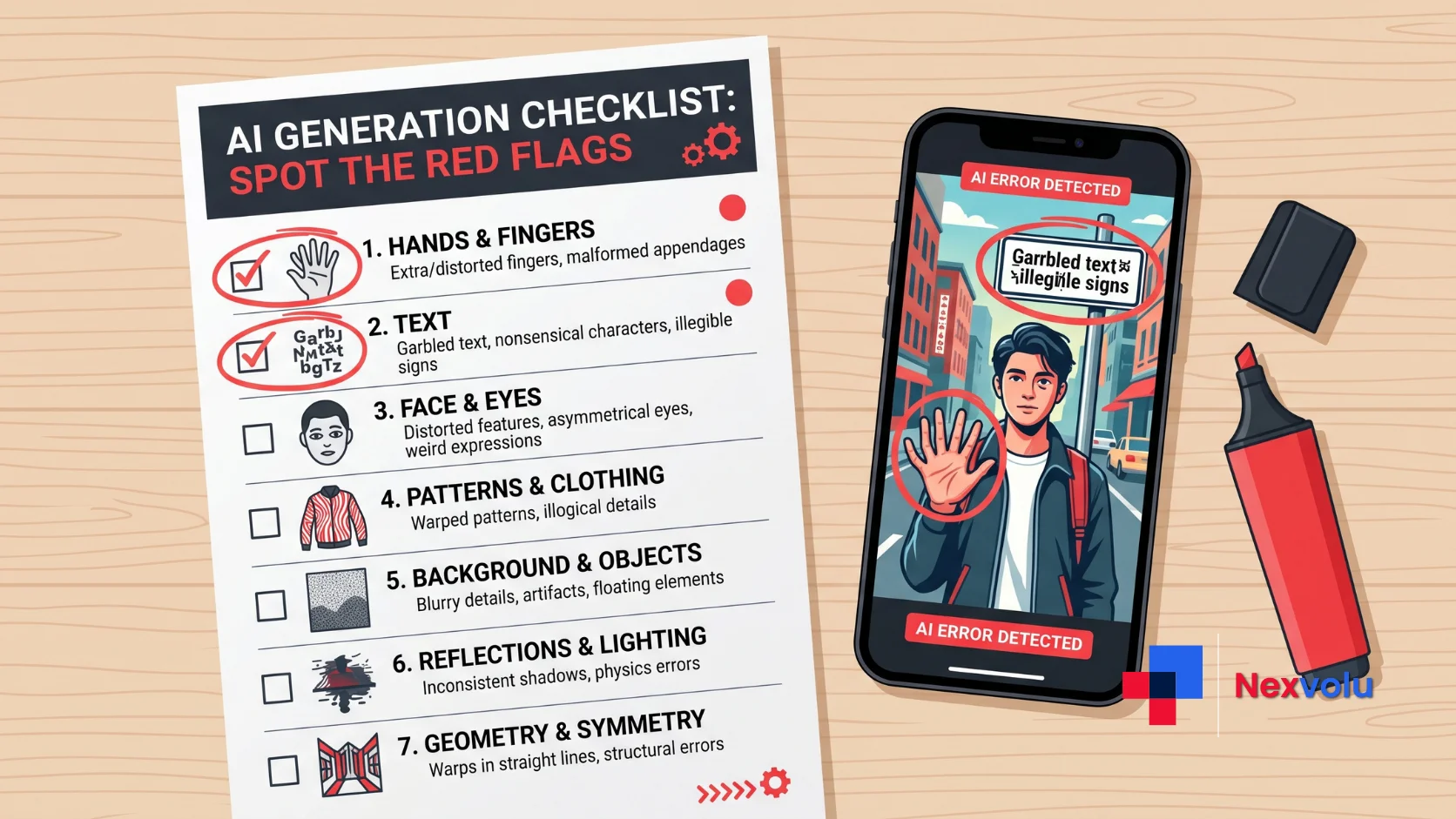
Image models have improved brutally fast, so the old “count the fingers” advice is fading. Even so, most fakes still slip on the details. Zoom in and look for:
- Hands with extra or fused fingers, or teeth that overlap oddly
- Garbled text on signs, labels, or clothing
- Mismatched earrings, buttons, or patterns that don’t line up
- Warped backgrounds and impossible architecture
- Plastic, too-smooth skin and a glassy, dead-eyed stare
- Lighting and reflections that quietly disagree with each other
Here’s the honest part. However, top-tier tools now clear most of these hurdles, so a flawless image proves nothing by itself. When your eyes can’t decide, change tactics: run a reverse image search to trace the original, then check the source. For instance, a striking “photo” with no origin, posted by an account with no history, earns a raised eyebrow.
How to Spot a Deepfake Video
Deepfakes are the hardest category and, in fact, they keep getting harder. The obvious glitches are mostly gone, so watch the edges of human behavior instead:
- Blinking. Real people blink every few seconds; AI faces often stare too long.
- Lip-sync drift. Audio and mouth movements fall slightly out of step.
- Face edges. Look for shimmer or blur where the face meets hair or neck.
- Hands and physics. Objects that bend, merge, or float unnaturally.
- Voice. Flat emotion, odd pacing, or breaths in the wrong places.
Want the frame-by-frame method? See our companion guide on how to spot a deepfake video. Therefore, for high-stakes clips – a “CEO” asking for a wire transfer, a politician “confessing” – slow down, zoom in, and verify through a second trusted source before you react.
Can AI Detectors Spot AI-Generated Content?
Short answer: only a little. An AI detector scans for statistical patterns – low variation in word choice and sentence length – and returns a probability score. Still, it’s a clue, never a verdict. Moreover, every serious test finds the same weaknesses: detectors miss lightly edited AI, and worse, they flag genuine human writing as fake. That false-positive risk is why no school or employer should treat a score as evidence on its own. Use one to raise a question, then confirm with your own judgment. We dig into whether AI detectors can be trusted in a separate breakdown.
Content Provenance: How to Spot AI Content at Scale
Chasing visual glitches is a losing race. Instead, the fix the whole industry is betting on is content provenance – a verifiable record of how a file was made and edited.
Indeed, two systems lead the way. C2PA Content Credentials work like a nutrition label for media: a tamper-evident history of the camera, tools, and edits behind a file. SynthID, from Google DeepMind, embeds an invisible watermark that survives screenshots and cropping. Google says SynthID has already tagged more than 100 billion images and videos, and at Google I/O 2026 the company began rolling provenance checks into Chrome, Search, and the Gemini app – with OpenAI now attaching the same signals to its output.
Still, one caveat matters. A missing credential doesn’t prove a file is fake; plenty of real phone photos carry none. That is, provenance confirms origin when it’s present – it doesn’t condemn media when it’s absent.
Your Printable Checklist to Spot AI-Generated Content
Here’s the part most guides skip: one unified checklist covering text, images, and deepfakes together. Screenshot it, print it, pin it by your monitor.
Text
- [ ] Flat, same-length sentences throughout
- [ ] Vague claims with no specific detail or sources
- [ ] Robotic balance and giveaway words (“delve,” “tapestry”)
- [ ] A confident statement you can’t verify (possible hallucination)
Images
- [ ] Odd hands, teeth, ears, or accessories
- [ ] Garbled text or warped background
- [ ] Plastic skin, mismatched lighting or reflections
- [ ] No traceable source (reverse image search comes back empty)
Deepfake video
- [ ] Too little blinking or drifting lip-sync
- [ ] Shimmer at the face edges
- [ ] Unnatural hands, objects, or physics
- [ ] Flat, oddly paced audio
Then, for anything that matters
- [ ] Check for C2PA Content Credentials or a SynthID watermark
- [ ] Confirm the source and cross-check a second outlet
So if two or more boxes tick in any section, slow down before you trust or share it.
Nexvolu’s Verdict
The verdict: In 2026 you can’t out-eyeball the machines anymore – spotting AI content is now a habit of stacking clues, not catching one obvious glitch.
Best for: Anyone who reads, hires, teaches, shops, or shares online. Which is basically everyone.
Skip it if: You’re waiting for one magic tool that spits out a clean yes/no. That tool doesn’t exist yet.
Pros
- The layered method (signs + context + provenance) works across text, images, and video.
- Provenance tools like C2PA and SynthID are finally reaching everyday browsers.
- Most fakes still fail on specifics and sourcing.
Cons
- Visual tells are fading fast as models improve.
- AI detectors stay unreliable and can wrongly accuse real people.
Standout point: The real shift isn’t sharper eyes – it’s provenance moving into Chrome and Search, turning “verify how it was made” into a right-click.
Nexvolu Editorial Score: 8/10 – a durable, high-value skill; the only drag is that detection tech is still racing to keep up.
Frequently Asked Questions
What is the easiest way to spot AI-generated content?
The easiest way to spot AI-generated content is to look for missing specifics: vague claims, no real sources, flat writing rhythm, or images with distorted hands and text. So stack two or more signals before deciding. In practice, context matters as much as the content itself a striking “photo” from an account with no history and no traceable origin is a bigger red flag than any single visual glitch, so always check where it came from before you trust or share it.
Can AI detectors reliably tell if text is AI-generated?
No, AI detectors can’t reliably confirm AI authorship. They estimate probability from patterns like low word variety, but they miss edited AI and often flag genuine human writing as fake. Therefore, treat any score as a hint, not proof. Documented cases show students’ original essays wrongly flagged, which is why schools are advised never to base misconduct decisions on a detector alone. Use one to start an investigation, then rely on human judgment and context.
What are the telltale signs of an AI-generated image?
Telltale signs of an AI-generated image include malformed hands or teeth, garbled text on signs, mismatched accessories, warped backgrounds, and plastic, over-smooth skin. In addition, check reflections and lighting too. That said, the newest models fix many of these tells, so a clean image proves nothing on its own. When the visuals look flawless, switch to a reverse image search and check the source’s posting history before you believe or reshare it.
How do watermarking and content provenance help?
Watermarking and content provenance help by recording how a file was created instead of guessing after the fact. SynthID embeds an invisible, screenshot-resistant watermark, while C2PA Content Credentials attach a tamper-evident edit history like a nutrition label for media. Google began adding these checks to Chrome and Search in 2026. The limit is important: a missing credential isn’t proof of fakery, since many authentic photos carry none, so absence alone tells you little.
Is it illegal to publish AI-generated content?
Publishing AI-generated content isn’t illegal in most places, but disclosure rules are tightening. The EU AI Act, for example, introduces transparency requirements around clearly labeling AI-generated media. Beyond the law, platforms like Meta now auto-label AI images, and search engines reward honesty. In practice the safe move is simple: label synthetic media clearly, never pass it off as a real photo or lived experience, and keep provenance intact so others can verify it.
The Bottom Line
Here’s what to take away. You can’t rely on your eyes alone anymore, so build the habit: read the signals in the content, question the context, and check the provenance whenever it counts. In short, text gives itself away with vagueness; images slip on the details; deepfakes fail at the edges of real human behavior.
Keep the checklist close, and when two red flags stack up, pause before you trust or share.
Seen a piece of content that fooled you or one you caught in the act?
Share this guide with someone who needs it, and tell us in the comments which telltale sign trips people up most.
References
- Ahrefs – What percentage of new content is AI-generated? (2025)
- Dolezal, Alam, Graham & Bohacek – The Impact of AI-Generated Text on the Internet, Stanford + Internet Archive (2025)
- Google – Identifying AI-generated media online: SynthID + C2PA (2026)
- C2PA – Content Credentials standard
- OpenAI – Advancing content provenance (2026)
4 thoughts on “How to Spot AI-Generated Content (Updated Guide)”