










How to Make a Personal Budget A Step-by-Step Guide
How to Make a Personal Budget: A Step-by-Step Guide
Roughly 54% of Americans now live paycheck to paycheck, according to Ramsey Solutions’ Q1 2026 State of Personal Finance report. That figure isn’t really about income. It’s about where the money goes and how few of us track it before it disappears. Learning how to make a personal budget is the fix, and it’s far simpler than most bank websites make it sound. A budget is just a plan that gives every dollar a job before the month begins. This walkthrough skips the jargon. You’ll get five plain-English steps, a side-by-side of the two most popular budgeting methods for both US and UK incomes, a free template you can copy, and the one habit that stops a budget from collapsing by week three.
Table of Contents
- What Is a Personal Budget?
- How to Make a Personal Budget in 5 Steps
- 50/30/20 vs Zero-Based Budgeting
- Build Your Emergency Fund First
- Common Budgeting Mistakes That Make Budgets Fail
- Frequently Asked Questions
What Is a Personal Budget?
A personal budget is a written plan that divides your monthly take-home pay across needs, wants, savings, and debt before you spend a penny. It weighs money coming in against money going out, so every dollar has a purpose. A good budget mirrors your real life not an idealised version of it.
Think of it less as a restriction and more as permission. Once your essentials and savings are covered on paper, the money left for fun is genuinely yours to enjoy guilt-free. That shift, from guessing to knowing, is what makes budgeting stick.
How to Make a Personal Budget in 5 Steps
Here’s the whole process at a glance:
- Add up your take-home pay
- List fixed and variable expenses
- Choose a budgeting method
- Give every category a number
- Track, review, and adjust monthly
Step 1 – Add up your take-home pay
Start with what actually lands in your account, not your headline salary. Take-home pay is your income after tax and deductions the real number you have to work with. Paid weekly or fortnightly? Multiply out to a monthly figure. If your income swings month to month, use the average of your last three months as a cautious baseline.
Step 2 – List fixed and variable expenses
Now map where it all goes. Split spending into two buckets. Fixed expenses stay roughly the same each month rent or mortgage, insurance, loan repayments, subscriptions. Variable expenses move around groceries, fuel, dining out, electricity. Pull up the last two or three months of bank statements and write down every recurring cost. Most people underestimate the variable stuff badly, so this step alone is eye-opening.
Step 3 – Choose a budgeting method
Don’t overthink this. Two methods cover most people, and we compare them in detail below. The 50/30/20 rule is light-touch and forgiving. Zero-based budgeting is precise and hands-on. Pick the one that matches how much detail you’ll realistically keep up with the best method is the one you won’t abandon.
Step 4 – Give every category a number
This is where a plan becomes a budget. Assign a planned amount to each category until your income is fully accounted for. Grab the free template below so the maths is done for you. Want a deeper breakdown of the most popular split? See our guide to the 50/30/20 budget rule.
Step 5 – Track, review, and adjust monthly
A budget isn’t “set and forget.” Log what you actually spend as the month goes on, then sit down at month-end and compare planned against actual. Overspent on groceries? Trim somewhere else next month. The first two or three months are calibration by month four, your numbers start to feel accurate. That review habit is the difference between a budget that works and a spreadsheet you never open again.
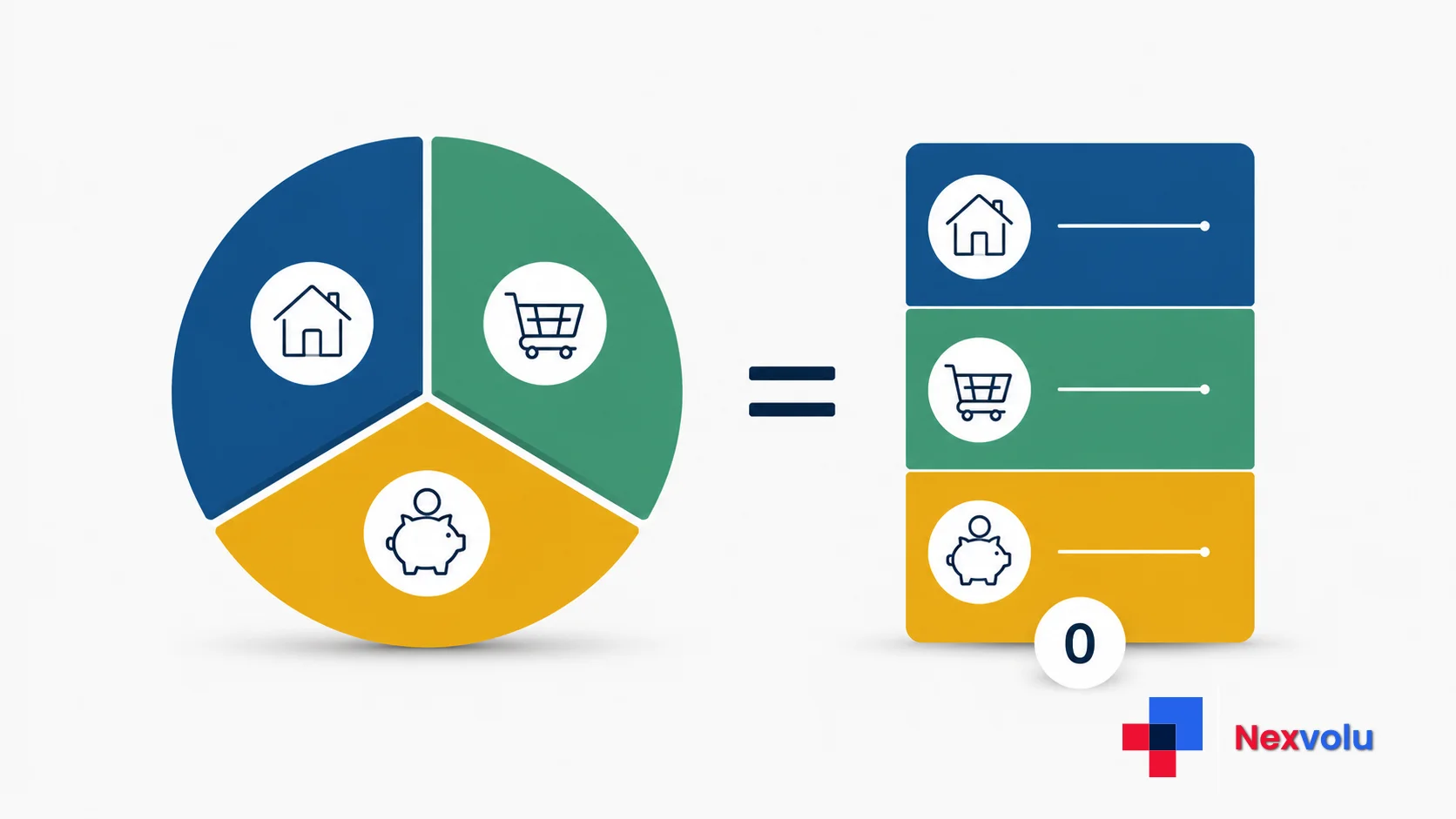
50/30/20 vs Zero-Based Budgeting
Both methods work. They just suit different temperaments. Here’s the side-by-side:
| Feature | 50/30/20 Rule | Zero-Based Budgeting |
|---|---|---|
| How it works | Split take-home pay into 50% needs, 30% wants, 20% savings & debt | Assign every dollar a job until income minus spending equals zero |
| Effort level | Low – three buckets to watch | High – every category planned each month |
| Best for | Beginners and busy people who want guardrails, not micromanagement | Detail-lovers, debt payoff, and irregular incomes |
| Main weakness | Too loose if your needs already exceed 50% | Time-consuming and can feel rigid |
The 50/30/20 rule was popularised by US Senator Elizabeth Warren in her book All Your Worth. Here’s how each looks on a real income.
US example – $4,000 monthly take-home pay
- 50/30/20: $2,000 to needs, $1,200 to wants, $800 to savings and extra debt.
- Zero-based: you assign all $4,000 line by line say $1,300 rent, $450 groceries, $300 transport, and so on until nothing is left unassigned.
UK example – £2,500 monthly net pay
- 50/30/20: £1,250 to needs, £750 to wants, £500 to savings and extra debt.
- Zero-based: every pound gets a label £900 rent, £300 groceries, £150 council tax, and onward until you reach zero.
Notice the maths is identical across currencies. Whether you earn dollars or pounds, the percentages and the “every unit has a job” principle don’t change.
Build Your Emergency Fund First
Here’s the move most generic guides bury: your first savings goal isn’t a holiday or a car. It’s a buffer. An emergency fund is cash set aside only for genuine surprises a car repair, a boiler breakdown, a sudden loss of income. According to the Consumer Financial Protection Bureau, even a small cushion stops a one-off shock from snowballing into long-term debt.
The payoff is bigger than it looks. Vanguard research from April 2025 found that holding at least $2,000 in emergency savings was linked to a 21% higher level of financial well-being than having none at all. The classic target is three to six months of essential expenses, but don’t let that number freeze you. Start with one month, automate a small weekly transfer, and build from there. Need a step-by-step plan? Read how to build an emergency fund from scratch.

Common Budgeting Mistakes That Make Budgets Fail
Most budgets don’t fail because of bad maths. They fail because of a few avoidable traps:
- Being unrealistic. A budget that bans every coffee won’t survive a fortnight. Build in a little fun, or you’ll quit.
- Forgetting irregular costs. Car insurance, birthdays, and annual subscriptions wreck budgets that only plan for monthly bills. Use sinking funds small monthly set-asides for big future costs.
- Budgeting your gross pay. Always plan around take-home pay, never the pre-tax figure.
- Skipping the review. A budget you never check is just a wish. The month-end review is non-negotiable.
- Going all-in too fast. Slashing every category at once leads to burnout. Change one or two habits a month.
The Free Budget Template
Grab the ready-made template below. Enter your take-home pay, fill in your categories, and it automatically shows your 50/30/20 percentages and a “left to budget” figure for zero-based planning. It works in any currency.
Personal Budget Template (Excel) – Free
Personal Budget Template (Excel) Free to Download – fill-in-the-blank, with 50/30/20 % feedback and a zero-based “left to budget” tracker
Frequently Asked Questions
How much of my income should go to savings?
Aim for at least 20% of your take-home pay toward savings and debt repayment, the figure the 50/30/20 rule recommends. If 20% is out of reach right now, start with 5% and raise it by one point each month. Consistency matters far more than the starting amount.
What is the 50/30/20 budget rule?
The 50/30/20 rule splits your after-tax income into three buckets: 50% for needs like housing and groceries, 30% for wants like dining out and hobbies, and 20% for savings and extra debt payments. It’s popular because it gives clear guardrails without tracking every single transaction.
Which budgeting method is best for beginners?
The 50/30/20 rule is usually best for beginners. It needs only three categories, forgives small slip-ups, and takes minutes to set up. Once you’re comfortable and want tighter control especially for paying off debt you can graduate to zero-based budgeting, which plans every dollar individually.
How do I budget on an irregular income?
Base your budget on your lowest recent month or a three-month average, whichever feels safer. Cover your essential needs first, then fund wants and savings in good months. Zero-based budgeting suits variable incomes well because you re-plan from scratch each month around the cash you actually have.
What’s the difference between take-home pay and gross pay?
Gross pay is your total earnings before anything is removed. Take-home pay, sometimes called net pay, is what remains after tax, pension, and other deductions the money that actually reaches your account. Always build your budget around take-home pay, because that’s the amount you can truly spend.
How often should I update my budget?
Review your budget once a month, ideally on payday or the last day of the month. Compare what you planned against what you spent, then adjust the next month’s numbers. Do a deeper review whenever your income, rent, or major expenses change so your plan stays accurate.
The Bottom Line
A personal budget isn’t about restriction it’s about knowing exactly where your money goes so you can spend the rest without guilt. Add up your take-home pay, separate needs from wants, pick a method you’ll actually keep up with, and protect a small emergency fund before anything else. Start with one month using the free template above, and refine as you go. What’s the first category you’ll give a job this month?
References
- Ramsey Solutions. “The State of Personal Finance in America, Q1 2026.” 2026. Ramsey Solutions
- YouGov. “U.S. consumer spending and budgeting trends in 2026.” 2026. Yougov
- Vanguard. “The relationship between emergency savings, financial well-being, and financial stress.” 2025. Corporate Vanguard
- Consumer Financial Protection Bureau. “An essential guide to building an emergency fund.” Consumer Finance
Disclaimer: This article is for informational purposes only and does not constitute financial advice. Consult a qualified financial advisor before making money decisions.