Lovable Could Double to $13.2B in Under 3 Years – Here’s Why
Two years ago, almost nobody outside Stockholm had heard of Lovable. Now investors are reportedly racing to value it at $13.2 billion double what the company was worth just seven months earlier. The round hasn’t even closed yet. That single number says something loud about where the AI market is heading in 2026, and this Lovable $13.2 billion valuation story is worth understanding beyond the headline.
Here’s what’s actually happening, who’s writing the checks, and whether a price tag this big holds up.
Table of Contents
- What is happening with the Lovable $13.2 billion valuation?
- How did Lovable reach a $13.2 billion valuation so fast?
- Why do investors keep betting on the Lovable $13.2 billion valuation?
- Is the Lovable $13.2 billion valuation justified?
- What does the Lovable $13.2 billion valuation mean for the AI and vibe coding market?
- Frequently Asked Questions
What is happening with the Lovable $13.2 billion valuation?
Lovable, a Swedish vibe coding startup, is in talks to raise roughly $300 million at a $13.2 billion valuation, according to a Sifted report. That figure is exactly double the $6.6 billion valuation the company reached in December 2025. Menlo Ventures is expected to lead the round, though the deal is not yet final. As a result, the Lovable $13.2 billion valuation would rank the company among Europe’s most valuable private AI startups.
That’s the headline. The context is where it gets interesting.
Lovable lets people build working web apps and websites by typing what they want in plain English. There’s no manual setup, no boilerplate, and no computer science degree required. Instead, you describe the product, and the platform generates the frontend, backend, database, and the actual editable code behind it.
How did Lovable reach a $13.2 billion valuation so fast?
Ultimately, speed is the whole story. Lovable launched its core product in late 2024 and has raised money at a higher price roughly every few months since. Here’s the trajectory:
| Date | Milestone | Valuation |
|---|---|---|
| July 2025 | $200M Series A (led by Accel) | $1.8B |
| December 2025 | $330M Series B (CapitalG, Menlo) | $6.6B |
| July 2026 | ~$300M round in talks (Menlo) | $13.2B (reported) |
The July 2025 Series A made Lovable Europe’s newest unicorn just eight months after launch, Crunchbase News reported. Six months later, the December round more than trebled that number. Now, another six months on, the reported figure doubles it again.
In fact, few startups in history have repriced this aggressively. The reason investors keep saying yes comes down to one metric: revenue.
Why do investors keep betting on the Lovable $13.2 billion valuation?
Money is following momentum. Lovable hit a $500 million annualized revenue run rate in June 2026, TechCrunch reported up from around $200 million late in 2025. The company also reported roughly one million new projects created on its platform every week.
That kind of growth is rare, and it explains why Menlo Ventures is reportedly leading again after backing the December round. Menlo announced a fresh $3 billion fund the month before, giving it plenty of firepower to double down.
Lovable isn’t only chasing hobbyists, either. Its customer list reportedly includes enterprises like Workday, Asana, and Nvidia a signal that vibe coding is moving from weekend experiments into real corporate workflows.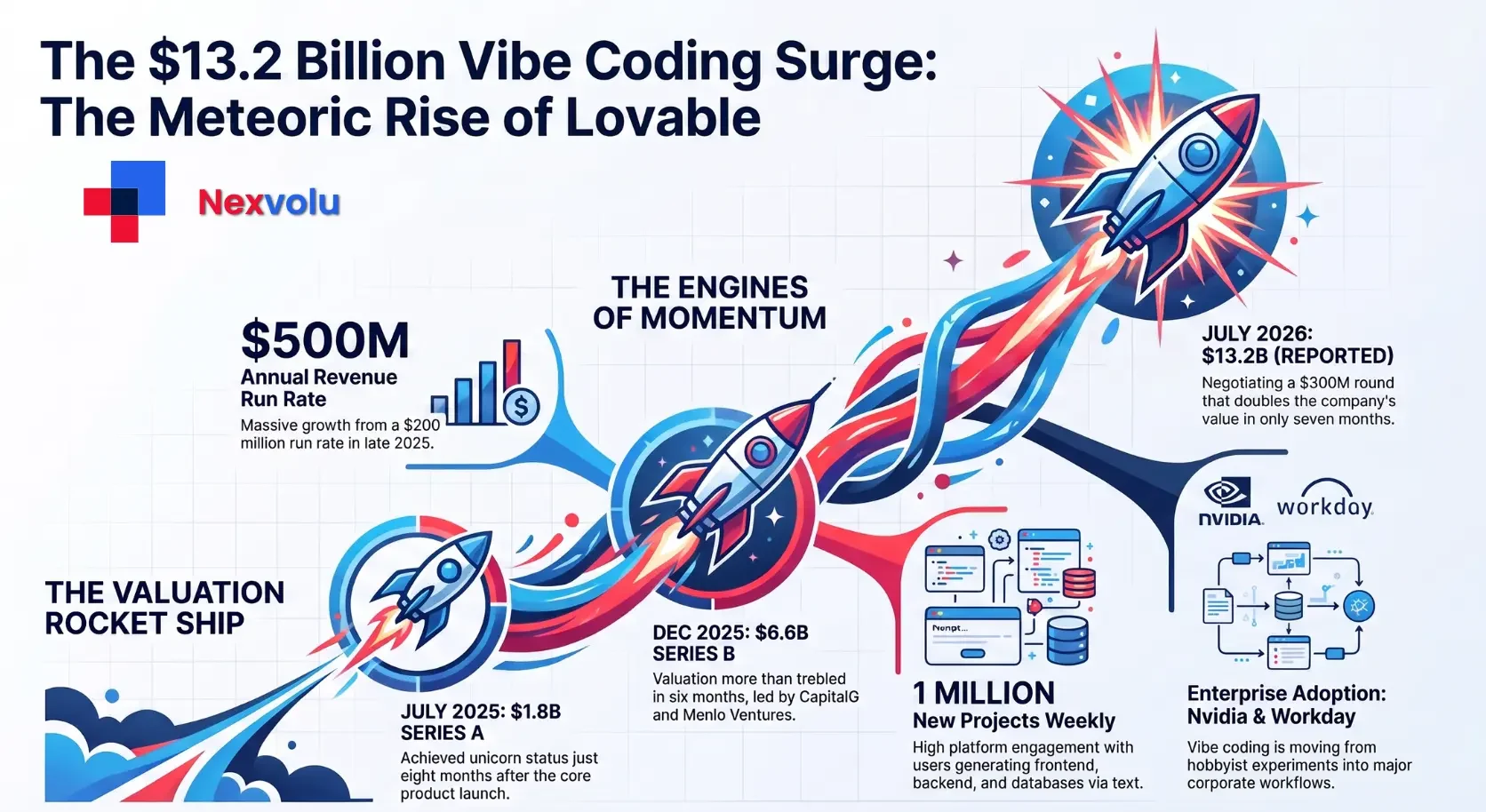
Is the Lovable $13.2 billion valuation justified?
This is the question most coverage skips. So let’s do the math.
A $13.2 billion valuation on a $500 million revenue run rate is roughly 26 times revenue. That’s steep even by frothy AI standards and it assumes the growth curve keeps bending upward. A “run rate” isn’t the same as booked annual revenue; it annualizes a recent period, so any slowdown would make that multiple look far worse in hindsight.
Of course, the risks are real. For instance, vibe coding is crowded. On top of that, the underlying AI models come from a handful of providers, which means Lovable’s costs and capabilities partly depend on companies it doesn’t control. And when Forbes reported earlier talks in June, a Lovable spokesperson pushed back, saying, “We’re not here to discuss rounds that haven’t happened yet.”
So treat the $13.2 billion figure as a strong signal, not a settled fact. Rounds get repriced. Terms change. The number could land higher or lower before the ink dries.
Still, the direction is hard to argue with. A company going from zero to a half-billion-dollar run rate in under two years is doing something the market genuinely wants.
What does the Lovable $13.2 billion valuation mean for the AI and vibe coding market?
Overall, Lovable’s rise is a proxy for a bigger shift. Building software used to require engineers. Now a designer, a founder, or a marketer can ship a working app in an afternoon. If that trend holds, the value doesn’t sit only with Lovable it reshapes who gets to build technology at all.
For everyday readers, the takeaway is simple. In short, the Lovable $13.2 billion valuation shows the tools that let non-coders build real products are no longer toys. They’re pulling in the same investors, and the same money, as the biggest names in AI. If you want the wider picture, our roundup of AI startup funding in 2026 tracks where the money is flowing.

Frequently Asked Questions
What is Lovable and what does it do?
Lovable is a Swedish AI startup that lets people build full web applications and websites using plain-English prompts instead of manual coding an approach the industry calls vibe coding. You describe the product you want, and the platform generates the frontend, backend, database, authentication, and the underlying editable code. Founded in 2023 and launched publicly in late 2024, it targets founders, designers, marketers, and small teams who have ideas but limited engineering resources, and it also sells to large enterprises. The core pitch is speed: turning a rough concept into a working, deployable app in minutes rather than weeks, with no developer on hand.
Why is Lovable valued at $13.2 billion?
Lovable’s reported $13.2 billion valuation reflects extraordinary revenue growth rather than profit or traditional scale. The company reached a $500 million annualized revenue run rate by June 2026, up from roughly $200 million just months earlier, and reported about one million new projects created each week. Investors are pricing in continued rapid expansion in the vibe-coding market, plus a growing roster of enterprise customers. Menlo Ventures, which already backed an earlier round, is expected to lead again. That said, the figure comes from a Sifted report and is not final valuations at this stage can shift meaningfully before a round officially closes.
Who founded Lovable?
Lovable was founded by Anton Osika, who serves as chief executive, and Fabian Hedin. The Stockholm-based company launched its core product in late 2024 and grew fast enough to reach unicorn status within eight months. After the December 2025 funding round valued Lovable at $6.6 billion, Forbes reported that both cofounders became billionaires, each worth roughly $1.6 billion based on an estimated combined 24% stake. The two have publicly pledged to donate half of any earnings from a future exit to charity. Their backgrounds blend product engineering and startup experience, and they have framed the company’s mission around making software creation accessible to almost anyone.
How does Lovable make money?
Lovable makes money primarily through subscription plans that give users credits to build and deploy applications on its platform. Individuals and small teams pay for higher usage limits and advanced features, while larger organizations buy enterprise access with added governance, security, and collaboration controls. Reported enterprise customers include Workday, Asana, and Nvidia, which suggests a meaningful business-to-business revenue stream alongside self-serve consumer signups. This mix helped push the company to a $500 million annualized revenue run rate by June 2026. Because usage scales with how much people build, revenue tends to grow as the platform adds projects and Lovable reported roughly one million new projects every week.
Is Lovable’s valuation a bubble?
Whether Lovable’s valuation is a bubble depends on your view of AI growth. At a reported $13.2 billion on a $500 million revenue run rate, the company trades at roughly 26 times revenue a steep multiple that assumes rapid growth continues for years. Skeptics point out that a run rate annualizes recent performance and can overstate durable revenue, that vibe coding is increasingly crowded, and that Lovable depends on AI models built by other companies. Optimists counter that its growth is real and fast, with strong enterprise adoption. The honest answer: it is priced for near-perfect execution, which carries genuine risk.
Who are Lovable’s main competitors?
Lovable competes in the fast-growing vibe-coding and AI app-building space, where several tools now let people create software from natural-language prompts. Rivals include other AI-first development platforms that generate working apps, websites, and code, as well as established coding assistants expanding into full app generation. Traditional no-code and low-code builders also compete for the same non-technical users who want to ship products without hiring engineers. The category is heating up because the underlying AI models keep improving, which lowers the barrier to entry. Lovable’s edge, for now, is momentum: rapid revenue growth, enterprise traction, and repeated funding at rising valuations have made it one of the field’s most visible names.
Conclusion
Three things stand out. Lovable is growing faster than almost any European startup on record. Investors are betting that vibe coding becomes a default way to build software, not a niche. And even a reported $13.2 billion price tag comes with a big asterisk until the round actually closes.
Keep an eye on whether that revenue run rate holds that number, more than any headline valuation, will decide if the bet pays off.
So what do you think: is a tool that writes your app worth more than most public software companies, or is this the top of the market? Share this with someone who’s still betting on manual coding.
This article is for informational purposes only and does not constitute financial or investment advice. Company valuations and funding talks can change; verify figures before making any decision.
REFERENCES
- TechCrunch. “Lovable reportedly in talks to double its valuation to $13.2B.” 2026. Tech Crunch
- TechCrunch. “Lovable says it has hit $500M in annualized revenue with 1 million new projects a week.” 2026. Tech Crunch
- CNBC. “Vibe coding startup Lovable’s latest funding round values it at $6.6 billion.” 2025. CNBC
- Crunchbase News. “Lovable, A Swedish AI Vibe Coding Startup, Becomes Unicorn With $200M Series A.” 2025. Crunchbase News
- Forbes. “AI Coding Startup Lovable In Talks To Raise Funding At A $12 Billion Valuation.” 2026. Forbes