










Small Business Cash Flow: The #1 Killer in 2026
Small Business Cash Flow: The #1 Killer in 2026
Revenue’s up. Confidence is climbing back. And yet small business cash flow has never felt tighter more owners than ever are lying awake at 2 a.m., running the numbers in their heads.
That contradiction defines small business cash flow in 2026. Sales expectations have recovered, yet the money in the bank feels tighter than it has in years. According to the U.S. Chamber of Commerce Small Business Index, only 16% of owners now say they’re very comfortable with their cash flow down 15 points from a year earlier. Optimism came back. Liquidity didn’t.
So this isn’t another evergreen checklist nagging you to “invoice faster.” You’ve read those a hundred times. Instead, you’ll get what’s actually happening beneath the numbers, why a growing business can still run dry, and one system you can start this week the 13-Week Rolling Cash-Flow Buffer. It’s the short-horizon forecast turnaround CFOs reach for in a crisis, rebuilt for a small team that just wants to cover payroll without the panic.
Fair warning: this takes about an hour to set up. It’s worth every minute.
Why is cash flow the #1 small business killer?
💡 Cash flow is the top small business killer because a company can look profitable on paper and still run out of money. When cash leaves faster than it arrives payroll, rent, and suppliers now, customer payments later the timing gap triggers missed obligations, costly emergency debt, or closure, even while sales are climbing.
Profit is an opinion. Cash is a fact. Your profit-and-loss statement can show a healthy margin while your bank balance quietly slides toward zero, because the P&L records a sale the day you invoice, not the day the money lands.
What the cash flow data shows
That gap has teeth. A widely cited 2015 U.S. Bank study found poor cash flow management was a contributing factor in 82% of business failures. The number gets tossed around loosely, so treat it as what it is a contributing factor across many failures, not a single smoking gun. Still, the pattern holds. The Federal Reserve’s 2025 Small Business Credit Survey found 51% of firms named uneven cash flow as a challenge, and Fora Financial reports cash flow stayed the top challenge for 55% of owners in 2026. If you want the full breakdown of where the money leaks, we cover the most common small business cash flow problems separately.
Sales problems are obvious. You see them coming. Cash-flow problems hide behind good revenue until the week they don’t.
The 2026 small business cash flow reversal: rising revenue, shrinking cash
Here’s the part most articles miss.
For two years, the story was demand. Would customers keep spending? In 2026, that fear eased. The NFIB Small Business Optimism Index climbed to 97.4 in June, its highest in four months. Fora Financial found 76% of owners expect revenue growth this year. On paper, things are looking up.
But confidence and cash aren’t the same thing. Relay’s 2025 Cash Flow Compass captured the paradox: 94% of small businesses expect growth, yet more than half hold less than 31 days of cash on hand. Growth plans are back. The safety net is thinner than a month.
Why cash is tightening in 2026
Why the split? A few forces are stacking up at once. Costs rose and stayed risen inflation and tariffs pushed input prices higher with no matching relief, and margin compression became its own battle, one we unpack in the pricing mistakes that quietly shrink profit margins. Borrowing got expensive, so the cheap cushion many owners leaned on disappeared. And customers, feeling their own squeeze, started paying slower.
The result is a business that’s optimistic and illiquid at the same time. You’re planning to hire while sweating this Friday’s payroll. That’s the 2026 reversal and it’s exactly why cash flow, not demand, is the killer to watch this year.
The real cause of cash flow problems: timing, not sales
Talk to owners and one theme repeats. It’s not that the work dried up. It’s the gap between doing the work and getting paid for it.
Across small-business forums through late 2025 and 2026, the recurring complaint shifted from “how do I get more customers” to “how do I survive net-60 terms.” One landscaping owner described waking at 4 a.m. after realizing three commercial jobs – all net-60 – meant buying materials, running trucks, and paying a 14-person crew for two months before a single client paid a dollar. Revenue was great. The timing nearly broke him.
Why growth widens the cash flow gap
That’s the trap. Growth makes it worse, not better. Every new order means spending on materials and labor upfront, then waiting weeks for the invoice to clear. Faster growth means a bigger gap, which means more strain. Plenty of owners have watched a record month curdle into a payroll scramble.
“Cash flow problems usually start before the bank account gets scary.” – a common refrain among small business owners
So the fix isn’t just “sell more.” More sales can deepen the hole. The fix is seeing the gap early and building a buffer wide enough to cross it. That’s what the next section gives you.
The 13-Week Rolling Cash-Flow Buffer
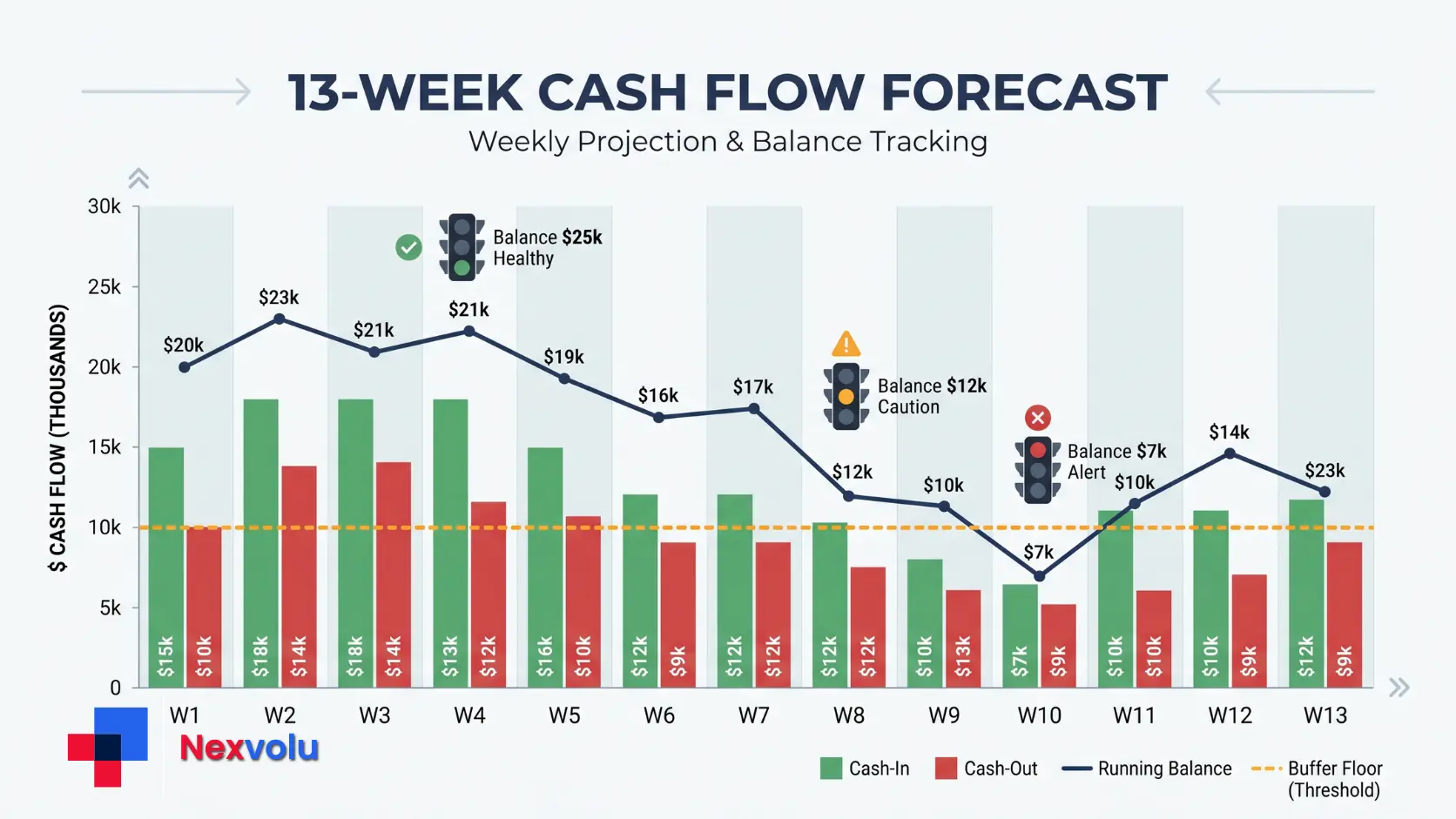
The 13-Week Rolling Cash-Flow Buffer is a weekly forecast of every dollar coming in and going out over the next quarter, paired with a minimum cash “floor” you commit to never crossing. You update it every week, always looking 13 weeks ahead, so a shortfall shows up with weeks of warning instead of days.
Why 13 weeks? It’s one quarter long enough to spot a crunch forming, short enough to forecast honestly. Restructuring CFOs use exactly this window when a company is fighting for survival, because it tracks real cash on a cash basis, not accrual accounting. You don’t need the distress to borrow the discipline.
Nexvolu’s version has three parts.
Part 1 – Build the rolling forecast
List, week by week for 13 weeks:
- Cash in: invoices you expect to actually clear (not just send), deposits, and other income.
- Cash out: payroll, rent, loan payments, suppliers, taxes, and subscriptions.
- Weekly net: cash in minus cash out.
- Running balance: last week’s balance plus this week’s net.
Be honest about timing. A net-60 invoice sent today lands in week 8 or 9, not week 1.
Part 2 – Set your Buffer Floor
Your Buffer Floor is the lowest cash balance you’re willing to hit. Below it, you act – no debate.
A conservative starting point: aim to keep at least four to six weeks of fixed operating costs in the bank. Because 39% of owners can’t cover even one month of expenses, a one-month floor is the bare minimum, and six weeks gives you room to breathe. Set the number that fits your business, then defend it. If you don’t have one yet, start by learning how to build an emergency cash reserve and fund it in stages.
Part 3 – Run the weekly traffic-light triage
Each Monday, update the forecast and read the next 13 weeks against your floor.
| Signal | What the forecast shows | What to do this week |
|---|---|---|
| 🟢 Green | Balance stays above your floor all 13 weeks | Keep going. Move any surplus into reserves. |
| 🟡 Amber | Balance dips below the floor in weeks 5–13 | You have lead time. Chase invoices, delay a non-urgent purchase, line up credit now. |
| 🔴 Red | Balance dips below the floor in weeks 1–4 | Act today. Protect payroll and critical suppliers, pull forward receivables, draw on standby credit. |
Then roll it forward: drop the week that just ended and add a fresh week 14. The window always looks a full quarter ahead.
That’s the whole system. A spreadsheet, an hour to build, and fifteen minutes each Monday. It won’t conjure cash from nothing but it turns a silent 2 a.m. surprise into a problem you saw ten weeks out.
📣 Found this useful? Bookmark it and share it with an owner who’s white-knuckling payroll – the buffer only helps if you build it before you need it.
5 moves to widen your cash flow buffer this quarter
Building the forecast shows you the gap. These five moves shrink it. Start with one.
- Shrink the gap at the front. Ask for deposits, bill on milestones, and shorten payment terms on new contracts. Net-30 beats net-60 every time you can negotiate it.
- Stagger what goes out. Line up supplier due dates and big purchases with the weeks when cash actually lands. Timing your outflows is free; it just takes a calendar.
- Fund the buffer on purpose. Move a fixed percentage of every strong week into a separate reserve account. Treat it like a bill you pay yourself.
- Arrange credit while you’re healthy. Major banks approve only about 27% of small business loan applications, and 63% of owners planned to seek capital heading into 2026. A line of credit set up in a green week is cheap insurance; the same line sought in a red week is expensive or gone.
- Watch leading indicators weekly. Track three numbers: invoices not yet sent, invoices sent but unpaid, and days until your next payroll. Trouble shows up here first.
None of these need more sales. They just widen the runway you already have. For proof that discipline beats luck, read Nexvolu’s look at businesses that thrived through tough times.
✉️ Want more owner-tested playbooks like this? Subscribe to the Nexvolu newsletter and get the next one in your inbox.
Nexvolu’s Verdict
The verdict: In 2026, cash flow – not weak demand – is the quiet killer, and a rolling 13-week buffer is the single highest-leverage habit a small business can adopt to survive it.
Best for: owners with lumpy income, long payment terms, or fast growth.
Skip it if: you run on prepaid, same-day income with near-zero receivables though even then, the floor discipline still helps.
Pros: it forces you to look forward, not just at last month’s books · it gives weeks of warning instead of days · it costs nothing but a spreadsheet and an hour.
Cons: it’s only as good as your honesty about invoice timing · it won’t fix a business that’s genuinely unprofitable it buys time, not miracles.
Standout: it borrows a turnaround-CFO tool most small owners have never heard of and turns it into a calm weekly routine instead of a crisis measure.
Nexvolu Editorial Score: 9/10 – because it’s cheap, fast, and aimed squarely at the timing gap that actually sinks businesses; the missing point is that it demands weekly discipline many owners struggle to keep.
Frequently Asked Questions
What is a 13-week cash flow forecast?
A 13-week cash flow forecast is a weekly projection of the cash entering and leaving your business over the next quarter. It tracks actual money on a cash basis – not accrual profit – so you can see exactly which weeks run tight before they arrive.
Finance teams and restructuring CFOs favor it because 13 weeks is long enough to plan and short enough to stay accurate. You update it weekly, dropping the finished week and adding a new one at the end. That rolling habit keeps a full quarter of visibility in front of you at all times, which is why it catches shortfalls early instead of at the last minute.
Why do profitable small businesses run out of cash?
Profitable businesses run out of cash because profit and cash aren’t the same thing. Your profit-and-loss statement counts a sale when you invoice it, but the money may not arrive for 30, 60, or 90 days while payroll, rent, and suppliers all want paying now.
That timing gap widens as you grow. Each new order means spending upfront on materials and labor, then waiting weeks to get paid. A record sales month can trigger a payroll scramble. It’s why so many owners describe feeling stressed even when business is good: the revenue is real, but the money simply hasn’t landed yet.
How much cash should a small business keep in reserve?
Many experts suggest keeping three to six months of operating expenses in reserve, though plenty of small businesses start with a more realistic goal of one month and build from there. The right number depends on how steady your income is and how long your customers take to pay.
The data shows how thin most reserves are: more than half of small businesses hold less than 31 days of cash, and 39% can’t cover a single month. If you’re below one month, treat that as your first buffer target. Steadier businesses can hold less; seasonal or lumpy ones should aim higher.
Is small business cash flow getting worse in 2026?
Cash-flow comfort is falling even as optimism rises. In 2026, only 16% of owners say they’re very comfortable with their cash flow down 15 points year over year while revenue expectations have recovered. So it’s not that business is bad; it’s that liquidity is tight despite decent sales.
The drivers are higher costs that never fully eased, pricier borrowing, and customers paying more slowly. Together they squeeze the cash buffer even when the top line looks fine. It’s the defining small business cash flow story of the year, and it’s why forecasting matters more now than it did in easier times.
What’s the difference between cash flow and profit?
Profit is what’s left after you subtract expenses from revenue on paper. Cash flow is the actual movement of money in and out of your bank account. You can have one without the other strong profit with negative cash flow, or positive cash flow in an unprofitable month.
The distinction matters because bills get paid with cash, not profit. A business can report a profitable quarter and still miss payroll if customer payments lag behind expenses. Tracking cash flow weekly, alongside your P&L, is the only reliable way to know whether you can actually cover what’s due.
How often should I update my cash flow forecast?
Update your cash flow forecast weekly. A weekly rhythm catches problems while you still have time to act chasing an invoice, delaying a purchase, or drawing on credit instead of discovering a shortfall the week it hits.
Pick a consistent day, ideally Monday, and spend about fifteen minutes refreshing your actual balances and rolling the window forward one week. Monthly updates are too slow for the timing gaps that sink small businesses; by the time a monthly review flags trouble, you may be days from a missed payment rather than weeks.

The bottom line
Cash flow became the number one small business killer not because sales collapsed, but because confidence outran liquidity. Owners are planning to grow while holding less than a month of cash and growth, without a buffer, only widens the timing gap.
You can’t always control when customers pay. You can control whether the shortfall surprises you. Build the 13-week forecast, set a floor you refuse to cross, and check it every Monday. That single hour a week turns cash flow from your biggest threat into something you manage on your own terms.
So, honestly what does next month actually look like for your business? Do you know, or are you guessing?
⚠️ Disclaimer: This article is for general informational and educational purposes only and is not financial, investment, tax, or legal advice. Business conditions and markets carry risk. Consult a licensed financial professional before making financial decisions.
References
- U.S. Chamber of Commerce – Small Business Index, Q2 2026 – https://www.uschamber.com/sbindex
- Federal Reserve Banks – 2025 Report on Employer Firms (Small Business Credit Survey) – https://www.fedsmallbusiness.org
- U.S. Bureau of Labor Statistics – Business Employment Dynamics – https://www.bls.gov/bdm/
- NFIB – Small Business Optimism Index, June 2026 – https://www.nfib.com/news/monthly_report/sbet/
- Fora Financial – Small Business Economic Outlook, 2026 – https://www.forafinancial.com/blog
- Relay – 2025 Cash Flow Compass – https://relayfi.com/blog
- OnDeck / Ocrolus – Small Business Cash Flow Trend Report, Q4 2025 – https://www.ondeck.com · https://www.ocrolus.com
- U.S. Bank – Study on small business failure and cash flow, 2015 (widely cited) – https://www.usbank.com
- Kaplan Group – Small business cash flow statistics, 2025 – https://www.kaplancollectionagency.com
Explore More Business Insights
- AI Layoff Reversal: Are the Job Cuts Actually Slowing?
- Are AI Layoffs Finally Slowing?
- Agentic AI for Business: 5 Jobs It Can Run in 2026
- Five Jobs AI Can Already Do
- AI Layoffs 2026: Which Jobs Are Safe vs Exposed
- Is Your Job AI-Proof?
- 2026 Tech Selloff: What It Means for Your 401(k)
- Is Your 401(k) at Risk?