








Agentic AI for Business 5 Jobs It Can Run in 2026
Your Competitors Already Let AI Agents Run Their Business
Right now, while you read this, a competitor down the street has an AI agent answering support emails, chasing an overdue invoice, and booking a sales call and nobody pressed a button to make it happen. In fact, that’s not a forecast; it’s already happening. Agentic AI for business has slipped quietly from flashy demo to daily operations, and as a result, the gap between owners who use it and owners who don’t is widening by the week.
Here’s the catch. Almost everything written about it is aimed at enterprises with seven-figure budgets and a dedicated AI team. You, however, don’t have either. Instead, you have a packed to-do list, a thin margin, and zero patience for software that overpromises.
So this piece takes a different route. Specifically, picture a one-person business that spends a single week handing five real jobs to AI agents. Together, we’ll walk through what genuinely saved money, what broke, and what each task cost grounded in documented tool behavior and current pricing, not vague theory. Ultimately, the scenarios are illustrative, but the numbers are real.
In this article
- What Is Agentic AI for Business?
- A Week With AI Agents: Five Real Jobs
- What Saved Money and What Was Hype
- What Agentic AI for Business Really Costs
- Before You Let an Agent Touch Customer Data
- Frequently Asked Questions
What Is Agentic AI for Business?
Agentic AI for business refers to AI systems that don’t just answer questions instead, they take action. For example, you give an agent a goal, and it plans the steps, uses connected tools like your inbox, CRM, or invoicing app, and then finishes multi-step work with little prompting. In short, think of software that does the job, not one that only advises on it.
That’s the leap. A chatbot, for instance, waits for you to ask. An agent, by contrast, notices an invoice is five days late, drafts the reminder, sends it, logs the reply, and flags the ones that need a human. According to McKinsey’s 2025 State of AI report, 88% of organizations now use AI in at least one business function yet most are still piloting rather than scaling. Ultimately, the owners pulling ahead are simply the ones who moved one real task from “assisted” to “automated.”
A Week With AI Agents Five Real Jobs
First, imagine you set one rule for the week: every repetitive task you hate gets handed to an agent. Here’s how that plays out, then, across five jobs and where reality bites.
| Task | What worked | What broke | Rough cost/week |
|---|---|---|---|
| Sales follow-up | Same-day nudges, calls auto-booked | Robotic tone if unsupervised | $15-$60 |
| Invoicing | Reminders + reconciliation | Edge cases (disputes, odd payments) | $10-$40 |
| Support triage | Sorting, tagging, draft replies | Full autonomy = wrong answers | $15-$50 |
| Lead qualification | Scores and routes inbound | Buries hot leads without rules | $10-$45 |
| Content repurposing | Fast first drafts at scale | Bland without your voice | $10-$30 |
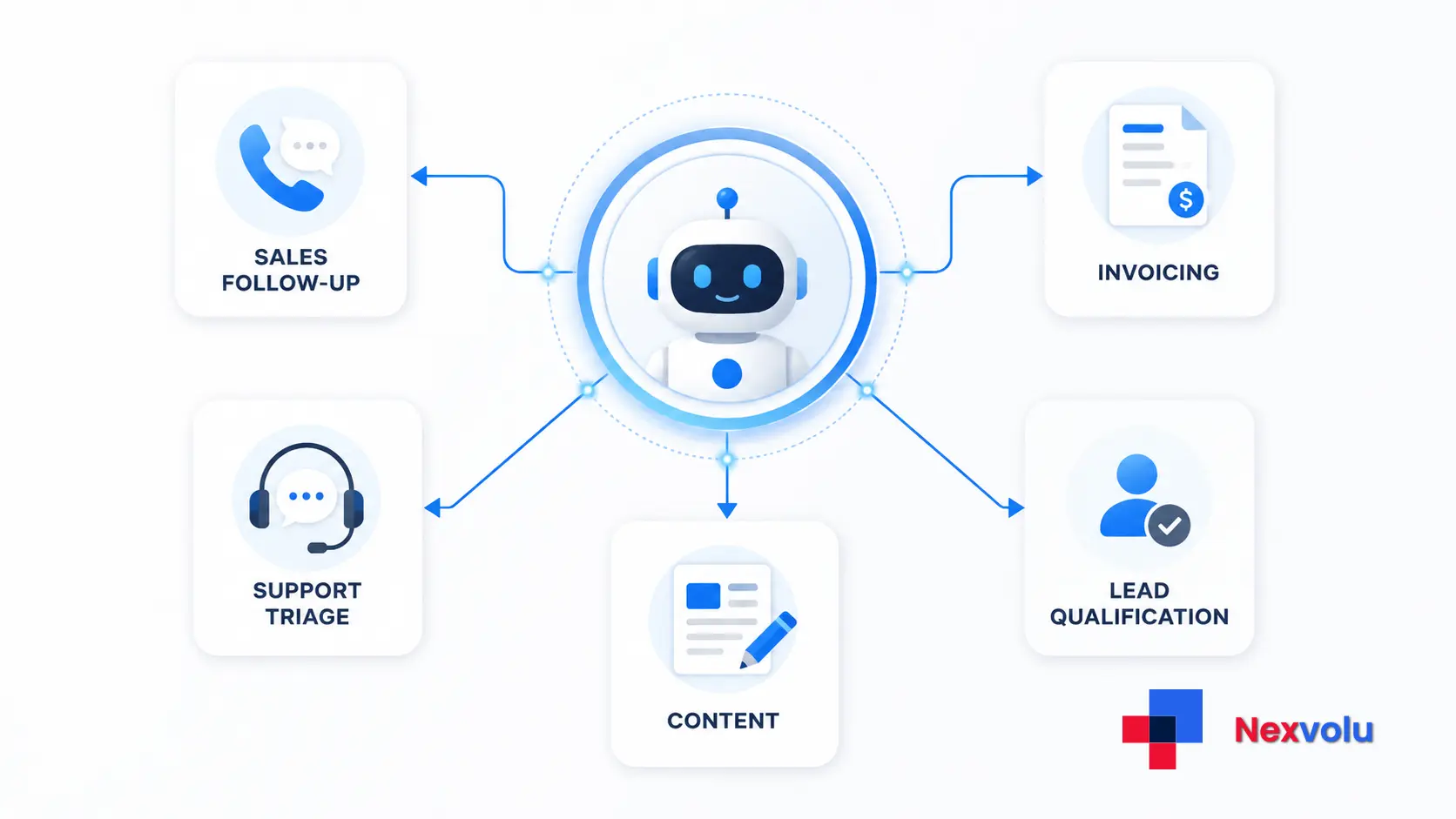
1. Sales follow-up
This is the clearest win. For example, an agent watches your pipeline, sends personalized follow-ups, and drops booked calls straight into your calendar. As a result, leads that used to go cold because you forgot to reply now get a same-day nudge. What breaks? Tone. Left alone, the agent can sound robotic or pushy so you still approve the first message in each sequence.
2. Invoicing and chasing payments
Agents are brilliant at the awkward job nobody enjoys: reminding clients to pay. Specifically, they track due dates, send escalating reminders, and reconcile replies. However, the break point is edge cases a client who paid through a different channel, or who disputed a line item. In short, the agent won’t know that unless your systems are connected cleanly.
3. Customer support triage
Handing the whole inbox to an agent is where most small teams get burned. Triage itself works sorting, tagging, and drafting replies to repeat questions. Full autonomy, however, doesn’t. For instance, one wrong refund or a confidently wrong answer costs more trust than it ever saves in time. So keep a human on the send button.
4. Inbox and lead qualification
An agent that reads incoming messages, scores leads, and routes them is a quiet money-saver. In practice, it clears the noise so you spend your morning on the three emails that actually matter. Still, the catch: it needs clear rules, or it buries a hot lead under newsletters and spam.
5. Content repurposing
Turning one blog post into social posts, a newsletter, and a video script is fast and genuinely useful. Indeed, it rarely “breaks” but it produces bland output if you don’t feed it your voice and examples. Therefore, treat it as a first draft, never the final word.
💡 Pro tip: Above all, start with one task you already hate and that follows a clear, repeatable rulebook. Indeed, narrow beats ambitious every single time.
⚠️ Warning: Never give an agent unsupervised power to spend money, delete data, or make legal or financial promises. Above all, keep a human approval step on anything irreversible.
What Saved Money and What Was Hype
Here’s the honest scorecard. The agents that saved real money each did one narrow thing well: follow-ups, payment reminders, and lead triage. As a result, they clawed back hours a solo founder would otherwise burn on admin. The “run my whole business” pitch, by contrast? That’s where the hype lives.
This isn’t just one week’s opinion. According to Gartner’s 2025 research, more than 40% of agentic AI projects will be canceled by the end of 2027 driven by unclear value, rising costs, and weak risk controls. Read that again. The technology, in fact, works; the over-scoped projects, meanwhile, fail. Ultimately, the teams that win pick one measurable task, build on tools they already use, and tie success to a number they can actually see.
So the rule for a small team is brutal and freeing: don’t automate everything. Instead, automate the one thing that drains your week, prove it saves money, then add the next.
What Agentic AI for Business Really Costs
Pricing here is all over the map, so here’s a grounded breakdown for a small business in 2026. Broadly speaking, costs rise with how custom the build is.
| Approach | Setup | Monthly | Best for |
|---|---|---|---|
| DIY (ChatGPT + Zapier/Make) | 40-100 hrs of your time | Free-low | One simple workflow |
| Off-the-shelf agent tools | Low | $50-$200 basic; $500-$2,000 mid-tier | Most small teams |
| Freelancer build | $1,000-$5,000 one-off | Varies | One custom chatbot |
| Agency build | $5,000 $25,000 | Retainer | Multi-agent setups |
| Custom enterprise | $15,000+ | Varies | Complex, regulated work |
The takeaway for most owners: one mid-tier tool that nails a single workflow beats a $10,000 agency project you’ll never fully use. Ultimately, match the tool to the bottleneck, not the hype.
Share this with a founder who’s drowning in admin it might hand them back their next ten hours.
Before You Let an Agent Touch Customer Data
An agent acting on customer data is not the same as a chatbot answering FAQs. In fact, the moment it reads, stores, or makes decisions about real people’s information, privacy rules apply and they bite hardest on small businesses, which are often treated as the easy targets.
If you operate in the US: there’s no single federal GDPR, but state laws (like California’s) and sector-specific rules still apply. Therefore, map exactly what data the agent touches, switch off training on customer data where you can, and keep a human reviewing any decision that affects a customer’s money or account.
If you operate in the UK or serve EU customers: UK GDPR and EU GDPR apply in full, even when a third party supplies the tool. First, run a Data Protection Impact Assessment before deploying anything high-risk, give people a way to contest automated decisions, and document your lawful basis. The UK’s Information Commissioner’s Office publishes practical AI guidance for exactly this. On top of that, the EU AI Act’s main obligations apply from 2 August 2026, including transparency rules that reach any business using AI with EU customers.
ℹ️ This section is general information, not legal advice. For your specific situation, check with a qualified professional.
Frequently Asked Questions
What is agentic AI for business in simple terms?
Agentic AI is software that completes tasks on its own, not just chat. For example, you set a goal say, “follow up with every new lead” and the agent plans the steps, uses your tools, and acts with minimal prompting. In short, it shifts AI from giving advice to actually doing the work for you.
Can a small business actually use agentic AI today?
Yes, and many already do. In fact, small business AI adoption reached 17.7% by the end of 2025, according to the JPMorganChase Institute. Moreover, you don’t need a tech team affordable off-the-shelf agents now handle follow-ups, invoicing, and support triage for a monthly subscription. Start with one workflow, then expand.
Which agentic AI for business tasks should I automate first?
First, start with repetitive, rule-based jobs that drain your week: sales follow-ups, payment reminders, lead qualification, and support triage. These have clear inputs and outputs, so an agent handles them reliably. However, avoid handing over anything needing judgment, money decisions, or irreversible actions without a human checking first.
How much does agentic AI for business cost?
Naturally, costs range widely. Basic off-the-shelf agents start around $50–$200 per month, while mid-tier tools with CRM integration run $500–$2,000 monthly. Custom agency builds begin near $15,000. Overall, for most small teams, one well-chosen subscription tool delivers the best return without a heavy upfront commitment.
Are AI agents safe to use with customer data under GDPR?
They can be, with care. Specifically, under UK and EU GDPR, you need a lawful basis, a Data Protection Impact Assessment for high-risk uses, and a way for people to contest automated decisions. In short, limit what data the agent accesses, avoid training on it, and keep human oversight on anything sensitive.
Will AI agents replace small business employees?
Not in most cases. Rather, agents replace tasks, not people the repetitive admin that eats your day. Used well, they let a small team punch above its weight, freeing people for work that needs judgment, creativity, and real relationships. Ultimately, the goal is leverage, not layoffs.
The Bottom Line on Agentic AI for Business
Three things to remember. First, agentic AI for business is already running real tasks follow-ups, invoicing, and triage for owners who started small. Second, the wins come from narrow, measurable jobs, not “automate everything” dreams. Third, the moment an agent touches customer data, privacy and oversight stop being optional.
In the end, you don’t need a big budget or a tech team to start. Instead, you need one task you’re tired of doing and the nerve to hand it over this week.
So which job would you give an agent first and what’s stopping you?

Subscribe to Nexvolu for Business updates before everyone else and share this with someone whose week could use ten hours back.
2026 Tech Selloff: What It Means for Your 401(k)
References
- McKinsey & Company. “The state of AI in 2025: Agents, innovation, and transformation.” 2025. McKinsey
- Gartner. “Gartner Predicts Over 40% of Agentic AI Projects Will Be Canceled by End of 2027.” 2025. Gartner
- JPMorganChase Institute. “Understanding the use of AI among small businesses.” 2025. JPMorganChase
- PwC. “PwC’s AI Agent Survey.” 2025. PwC
- Information Commissioner’s Office (ICO). “Artificial intelligence and data protection.” 2026. ICO
- European Commission. “Regulatory framework on AI (AI Act).” 2024–2026. European Commission




Agentic AI is software that completes tasks on its own, not just chat. That’s the new era begininig. Awaited