






Electricity VAT Cut 2026: What You’ll Actually Save
Burnham Just Scrapped Electricity VAT – Here’s the Catch
A new prime minister’s first move, and it landed on your electricity bill. Within 24 hours of walking into Downing Street, Andy Burnham announced that the government would cut VAT on household electricity from 5% to 0%. Naturally, the headlines wrote themselves. Indeed, Martin Lewis hit breakfast TV before most people had finished their coffee. However, behind the “tax scrapped” splash sits a much quieter question the only one that actually matters to your bank account.
Will you really feel £45?
That’s the number the Treasury is putting on this. And technically, it’s true. Still, it’s doing a lot of heavy lifting. So this piece breaks the electricity VAT cut down the way no one on the morning news bulletins did: pound by pound, usage tier by usage tier, and we spell out the catch in plain English.
How much will the electricity VAT cut save you?
In short, the electricity VAT cut removes VAT on domestic electricity from 5% to 0%, running from 1 October 2026 to 31 March 2027. According to the Treasury, it saves a typical home around £45 a year – roughly 80p a week. However, your real saving depends entirely on how much electricity you use and, crucially, how much of it falls inside that six-month window.
On this page:
- What Burnham announced
- The usage-tier breakdown
- Why the benefit is smaller than it sounds
- Why gas VAT wasn’t touched
- UK vs USA
- What you can do
- Nexvolu’s Verdict
- FAQ
What Burnham actually announced
Let’s get the facts straight, because the social feeds are already garbling them.
First, some background. Andy Burnham became the UK’s prime minister on 20 July 2026 – the seventh in a decade. Then, on his first full day in office, he confirmed a single, sharp cost-of-living measure: VAT on household electricity drops from the reduced rate of 5% to zero. It kicks in on 1 October 2026, the same day Ofgem’s new price cap takes effect, and it runs until 31 March 2027.
The government frames it as “breathing space” for households heading into the most expensive billing months of the year. According to the official Treasury announcement, the cut will cost around £850 million in 2026-27, because ministers cancelled the planned Digital ID programme to pay for it. Moreover, it should shave about 0.1 percentage points off inflation.
Here’s the part worth underlining: this is temporary. Specifically, it applies only to the current financial year. Keeping it beyond March 2027 would need a formal Budget decision – so treat it as a one-winter measure, not a new permanent rate.
One more bit of context. Notably, this is the government’s second energy intervention in six months. Back in April, for example, former chancellor Rachel Reeves removed one policy levy from bills and shifted others onto general taxation. As a result, the cut now stacks on top of an already-adjusted bill rather than 2024’s numbers.
How much will you really save?
Time for the calculator angle. This is where “£45” either holds up or falls apart for your household.
The mechanics are simple. Essentially, removing 5% VAT means you stop paying roughly £1 in tax for every £21 you spend on electricity about 4.76% off the electricity portion of your bill. However, it does not touch your standing charge structure, your gas, or the wholesale cost of power. Instead, it only strips the VAT off the electricity you buy.
So the saving scales directly with how much electricity you burn. For example, a one-bed flat with gas heating saves far less than an all-electric family home running a heat pump and an EV charger. In other words, same percentage, very different pounds.
The usage-tier breakdown: what each home keeps
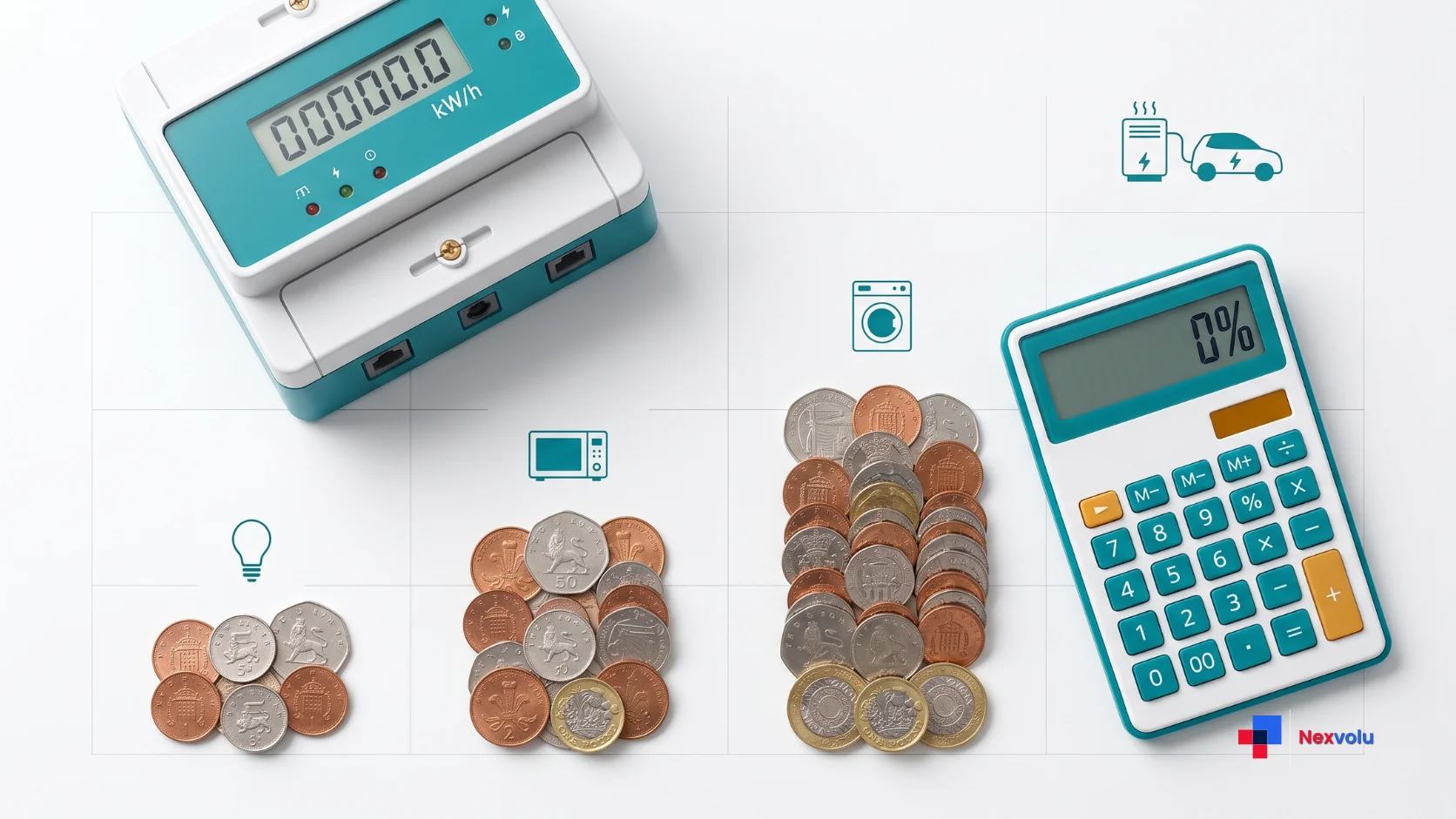
Here’s the tiered breakdown. These figures are illustrative estimates built from the government’s official £45/5% math – use them as a guide, then check your own annual electricity spend on your latest statement.
| Your annual electricity spend (incl. VAT) | Full-year VAT saving (≈4.76%) | Actual saving over the 6-month window* |
|---|---|---|
| ~£500 – low use / small flat | ~£24 | ~£13-£16 |
| ~£945 – typical home (the “£45” case) | ~£45 | ~£25-£30 |
| ~£1,400 – family / high use | ~£67 | ~£37-£45 |
| ~£2,000 – large, all-electric home | ~£95 | ~£53-£64 |
*The cut only runs 1 October-31 March, so you only save on electricity used in those six months. Winter usage is higher, so you keep a bit more than half the full-year figure but not all of it.
Read that last column again. In reality, the typical household’s real cash saving over the actual window is closer to £25-£30, not the £45 splashed across the headlines. Ultimately, that’s the gap between an annualised figure and money that lands in your account.
📣 Found this useful? Share it with someone who’s already spent their £45 in their head – the real number is worth knowing before the bills land.
Why the benefit is smaller than it sounds
The £45 isn’t wrong. Rather, it’s just annualised – it describes a full year of zero-VAT electricity. But the cut lasts half a year.
There are three reasons the relief feels lighter than the announcement:
- It’s temporary. Six months, then VAT returns to 5% unless a Budget extends it. This is a winter cushion, not a structural change.
- It’s electricity only. If you heat with gas – most UK homes do – the biggest chunk of your winter energy bill is completely untouched.
- Everything else dwarfs it. Analysts expect higher energy prices to persist into winter, driven partly by the US–Israeli conflict with Iran constraining global gas and oil supply. Consequently, a single cold snap or price-cap rise can wipe out a £25-£30 VAT saving.
Martin Lewis put it bluntly. He called the move a “good totemic step and very welcomed,” then added the line that matters: “in practice most won’t feel much benefit.” That’s not cynicism. It’s arithmetic. When your bill is four figures, knocking a couple of tenners off the electricity tax is real – but it’s not rescue.
The honest framing? Welcome it. Don’t budget your Christmas around it.
Why gas VAT wasn’t touched
This is the question flooding the comment sections, and it’s a fair one. Gas heats most British homes, so why zero-rate the electricity and leave gas sitting at 5%?
Two reasons stand out. First, cost and control. Zero-rating gas as well would roughly double the price tag, and therefore the Treasury capped this at around £850 million. Second, direction of travel. For over a decade, policy has nudged households toward electric heating and away from gas. As a result, cutting electricity VAT while leaving gas alone quietly rewards the greener choice – a heat-pump home now gets a tax break a gas-boiler home doesn’t.
There’s a Brexit footnote here too. Because the UK now sits outside the EU VAT regime – which historically limited how far member states could drop rates – it can zero-rate domestic electricity with far more flexibility. So whether you think that’s a genuine win or a rounding error, it’s the mechanism that made this specific move possible.
UK vs USA: how each country taxes your electricity
Worth a quick transatlantic sidebar, because the two systems work nothing alike.
The UK applies a single nationwide consumption tax – VAT – to household electricity. Until now that was 5%; from October it’s 0% for six months. One country, one rate, one rule.
The United States, by contrast, has no VAT at all. Instead, each state and often each city decides electricity taxation for itself, creating a patchwork:
- Fully exempt states: Many states – including Texas, New York, Massachusetts and Colorado – exempt residential electricity from state sales tax entirely. Households there already pay 0% and have for years.
- Taxed states: Others fold electricity into general sales tax. North Carolina, for example, applies a combined 7% rate to electricity.
- Local layers: Cities and special districts can add or remove their own slice on top, so two American homes 20 miles apart can pay different tax on identical power.
So the takeaway for a UK reader: Burnham’s cut brings British households, temporarily, to the same 0% that a New Yorker or Texan already enjoys permanently. However, the American version isn’t a headline-grabbing “first act” – it’s simply the baseline.

What you can actually do to cut your bill further
If £25-£30 over a winter doesn’t feel like much, that’s because it isn’t on its own. Instead, the VAT cut works best as one lever among several. So here’s where the bigger money usually hides:
- Check your price-cap position first. Remember, the cap sets the maximum unit rate on a standard variable tariff, not your total bill. Therefore, knowing your electricity unit rate and standing charge tells you what the VAT cut is actually shaving.
- Compare a fixed deal against the cap. In some periods a fixed tariff beats the capped rate; in others it doesn’t. Run the comparison rather than assuming.
- Attack usage, not just rate. The VAT cut trims the price of each unit. Cutting the units – heating controls, draught-proofing, shifting heavy appliance use – compounds on top of it.
- Read the meter around 1 October. A manual reading on changeover day helps ensure your supplier bills the zero-rated period correctly and doesn’t estimate you onto the old rate.
None of this is glamorous. Still, it’s where households routinely save far more than £45.
📣 Want the plain-English version of every energy change as it lands? Follow Nexvolu – we translate the headline into what it means for your actual bill.
Nexvolu’s Verdict
One-line verdict: A genuinely welcome, genuinely small tax cut – good politics, modest relief, and no substitute for tackling the wholesale prices doing the real damage.
Best for: High-usage and all-electric homes, who’ll see the largest pound saving over winter.
Skip the hype if: You heat with gas – your biggest winter cost is untouched.
Pros
- Real, immediate relief timed for the most expensive billing months.
- Nudges households toward lower-carbon electric heating.
- Fully funded and mildly deflationary (≈0.1pp off inflation).
Cons
- Annualised £45 headline overstates the ~£25-£30 most homes actually keep.
- Temporary – reverts after 31 March 2027 without a Budget extension.
- Leaves gas, the bigger winter cost for most homes, at 5%.
Standout point: The framing gap. Almost every outlet ran the £45 annual figure; far fewer flagged that a six-month, electricity-only cut delivers roughly half that in real cash.
Nexvolu Editorial Score: 6.5/10 – a solid, honest cost-of-living gesture that scores well on intent and speed, lower on scale. This is our editorial assessment of the announced facts, not a hands-on financial review.
Disclaimer: This article is for general informational and educational purposes only and is not financial, investment, tax, or legal advice. Markets and energy prices carry risk. Consult a licensed financial professional before making financial decisions.
Frequently Asked Questions
When does the electricity VAT cut start and end?
The electricity VAT cut starts on 1 October 2026 and is scheduled to end on 31 March 2027 – a six-month window aligned with the winter billing period and Ofgem’s new price cap. It applies to the current financial year only. Because extending it beyond March 2027 would require a formal Budget decision, households should plan around it as a one-winter measure rather than a permanent rate change. Ultimately, unless the government announces something further, VAT on domestic electricity automatically returns to 5% from 1 April 2027.
Does the VAT cut apply to gas bills too?
No. The cut applies only to domestic electricity. Meanwhile, gas remains at the reduced 5% VAT rate, which matters because most UK homes still heat with gas – so the largest part of a typical winter energy bill stays untouched. Notably, the government limited the measure to electricity partly to cap the cost at around £850 million and partly to reward electric, lower-carbon heating. Therefore, if you run a heat pump or electric heating, you’ll feel more benefit than a gas-heated home will.
Will the VAT cut lower my monthly direct debit automatically?
In most cases your supplier applies the zero rate at the billing level, so the VAT line on your electricity charges should fall from October without you doing anything. However, suppliers spread direct debit amounts across the year as estimates, and they don’t always move immediately. Therefore, it’s worth submitting a meter reading around 1 October and checking your next statement shows 0% VAT on electricity. Finally, if your direct debit looks unchanged after a couple of billing cycles, contact your supplier to review it.
Is the electricity VAT cut permanent?
No, and this is the most misunderstood part. The cut is explicitly temporary, covering 1 October 2026 to 31 March 2027 only. It sits within the current financial year, and the government would have to take any decision to extend or make it permanent at a future Budget. Treat the saving as a one-off winter cushion. Building it into a long-term household budget would be a mistake, because the rate is scheduled to revert to 5% in spring 2027 unless the government acts again.
Who benefits most from the electricity VAT cut?
Households that use the most electricity benefit most in pound terms, because the saving is a percentage of what you spend. All-electric homes, families running high loads, and anyone with electric heating, a heat pump, or an EV charger will see the largest cash reduction over winter. Homes that heat with gas and use modest electricity – many flats and smaller households – will see the least, often well under the headline £45, because their electricity spend is comparatively low.
Does the price-cap saving apply in Scotland, Wales and Northern Ireland?
The £45 estimate ties directly to Ofgem’s price cap, which covers England, Scotland and Wales. Households across those nations on standard tariffs form the basis for the typical figure. Northern Ireland runs a separate energy market with its own regulator, so the price-cap comparison doesn’t map across cleanly. The VAT change itself operates through the UK’s VAT system, but if you’re in Northern Ireland, check your supplier’s confirmation of how and when the 0% rate appears on your bill.
The bottom line
Here’s what to actually take away. The electricity VAT cut is real, it starts on 1 October, and it will trim your electricity tax for six months. In short, it’s a decent, well-timed gesture from a brand-new government that wanted a fast cost-of-living win and it got one.
Still, keep the scale honest. The £45 is an annual headline; meanwhile, most homes will pocket closer to £25-£30 over the actual window, and gas-heated households least of all. Ultimately, the bigger savings still come from your tariff and your usage, not from a tax line.
So bank the relief, read your meter in October, and don’t spend the £45 twice. What’s your electricity spend telling you – will you actually feel this one, or is it 80p a week you’ll never notice?
References
- HM Treasury / GOV.UK – New PM cuts tax on household electricity bills
- BBC News – VAT to be cut from household electricity bills in October
- MoneySavingExpert / Martin Lewis – analysis of the cut
- The Guardian – What will Burnham’s VAT cut mean for you?
- Ofgem – energy price cap unit rates and standing charges
- PKF Littlejohn – Zero-rated electricity returns
Explore More 2026 Finance Updates
Who Gets the $1,000 Deposit? → Trump Accounts: $1,000 Newborn Deposit Explained (2026)
The New Student Loan Plan Explained → RAP Plan Begins July 1: Your 2026 Plan Guide
Which Repayment Plan Saves More? → Student Loan Changes 2026: Which Repayment Plan to Pick
Why Wall Street Can’t Buy Homes → Congress Just Banned Wall Street From Buying Homes