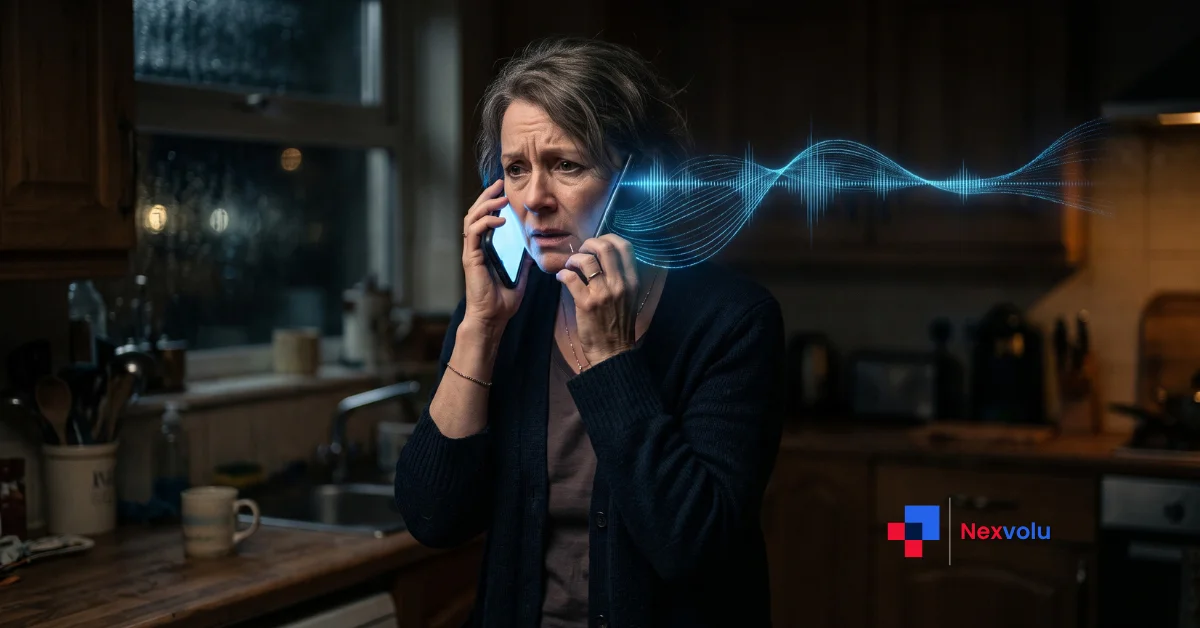
The AI voice scam call comes at 11:47 p.m. It’s your daughter’s voice – crying, breathing too fast, saying there’s been an accident and the other driver is threatening to involve the police. Then a calm man takes the phone and tells you exactly where to send the money.
Everything about that call is real except your daughter.
An AI voice scam needs almost nothing to work: a few seconds of audio scraped from a public video, a cloning tool anyone can download in a minute, and about ninety seconds of your panic. Americans reported $893 million in losses to AI-enabled fraud in 2025, according to the FBI’s Internet Crime Complaint Center. Those victims weren’t careless. They were ambushed.
So this guide runs backwards on purpose. Because an AI voice scam is won or lost in the first ninety seconds, you get the protocol first – the exact sequence to use when a call feels wrong and the explanation second. At 11:47 p.m., in other words, nobody needs a lecture on neural voice models. They need thirty seconds of muscle memory.
Table of contents
- How to Spot an AI Voice Scam or Deepfake Call in 30 Seconds
- What an AI Voice Scam Actually Is and Why It Works
- The Four Versions You’re Most Likely to Meet
- Can an AI Voice Scam Fake a Video Call? What to Look For
- The Verification Ladder: What Stops an AI Voice Scam
- Set a Family Safe Word Tonight
- What to Do in the First Hour After an AI Voice Scam
- Nexvolu’s Verdict
- Frequently Asked Questions
How to Spot an AI Voice Scam or Deepfake Call in 30 Seconds
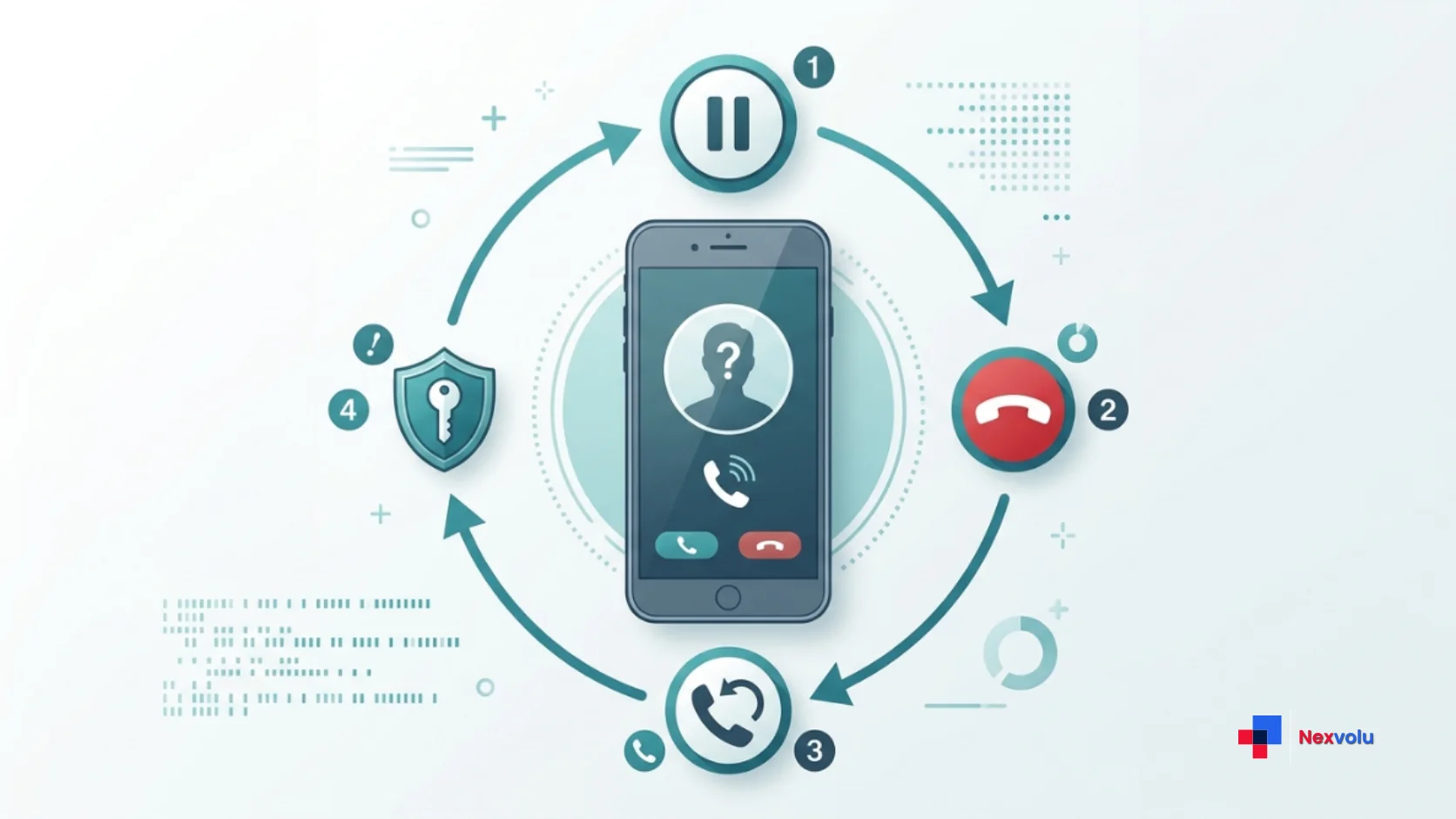
To spot a deepfake scam call, stop the conversation and verify on a second channel. Hang up, call the person back on a number already saved in your phone, and ask for a pre-agreed safe word. As a rule, a real caller passes instantly. A cloned voice cannot follow you onto a channel the scammer didn’t choose.
That’s the whole defence. So here it is as a timed sequence you can practise once and keep forever.
| Seconds | Do this | Why it beats the clone |
|---|---|---|
| 0-5 | Say nothing useful. Don’t confirm names, don’t say “Is that you, Sam?” | Callers fish for names and details to feed back to you |
| 5-10 | Ask for the safe word | Voice models copy sound, not shared secrets |
| 10-20 | Hang up. Yes, even mid-sentence | Urgency is the weapon; ending the call disarms it |
| 20-30 | Call back on the saved number, or text a second family member | Moves verification to a channel the scammer doesn’t control |
Three rules sit under that table, and although they sound simple, they matter more than any listening trick:
- Never verify on the channel the stranger picked. Incoming calls, incoming texts, and callback numbers they read out are all theirs. In other words, if the stranger picked the channel, it is not a safe one.
- Treat urgency as the red flag, not the emergency. After all, real crises survive a five-minute callback. Scams don’t.
- Watch the payment method. Gift cards, crypto ATMs, wire transfers, or a courier coming to your door mean fraud, every single time. Therefore the payment method alone is enough to end the conversation.
If you remember nothing else from this article, remember the three-word version: pause, hang up, call back.
Share this with the person in your family most likely to answer that 11:47 p.m. call. Thirty seconds of preparation is the entire difference between a scary story and a five-figure loss.
What an AI Voice Scam Actually Is and Why It Works
An AI voice scam is fraud in which criminals use a synthetic copy of someone’s voice – a relative, a boss, a bank employee – to trigger an urgent payment or hand over data. The technical term is voice cloning; the FBI files it under AI-enabled fraud, and the older, non-AI version of the same trick is the grandparent scam.
Why three seconds of audio is enough
The barrier to entry collapsed years ago, because cloning tools moved out of research labs and into consumer apps. McAfee Labs researchers found that just three seconds of audio produced a clone with an 85% match to the original voice, and that training on a small number of files pushed the similarity to roughly 95%. As a result, three seconds is a voicemail greeting. It’s a wedding toast on Facebook, a graduation clip, a podcast intro, a TikTok caption read aloud.
The numbers behind it aren’t small either. The FBI’s 2025 Internet Crime Report logged 22,364 AI-related complaints totalling $893,346,472 in reported losses – the first time the bureau broke out AI as its own category. Separately, the FTC reported that consumers filed more than a million imposter-scam reports in 2025, with $3.5 billion lost. Reported losses are the floor, not the ceiling, since most people never file.
Why an AI voice scam beats your instincts
Here’s the part the technology explainers miss. A cloned voice doesn’t beat your ears. Instead, it beats your nervous system. Fear of harm to a child, fear of arrest, fear of losing a job – those reactions fire before analysis does, which is exactly why the script always includes a deadline and a secrecy clause (“don’t tell Dad, he’ll panic”). The FBI’s public advice on this is refreshingly plain: take a beat.
Finally, one more thing worth naming. Consider a person who receives a distressed call and hangs up to check – that person is not being rude to their own child. They’re doing the one thing the script is designed to prevent.
The Four Versions You’re Most Likely to Meet
Right now, four AI voice scam patterns account for most consumer and small-business cases, because they keep working. While the scripts differ, the structure almost never does.
| Scam type | The hook | The tell |
|---|---|---|
| Family emergency / grandparent scam | “I crashed the car, I’m in jail, don’t tell Mom” | Secrecy request plus an irreversible payment method |
| Bank or government impersonation | “We’ve detected fraud on your account – verify this code” | They called you and want a code or a transfer |
| Workplace deepfake (CEO/CFO fraud) | An urgent video call approving a confidential payment | Process shortcuts and “don’t discuss this internally” |
| Voice harvesting | A short call, a silence, or a survey that gets you talking | No clear purpose – the audio was the purpose |
How each AI voice scam script works
Family emergency calls are the classic, and AI made them credible. The FTC has warned since 2023 that a scammer only needs a short clip of a relative’s voice pulled from social media to run the script. The FCC adds the detail that hurts most: callers often spoof the caller ID too, so your grandchild’s real number appears on screen.
Bank and government impersonation works the same way in reverse – the cloned voice belongs to an authority figure rather than a loved one. For example, nobody from your bank will ever call you and need a one-time passcode. Likewise, nobody from a government agency will accept payment in gift cards.
Workplace deepfakes graduated from theory to accounting entry in 2024, when British engineering firm Arup lost HK$200 million – about $25.6 million – after a Hong Kong finance employee joined a video call where every other “colleague,” including the chief financial officer, was AI-generated. As a result, fifteen transfers went out in a single day.
Voice harvesting, meanwhile, is the quiet one. A short call, a wrong number, a survey, a moment of dead air that makes you say “Hello? Hello?” – that’s enough raw material. If you don’t recognise a number, let it go to voicemail.
Can an AI Voice Scam Fake a Video Call? What to Look For
Yes, when the payoff is large enough, live video calls can be faked convincingly, and the Arup case proved a full room of synthetic “colleagues” can hold up long enough to move real money. So an AI voice scam now arrives with a face attached. Video is no longer proof of identity, and treating it as proof is therefore the single most expensive assumption in corporate finance.
You’ll see plenty of advice about spotting bad blinking, waxy skin, or lighting that doesn’t match. Of course, some of it still helps. But be honest about the trend line: research on high-quality deepfake video found human detection accuracy sitting around 24.5% – worse than a coin flip. However, visual tells fade with every model release. Process doesn’t.
Behaviour tests that beat a deepfake video call
So run behaviour tests instead of pixel tests:
- Ask them to turn their head fully sideways and hold it. Profile views still break many real-time face swaps.
- Ask them to pass a hand slowly in front of their face. Occlusion is computationally expensive and often smears.
- Ask an unscriptable question – what you argued about last Tuesday, where you ate after the airport run.
- Change the channel yourself. End the call and dial them on the number you already have. A synthetic caller can’t survive that.
- Enforce dual approval for money. Any payment above a set threshold needs a second human on a separate channel. No exceptions for seniority, which is precisely the exception attackers ask for.
If you also want the text-and-image side of this problem – fake articles, generated photos, cloned websites – that’s a different skill set, covered in our guide to how to spot AI-generated content. This article stays on voice, video calls, and money.
The Verification Ladder: What Stops an AI Voice Scam
Most coverage of AI voice scams stops at “be careful.” That’s not actionable at midnight. So here’s the original framework this guide contributes: a ranking of every common verification habit by whether it actually survives cloning technology.
| Verification method | Survives voice cloning? | Survives video deepfake? | Verdict |
|---|---|---|---|
| Recognising the voice | ❌ No | ❌ No | Obsolete. Your ears are the target |
| Trusting caller ID | ❌ No | ❌ No | Spoofable in seconds |
| Asking a personal question | ⚠️ Sometimes | ⚠️ Sometimes | Fails if the answer is on social media |
| Bank verbal passcode | ⚠️ Partly | – | Good for inbound bank checks, useless with family |
| Family safe word (shared offline) | ✅ Yes | ✅ Yes | Best effort-to-protection ratio available |
| Hanging up and calling back | ✅ Yes | ✅ Yes | The gold standard, always free |
| Dual approval on payments | ✅ Yes | ✅ Yes | The only control that scales to a business |
Read the table top to bottom and, as a result, a clear pattern appears: everything based on recognition fails, everything based on channel-switching holds. Cloning attacks perception, first and foremost. It cannot attack a shared secret that never existed online, and it cannot follow you to a number you dialled yourself.
Follow the money, not the voice
One more filter, and it’s the most reliable of all – follow the money. After all, legitimate emergencies do not require gift cards, crypto ATM deposits, courier cash pickups, or a wire that must clear in the next twenty minutes. Fraud needs irreversible rails. Therefore that requirement is, in effect, a confession.
Set a Family Safe Word Tonight
A family safe word is a private phrase agreed in advance so that anyone can confirm identity during an urgent call. The National Cybersecurity Alliance now runs a public campaign around exactly this, and it works because it inverts the attack: the scammer has your voice, but not your secret.
Setting one up takes about five minutes, and it therefore costs less than almost any other security habit you will ever adopt.
- Choose something unguessable. Not a pet’s name, not a birthday, not a street you’ve lived on. Two unrelated words beat one meaningful word – “copper walrus” over “Bella2015.”
- Share it out loud, in person. Never text it, email it, or put it in a group chat. A safe word with a digital trail isn’t a safe word.
- Keep it short enough for a frightened child or an eighty-year-old to recall under stress.
- Agree a duress version. A second phrase that means “I’m being coerced, call for help.”
- Brief everyone who’d be called – grandparents especially, since they’re the primary target and usually the last to be told.
- Refresh it once a year, or immediately after anyone shares it somewhere they shouldn’t have.
Similarly, small businesses should do the same thing with a different label: a verbal challenge phrase for any payment instruction arriving by call or video, plus a written rule that no single person can release funds alone.
Send this section to your family group chat and pick your phrase this week – just don’t type the phrase itself into the chat. Five minutes tonight beats a police report later.
What to Do in the First Hour After an AI Voice Scam
When money has already moved, speed matters more than embarrassment. So work down this list, in order, as soon as you realise what happened.
- Call your bank or payment provider immediately and ask for a recall or reversal. Wires and app payments can sometimes be stopped within hours, rarely after that.
- Report to the FBI’s IC3 at ic3.gov with dates, numbers, and amounts. Recovery teams work from these reports, so file even when the amount feels small.
- Report to the FTC at reportfraud.ftc.gov. It feeds enforcement even when your individual money is gone.
- Preserve everything – call logs, screenshots, voicemails, transfer receipts, because banks and investigators will both ask for them.
- Freeze your credit with the major bureaus if any personal data was shared.
- Tell the family, and tell them fast. The same crew often works a contact list.
Above all, be kind to whoever it happened to. Indeed, these scripts are built by professionals to defeat calm people on their worst night.
This article is for general information and consumer safety education. It isn’t legal or financial advice – for account-specific action, contact your bank or a qualified professional directly.
Nexvolu’s Verdict
One-line verdict: An AI voice scam defeats recognition rather than procedure, so the only defence that still works is boring, free, and takes five minutes – a safe word plus a callback habit.
Best for: Anyone with elderly relatives, teenagers, or authority over a company bank account.
Skip it if: You’ve already set a family safe word, enforced dual approval on payments, and briefed your parents – you’re ahead of most organisations.
Pros
- The countermeasures cost nothing and need no apps or subscriptions.
- A safe word defeats both voice and video impersonation with one habit.
- Public reporting channels (IC3, FTC) are fast and genuinely used.
Cons
- Detection advice ages badly; every visual tell has a shelf life.
- Recovery odds after an irreversible transfer remain poor.
- Protection depends on the least-prepared person in your family, not the most.
Standout point: Every mainstream guide tells you to listen harder. The evidence says listening is exactly the wrong layer to defend – recognition-based checks fail, channel-based checks hold.
Nexvolu Editorial Score: 8.5/10 – for the threat’s severity relative to how simple the fix is. This is one of the rare security problems where a five-minute conversation genuinely closes most of the gap.
Frequently Asked Questions
How can you tell if a call is an AI voice scam?
You often can’t, and that’s the honest answer. Cloned voices can reach roughly 95% similarity, so listening for robotic tone, flat emotion, odd pauses, or clipped breathing catches only the sloppy attempts. So verify instead of listening.
If you want a practical listening cue, pay attention to responsiveness rather than sound quality: synthetic callers often talk over you, repeat a rehearsed line when interrupted, or lag oddly before answering an unexpected question. Even then, treat any hunch as a prompt to hang up and call back – never as clearance to keep talking. Ultimately, detection is a coin flip. Callbacks aren’t.
How much audio does someone need to clone your voice?
About three seconds. McAfee Labs found that a three-second sample produced an 85% voice match, and training on a handful of clips pushed similarity to roughly 95%. That’s a voicemail greeting, a story on Instagram, or the first line of a work presentation.
In fact, the sample almost always comes from something you posted willingly. You don’t need to disappear from the internet over it – but locking down public video, keeping voicemail greetings generic rather than personal, and letting unknown numbers ring out all reduce the raw material available. So prevention here is about lowering supply, not eliminating it entirely.
Can scammers fake a live video call?
Yes. Real-time face and voice swaps are good enough to hold a business meeting, which is how Arup lost about $25.6 million across fifteen transfers after a finance employee joined a call with entirely synthetic colleagues.
Live fakes still struggle with awkward physical requests – a full side-on head turn, a hand passed slowly across the face, standing up and moving away from the camera. Still, use those as speed bumps, not verdicts. Instead, the durable control is procedural: end the call, redial on a known number, and require a second approver for any money movement, no matter who appears to be asking.
What makes a good family safe word?
A good safe word is short, unguessable, meaningless to outsiders, and shared only in person. For instance, two unrelated nouns work best – something like “copper walrus.” Avoid pet names, birthdays, addresses, school names, or anything discoverable on a social profile.
Above all, make it easy enough that a scared nine-year-old or a ninety-year-old can produce it under pressure, and agree a second phrase that quietly signals coercion. Refresh it annually, or immediately if someone texts it by accident. One caution: a safe word only protects the people who know it exists, so brief the relatives most likely to be targeted first – grandparents usually top that list.
Can I trust caller ID if it shows my daughter’s number?
No. In fact, caller ID spoofing lets a scammer display any number they choose, and the FCC specifically warns that impersonation calls often arrive showing a trusted contact’s real number. Therefore treat the display as decoration, not evidence.
This is why the callback rule is phrased so carefully: you must dial out yourself, from your own contacts, rather than returning the call from your recent-calls list or using a number the caller reads to you. If the line is busy or unanswered, reach the person through a second relative, a work number, or a messaging app before doing anything with money.
Are AI voice scams actually increasing?
Yes, sharply. The FBI’s 2025 Internet Crime Report recorded 22,364 AI-related complaints and $893 million in reported losses, the first year it tracked AI separately. The FTC logged over a million imposter-scam reports and $3.5 billion lost in the same period.
Both figures understate reality, because most victims never report – embarrassment keeps the true total invisible. The practical takeaway isn’t the number, though. It’s the direction: cloning tools keep getting cheaper and better while the defence stays fixed at pause, hang up, call back. The gap between how fast the attack improves and how simple the fix remains is the whole story.

The Habit That Costs Nothing
Here’s where this lands. By now, your voice is already public, cloning is already cheap, and no amount of careful listening will reliably tell you who’s on the line. That sounds bleak until you notice how modest the countermeasure is. In short, an AI voice scam is beaten by preparation, never by perception.
So, three things tonight: pick a family safe word and say it out loud to the people who’d need it. Then teach one person over sixty the callback rule. Add a second-approver rule to any account you can move money from.
That’s it. That’s the entire defence against deepfake scam calls, and it works whether the technology improves tenfold or a hundredfold, because it never depended on detection in the first place.
Which relative are you calling first and do they already know what your safe word is going to be?
References
- FBI 2025 Internet Crime Report (IC3) – 22,364 AI-related complaints, $893,346,472 in reported losses, 2025.
- FTC: People reported losing $3.5 billion to imposter scams in 2025 – Federal Trade Commission, June 2026.
- McAfee Labs: Artificial Imposters – cybercriminals turn to AI voice cloning – 3 seconds of audio, 85% voice match; up to 95% with training.
- FTC Consumer Alert: Scammers use AI to enhance their family emergency schemes – callback verification guidance.
- FCC: ‘Grandparent’ Scams Get More Sophisticated – caller ID spoofing plus AI voice cloning.
- The Guardian: UK engineering firm Arup falls victim to £20m deepfake scam – HK$200m / ~$25.6m, deepfake video call.
- National Cybersecurity Alliance: Safe Word campaign – safe words and extra verification steps.
3 thoughts on “AI Voice Scam: How to Spot a Deepfake Call (Updated)”