SEO vs PPC: Which Should a Small Business Start With?
A small business with £500 a month to spend does not have the same choice as one with £5,000. Yet almost every guide on SEO vs PPC hands both of them the same answer: it depends, do both.
However, that answer is useless when the money only stretches one way.
So this SEO vs PPC guide does something different. First, it gives you a stated winner for each monthly budget band. Second, it runs the actual click arithmetic for US and UK cost-per-click rates. Finally, it hands you two rules – a payback period and a cash runway test that settle the decision when the budget alone doesn’t. In short, no fence-sitting.
SEO vs PPC: what is the difference between them?
SEO earns clicks by improving your site so it ranks in unpaid search results. PPC, by contrast, buys clicks by bidding for ad placement above and around those results. In other words, SEO costs time and compounds, whereas PPC costs money per click and stops the moment you pause the budget. Ultimately, that trade – time versus money – is the entire SEO vs PPC decision.
Google frames the two as complementary rather than rival channels in its own guidance on SEO and PPC, and that’s fair from a platform’s point of view. From your side of the desk, though, they behave like opposites in three ways that matter:
- Speed. A PPC campaign can serve its first impression within hours of approval. Organic rankings arrive in months.
- Ownership. Rankings are an asset you keep. Ad placements are rented, and the rent rises.
- Failure mode. Bad SEO wastes time. Bad PPC wastes cash, quickly and quietly.
Above all, keep those three in mind, because every recommendation below traces back to one of them.
Which is cheaper for a small business, SEO or PPC?
Neither is cheap any more. However, what’s changed is that paid search now has a published price, whereas organic search doesn’t.
What does PPC cost per click in 2026?
According to WordStream and LocaliQ’s 2026 benchmark analysis, the average cost per click on Google Search across all industries is $5.42, and the average cost per lead is $70.11. Those same benchmarks show cost per click rising for roughly 87% of industries year over year – paid clicks have been getting more expensive, not less, for five straight years.
What does SEO cost a small business?
By comparison, SEO pricing is murkier, because you’re buying labour rather than clicks. Agency retainers for small businesses commonly land in the $1,000-$3,000 a month range, and threads in r/SEO regularly show single-location businesses being quoted $2,500 a month – a figure several owners describe as more than their rent. Doing the work in-house replaces that invoice with your own hours, which is the real reason SEO looks cheap to founders and expensive to accountants.
SEO vs PPC cost comparison at a glance
Here’s how the two spends actually behave once you compare like with like.
| Factor | SEO | PPC |
|---|---|---|
| Typical small-business cost | $500–$3,000/mo (or your own hours) | $500–$5,000/mo ad spend + management |
| Time to first meaningful result | 3-6 months | 24-72 hours |
| Cost per click at scale | Approaches zero | Fixed, and rising ~13% a year |
| What happens when you stop paying | Traffic decays slowly | Traffic stops that day |
| Predictability | Low early, high later | High from day one |
| Best at | Compounding demand capture | Testing, seasonality, urgency |
| Main risk | Months of effort, no ranking | Months of spend, no conversions |
The row that decides most arguments is the second-to-last one. PPC is predictable. Therefore, for a business that needs to know what next month looks like, predictability is worth paying a premium for.
Work out your own numbers before you commit
Try this before you commit a penny: open Google Keyword Planner, pull the top-of-page bid range for the five keywords you’d actually want to be found for, and multiply the low end by 100. That’s roughly what a minimum viable test month costs in your market. If that number makes you wince, you have your answer about which channel you can afford to learn on.
How long does SEO take to work?
Most sites see early movement in 3–6 months and meaningful, compounding traffic between 6 and 12 months. New domains in competitive niches sit at the slow end of that range, and the odds are genuinely unforgiving: Ahrefs’ analysis of roughly 2 million pages found that 95% of newly published pages never reach Google’s top 10 within their first year, while the average page currently ranking in the top 10 is more than two years old.
In other words, read that as a scheduling fact rather than a discouragement. Authority accrues; it simply doesn’t switch on.
| Month | What realistically happens |
|---|---|
| 0-1 | Technical fixes, indexing, keyword and intent mapping |
| 2-3 | Long-tail impressions appear in Search Console, few clicks |
| 4-6 | First rankings on low-difficulty terms; early leads possible |
| 7-12 | Compounding growth on mid-difficulty terms; topical authority forms |
| 12+ | Head terms become winnable; cost per lead drops sharply |
How zero-click search changes the SEO vs PPC timeline
Meanwhile, there’s a second timing wrinkle in 2026 that older comparisons miss. SparkToro’s early-2026 study, reported by Search Engine Land, found that 68% of Google searches now end without a click. Seer Interactive’s tracking showed organic click-through rate falling sharply on queries where an AI Overview appears – though it also recorded a partial rebound in early 2026, from a December 2025 floor of 1.3% back up to 2.4%.
So what does that mean practically? Organic visibility is still worth chasing. Nevertheless, you should plan for fewer clicks per ranking than the 2019-era case studies promised. Rank for questions that require a purchase decision, not questions an AI summary can close on your behalf.
SEO vs PPC: the decision table by monthly budget
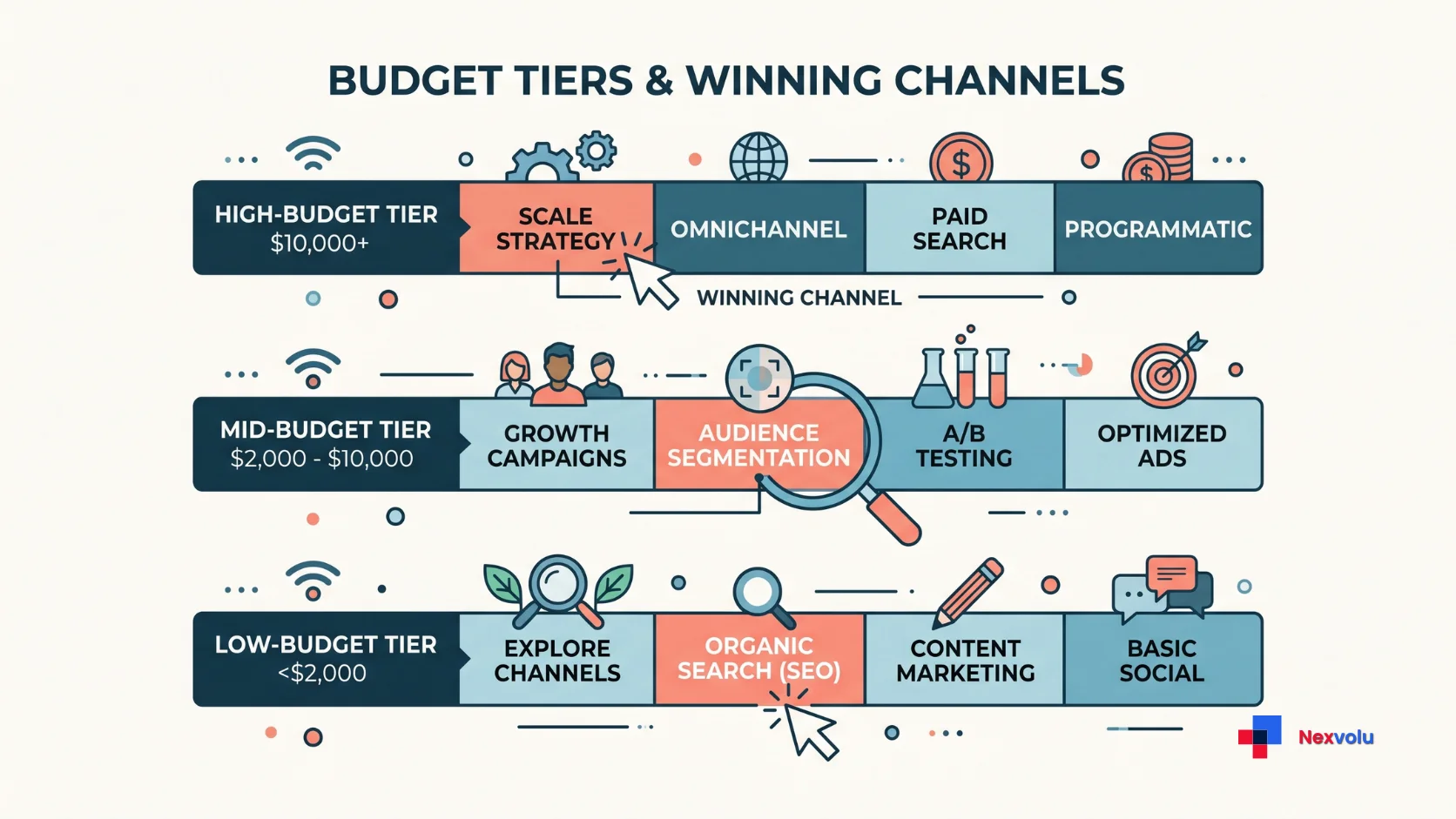
This is the part every other guide skips. Below, each band gets one winner, not a shrug.
How the budget bands were calculated
The arithmetic behind it is simple. Take the band’s budget, divide by the average cost per click, apply a realistic conversion rate, then ask whether the resulting number of leads is large enough to learn anything from. Below roughly 20 leads a month, you’re not running a campaign; you’re buying anecdotes.
| Monthly budget | Winner | Why | Do this instead of that |
|---|---|---|---|
| $/£0-500 | SEO | At $5.42 a click, $500 buys ~92 US clicks. At a 7.5% conversion rate that’s ~7 leads – far too few to optimise against. The same money spent on a Google Business Profile, three genuinely useful pages and local citations builds an asset. | Skip broad paid search. Exception: if your CPC is under $2 and a customer is worth $500+, run a tiny brand-and-service-name campaign only. |
| $/£500-2,000 | PPC first, SEO second (70/30) | This band finally buys statistical signal – roughly 90–370 clicks a month in the US, more in the UK. Use ads to discover which keywords actually convert, then aim your content at the proven winners. | Don’t split 50/50. Run 90 days of paid discovery, then move the SEO share up as the keyword data firms up. |
| $/£2,000+ | Both – but PPC funds SEO | Enough budget to run paid acquisition for cash flow while content and links compound underneath. Start 60/40 paid-to-organic and flip toward organic from month six as cost per lead falls. | Don’t treat them as separate teams. Feed paid search-term reports into the content calendar every month. |
Two tiebreakers that override the table
Admittedly, two tiebreakers override the table.
The runway rule. Under six months of cash runway, choose PPC regardless of band – SEO’s payoff arrives after your deadline. Over twelve months of runway, lead with SEO even in the middle band, because you can afford to buy the cheaper long-term click.
The margin rule. If your gross margin per customer is under about $100, PPC math rarely works at a $70 average cost per lead. High-volume, low-margin businesses belong in organic, marketplaces or referral channels, not in an auction against better-funded bidders.
How do you calculate your payback period first?
Payback period is how long a channel takes to return the money it consumed. It’s the number that settles arguments, and you can work it out on the back of an envelope.
Payback period = customer acquisition cost ÷ monthly gross profit per customer
Work through a $1,000 paid budget in the US at benchmark rates:
- $1,000 ÷ $5.42 CPC = ~185 clicks
- 185 clicks × 7.5% conversion rate = ~14 leads
- 14 leads × 20% close rate = ~2.8 customers
- $1,000 ÷ 2.8 = ~$357 acquisition cost per customer
So paid search works for you at that budget only if a customer is worth comfortably more than $357. A dentist or a roofer clears that on one job. A £25-a-month subscription needs fourteen months just to break even, and startup benchmarks generally place paid search payback in the 3-9 month window anything past that is a cash-flow problem dressed up as a marketing plan.
Comparing payback period for SEO vs PPC
Similarly, run the same sum for SEO by dividing your monthly retainer or hourly cost by the customers organic search produced. It’ll look terrible for months, then better than paid forever. Both numbers are honest; they just measure different time horizons.
Do the two sums for your own business before you read another comparison article. Whichever channel pays back inside your cash runway is the one to start with and that’s a decision no generic guide can make for you.
Does the answer change in the US versus the UK?
Yes, and this is the single most-ignored variable in the SEO vs PPC debate. The same £500 buys a meaningfully different experiment depending on which side of the Atlantic you’re bidding in.
Admittedly, UK cost-per-click data varies by source, which is worth stating plainly rather than hiding. PPC Chief’s January 2026 benchmark puts the average UK Search CPC at £1.95; Whitehat’s 2026 figure is higher at £3.50–£3.65; and Whito’s UK research reports a working range of £0.66-£5.00, with most small and medium businesses landing between £1.50 and £2.50, legal services around £8.25, and London campaigns costing 15-30% more per click than the rest of the UK.
| Measure | United States | United Kingdom |
|---|---|---|
| Average search CPC | ~$5.42 | ~£1.95-£3.65 (source-dependent) |
| Clicks from a 500 budget | ~92 | ~140-255 |
| Practical implication | Small budgets starve | Small budgets can still test |
| Most expensive verticals | Legal, insurance, B2B services | Legal (~£8.25), finance, insurance |
| Geographic premium | Major metros | London, 15–30% above national |
The takeaway is uncomfortable for one-size-fits-all advice: a UK small business can often run a legitimate paid test on a budget that would be pure waste in the US. If you’re in the bottom band and your UK CPCs sit near £1.50, treat yourself as if you were in the middle band instead.
When should you run both at once?
In fact, running both is right more often than the fence-sitters realise just not for the reason they give. The value isn’t “more coverage.” It’s that paid search is the fastest keyword research tool ever built, and SEO is the cheapest way to keep the clicks paid search taught you to want.
Run both when all three of these are true:
- You’re spending at least $/£2,000 a month, so neither channel is starved.
- You have 90 days of search-term data worth mining for content.
- Someone owns the handoff between the two – one person, one monthly review.
There’s a defensive argument too. Similarweb data comparing January 2025 with January 2026, reported by Search Engine Land, found paid click share rising sharply across major verticals, with text ads capturing up to roughly one-third of clicks in product categories. Google keeps expanding paid real estate; holding organic ground alone gets harder each year.
That said, don’t run both simply to feel safe. Underfunding two channels is how small businesses end up with a mediocre ad account and a blog nobody reads.
Nexvolu’s Verdict
One-line verdict: For most small businesses under $/£500 a month, start with SEO and stop pretending you can afford an auction but the moment you clear $/£500 with a customer worth over $360, PPC becomes the faster, smarter first move.
Best for PPC: businesses with high customer value, short cash runway, seasonal urgency, or a product that needs demand tested before content gets written.
Skip PPC if: your margin per customer is under ~$100, your landing page or tracking is broken, or your total budget buys fewer than 20 leads a month.
Pros of leading with PPC
- Revenue and data in days, not quarters.
- Search-term reports tell you exactly what SEO should target next.
- Fully attributable, so you can kill what fails fast.
Cons of leading with PPC
- Clicks have risen for ~87% of industries and keep climbing.
- Traffic ends the day the card declines.
- Small budgets produce data too thin to optimise.
Standout point: the US/UK cost-per-click gap quietly reverses the recommendation for identical businesses. A £500 UK budget can buy over twice the clicks of a $500 US budget – the same guide should not give both owners the same advice, and almost every guide does.
Nexvolu Editorial Score – 8.5/10 for a PPC-first start in the middle and upper budget bands; 5/10 in the sub-500 band. Scored on capability, value, ease and trust from the published benchmark data above. This is Nexvolu’s editorial judgement of the evidence, not a hands-on campaign test.
Frequently asked questions
Is SEO or PPC better for a brand new website?
PPC is better for a brand new website if you need revenue within 90 days, because new domains rarely rank quickly – Ahrefs found 95% of new pages don’t reach the top 10 within a year. SEO is better if you have runway and want an asset that compounds.
In practice most new sites should do a narrow version of both: run ads on your two highest-intent commercial keywords while publishing genuinely useful pages around them. However, the exception is a brand new site with a broken conversion path. Sending paid clicks to a page that doesn’t convert burns the budget you’d need for the second attempt, so fix tracking and the offer before bidding on anything.
How much should a small business spend on SEO per month?
Most small businesses spend between $500 and $2,000 a month on SEO, with agency retainers for competitive local markets commonly quoted at $1,000–$3,000. Sub-$500 budgets usually only cover a Google Business Profile, basic technical fixes and occasional content.
Instead, anchor the figure to revenue rather than to a vendor’s price list. Gartner’s 2025 CMO Spend Survey put average marketing spend at 7.7% of revenue, and the US Small Business Administration suggests 7–8% for businesses under $5 million. If SEO is your primary channel, it can reasonably take half of that allocation. If a quoted retainer is a large share of your rent, ask the provider to model the leads required to break even before you sign.
Can you do SEO and PPC at the same time on a small budget?
You can, but on a budget under $/£500 a month it usually makes both worse. Splitting a small budget produces too few paid clicks to optimise and too little content to build authority – the classic underfunded-on-two-fronts mistake.
Fortunately, a better compromise exists if you’re determined to test both. Spend 80% on organic foundations for one quarter, then reallocate that same 80% into a single tightly targeted paid campaign for one month as a pure experiment. You get a real CPC and conversion-rate reading for your own market instead of a national average, and you learn it without permanently splitting the budget.
Does PPC help SEO rankings?
No. Paid clicks are not a ranking factor, and running Google Ads gives your site no direct organic advantage. Google treats the two systems separately, and paying for ads never buys a better organic position.
The indirect benefits are real, though, and they’re worth having. Ad campaigns reveal which keywords convert, which headlines get clicked, and which landing pages hold attention all of which make your SEO targeting sharper. Ads also let you occupy the results page while a page is still climbing. Just don’t expect a ranking lift, and be sceptical of anyone who promises one.
How long before Google Ads becomes profitable?
Most well-managed accounts need 4-12 weeks to become reliably profitable, because early spend goes toward learning which keywords, audiences and creatives convert. Startup benchmarks typically show paid search payback landing in the 3-9 month range.
Notably, the biggest variable isn’t the platform it’s your conversion rate. At a $70 average cost per lead, a business closing 10% of leads pays roughly $700 per customer, while one closing 30% pays around $233. Improving the follow-up process often does more for profitability than any bid adjustment, which is why the accounts that turn a profit fastest are usually the ones with the tightest sales process behind them.
Is SEO still worth it with AI Overviews and zero-click search?
SEO is still worth it, but the return has shifted. SparkToro found 68% of searches ended without a click in early 2026, and organic click-through rates fall substantially on queries showing an AI Overview – so ranking now delivers fewer clicks than it did five years ago.
In reality, the money moved rather than vanished. Informational queries lose the most clicks, while commercial and comparison queries – the ones where someone is about to spend – still send traffic, and Seer Interactive recorded organic click-through rate partially recovering in early 2026. Being cited inside AI answers also carries measurable value. The practical adjustment is to stop writing definition posts and start covering decisions, comparisons and pricing.

The bottom line
Three things to take away. First, your monthly budget band settles the SEO vs PPC question more reliably than any pros-and-cons list. Second, payback period and cash runway break the tie whenever the band is ambiguous. Third, where you advertise changes the math – the UK’s lower cost per click can flip the same business from SEO-first to paid-first.
Above all, your next action is small: run the four-line payback sum on your own numbers before you spend anything on either channel. It takes ten minutes and it’ll tell you more than another comparison of organic traffic versus paid search ever will.
If this helped, share it with the business owner in your life who’s about to spend £500 on the wrong channel.
Which one did you start with and would you make the same call again? Tell us in the comments.
References
- SEO vs. PPC: Understanding the Difference – Google Ads
- Google Ads Benchmarks 2026 – WordStream
- Search Advertising Benchmarks for Every Industry, 2026 Data – LocaliQ
- Google zero-click searches reach 68% in early 2026 – Search Engine Land
- Paid search click share doubles as organic clicks fall – Search Engine Land
- AI Overviews reduce clicks – Ahrefs
- AIO Impact on Google CTR: 2026 Update – Seer Interactive
- UK PPC Costs 2026 – Whito
- Google Ads Benchmarks 2026: UK CPC & CTR – PPC Chief
- 2025 CMO Spend Survey – Gartner