








Do I Need a Vitamin D Supplement? Dose Guide (Updated)
Do I Need a Vitamin D Supplement? Dose Guide (Updated)
Somewhere in the second week of October, the light changes. The sun sits lower, you stop eating lunch outside, and the supplement aisle suddenly has a vitamin D display at the front. If you’re standing in front of four bottles wondering do I need a vitamin D supplement – and whether to grab the 400 IU, the 1,000 IU or the 4,000 IU – the answer comes down to two things: where you live, and which risk group you fall into.
This guide answers both. You’ll get the UK and US recommendations side by side, a conversion table so micrograms and international units stop being two different languages, a checklist for the groups that need a supplement all year, and a straight answer on whether a blood test is worth paying for. Every figure here ties back to published national guidance, named in the sentence, so you can check it yourself.
Disclaimer: This article is for informational purposes only and does not constitute medical advice. Consult a qualified healthcare professional before making any health decisions.
Do I need a vitamin D supplement? The short answer
The NHS advises most adults in the UK to take a daily 10 microgram (400 IU) vitamin D supplement from October to March, and all year round if they have dark skin, cover their skin outdoors, or are rarely outside. In the US, the NIH recommends 15 micrograms (600 IU) daily, rising to 20 micrograms (800 IU) at 71.
So that’s the whole decision for most people. Still, the rest of this guide covers the parts the official pages leave out: which bottle strength that translates to, whether the form matters, and where the ceiling sits.
Table of contents
- Why vitamin D is a winter problem
- The risk-group checklist
- How much per day: UK track vs US track
- Micrograms vs IU: the conversion table
- 400, 1,000 or 4,000 IU: which bottle
- D2 vs D3: does the form matter?
- Is a 25(OH)D blood test worth it?
- The part nobody covers: too much is now a real trend
- When to see a doctor
- Nexvolu’s Verdict
- Frequently asked questions
Why vitamin D is a winter problem
Your skin makes vitamin D when UVB light hits it. Above roughly 37 degrees of latitude – which covers all of the UK, most of northern Europe, and the northern half of the United States – the sun sits too low between October and March for meaningful UVB to reach the ground. Your skin can be in daylight for an hour and still produce almost nothing.
So that’s the entire reason a seasonal supplement exists. It isn’t a trend and it isn’t a wellness fad; instead, it’s a latitude problem with a fixed calendar.
Food barely closes the gap. Oily fish is the strongest natural source – a 3-ounce portion of cooked salmon carries about 11 micrograms, according to Harvard Health’s summary of USDA data but a fortified glass of milk contributes under 3 micrograms. Unless you eat salmon or sardines several times a week, winter diet alone rarely reaches the recommended intake.
The UK went further than most countries in acknowledging this. In its 2016 Vitamin D and Health report, the Scientific Advisory Committee on Nutrition (SACN) set a Reference Nutrient Intake of 10 micrograms a day for everyone aged 4 and over, explicitly assuming minimal sunshine exposure. Because of that report, the NHS advice you see every autumn rests directly on that number.
The risk-group checklist
The NHS advises some people to supplement every month of the year, not just through winter. So tick any box below, and the year-round recommendation applies to you.
- [ ] You have dark skin – an African, African-Caribbean or South Asian background (higher melanin reduces UVB-driven synthesis)
- [ ] You usually wear clothing that covers most of your skin outdoors
- [ ] You’re rarely outdoors – housebound, frail, or working entirely indoors
- [ ] You live in a care home or another institution
- [ ] You’re pregnant or breastfeeding
- [ ] You’re over 65 (skin synthesis and gut absorption both decline with age)
- [ ] You have a condition affecting fat absorption – coeliac disease, Crohn’s, cystic fibrosis, or a history of bariatric surgery
- [ ] You have obesity (vitamin D is fat-soluble and distributes into fat tissue, lowering circulating levels)
The first four are lifted straight from NHS guidance, which states that adults and children over 4 should take a daily 10 microgram supplement throughout the year if they’re not often outdoors, live in an institution, or usually cover their skin. GOV.UK‘s migrant health guide adds people with darker skin to the same list.
Children need their own numbers. The NHS advises 8.5 to 10 micrograms daily for breastfed babies from birth to one year, and 10 micrograms daily for all children aged 1 to 4, year-round. Formula-fed babies drinking 500 ml or more a day don’t need drops, because infant formula is already fortified.
How much per day: UK track vs US track
The two countries answer the same question differently, so the gap confuses people who read both. The UK sets a floor that protects musculoskeletal health with minimal sun, while the US sets a population average intake target. Neither is wrong; they simply rest on different thresholds.
| Who you are | UK (SACN / NHS) | US (NIH ODS) |
|---|---|---|
| Babies under 1 | 8.5-10 µg (340-400 IU) daily | 10 µg (400 IU) daily |
| Children 1-3 | 10 µg (400 IU) daily | 15 µg (600 IU) daily |
| Children 4-18 | 10 µg (400 IU), Oct-Mar | 15 µg (600 IU) daily |
| Adults 19-70 | 10 µg (400 IU), Oct-Mar | 15 µg (600 IU) daily |
| Adults 71+ | 10 µg (400 IU), year-round advised | 20 µg (800 IU) daily |
| Pregnancy / breastfeeding | 10 µg (400 IU), year-round | 15 µg (600 IU) daily |
| Anyone in a risk group | 10 µg (400 IU), year-round | Same RDA, plus clinical judgement |
| Upper limit, adults | 100 µg (4,000 IU) daily | 100 µg (4,000 IU) daily |
The two tracks agree on the ceiling. The NIH Office of Dietary Supplements sets the tolerable upper intake level at 100 micrograms (4,000 IU) a day for everyone aged 9 and over, counting food, drinks and supplements together, and UK prescribing guidance repeats the same 4,000-unit maximum for routine prevention.
One practical note the official pages bury: the UK figure covers what 97.5% of people need to keep blood 25(OH)D above 25 nmol/L when there’s no sun to work with. In other words, it’s a deficiency-prevention floor, not an optimisation target. That distinction explains most of the arguing you’ll see online.
Micrograms vs IU: the conversion table
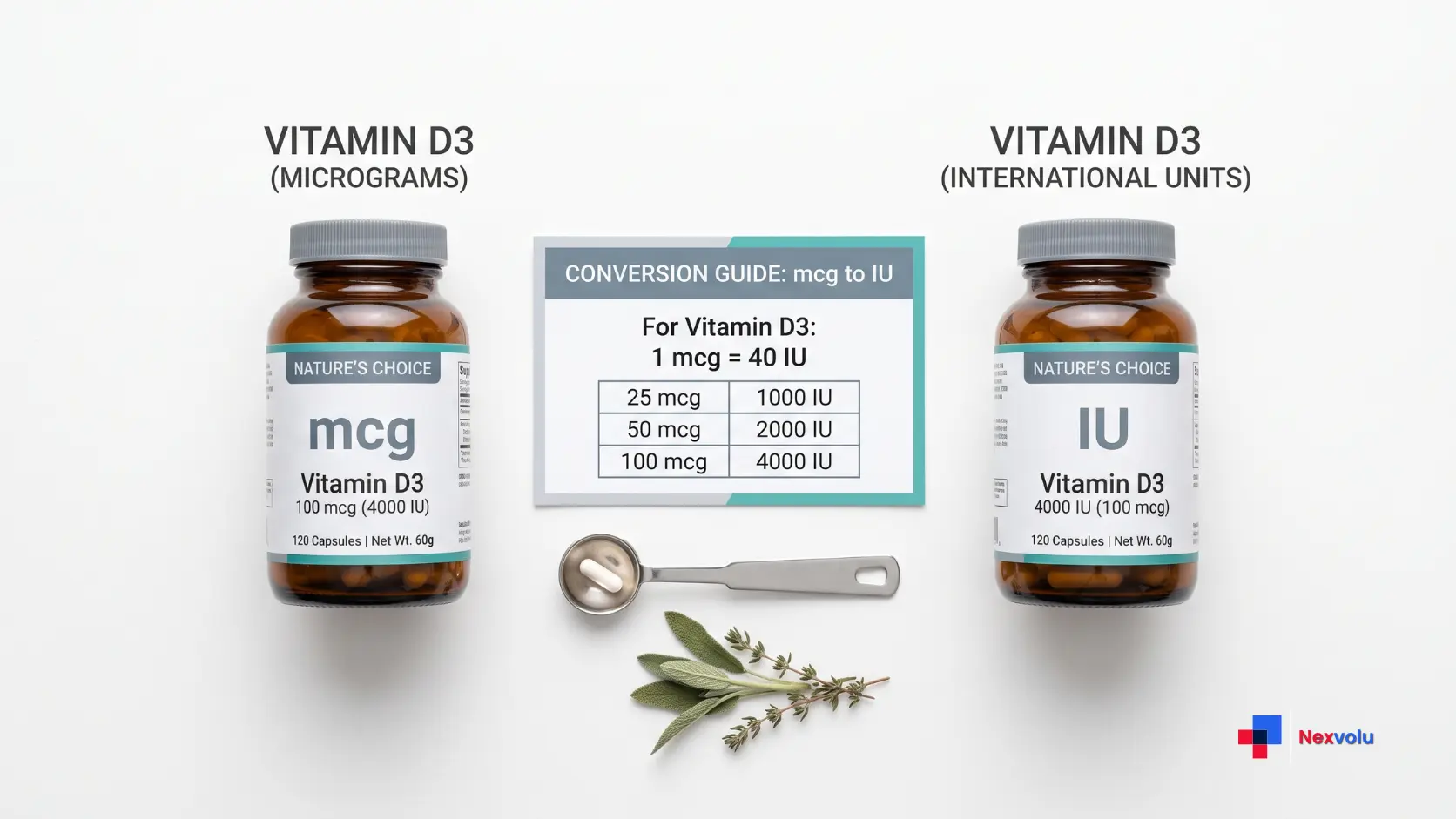
UK labels use micrograms. US labels use international units. Same substance, different arithmetic – and 1 microgram equals 40 IU. Print this row of numbers and the confusion disappears.
| Micrograms (µg / mcg) | International units (IU) | What it usually is |
|---|---|---|
| 10 µg | 400 IU | UK daily recommendation |
| 15 µg | 600 IU | US RDA, ages 1-70 |
| 20 µg | 800 IU | US RDA, age 71+ |
| 25 µg | 1,000 IU | Most common shop-shelf strength |
| 50 µg | 2,000 IU | Common “high strength” bottle |
| 100 µg | 4,000 IU | Tolerable upper intake, adults |
Anything above that last row belongs in a conversation with a doctor, not a shopping basket.
400, 1,000 or 4,000 IU: which bottle
For most readers, do I need a vitamin D supplement quickly becomes which one do I actually buy — and that’s the question the authority pages never answer. So here it is directly. A 400 IU tablet matches UK guidance exactly and costs the least per day. A 1,000 IU tablet is the most widely stocked strength and sits comfortably between the UK floor and the US RDA, which is why UK regional prescribing guidance describes 10 to 25 micrograms (400 to 1,000 units) as the everyday prevention range.
| Strength | Best for | Watch out for |
|---|---|---|
| 400 IU (10 µg) | Matching UK guidance precisely; children over 4 | Often harder to find than 1,000 IU |
| 1,000 IU (25 µg) | Adults wanting one tablet that covers UK and US targets | Still well under the upper limit |
| 2,000 IU (50 µg) | People in year-round risk groups, on advice | Halfway to the ceiling before food counts |
| 4,000 IU (100 µg) | Nobody, as a default choice | This is the upper limit – no headroom left |
The honest summary: for a healthy adult with no risk factors, 400 to 1,000 IU a day does the job national guidance asks for. Buying 4,000 IU because it looks like better value means starting at the maximum tolerated dose, which is backwards.
One more thing worth knowing, because it comes up constantly in supplement forums: vitamin D is fat-soluble, so taking it with a meal containing some fat is a reasonable habit. Absorption studies support it, and it costs nothing to try.
Share this with the person in your life who bought the biggest bottle on the shelf.
D2 vs D3: does the form matter?
Yes, modestly, and the evidence points one way. Vitamin D3 (cholecalciferol) raises blood 25(OH)D more effectively than vitamin D2 (ergocalciferol) when both are taken daily. A 2023 systematic review and meta-analysis published in Advances in Nutrition, pooling 20 comparative studies, found total 25(OH)D was on average 10.39 nmol/L lower in the D2 groups than the D3 groups – a gap the authors describe as roughly 40%.
So, in practice: if you’re buying an over-the-counter supplement and have a free choice, D3 is the better-supported pick. Body mass index turned out to be the strongest factor changing the size of that difference, which lines up with vitamin D’s distribution into fat tissue.
D2 still has a role. It’s plant-derived, so it appears in some vegan products, and prescription formulations in several countries use it. Vegans who want D3 can buy lichen-derived cholecalciferol, which is now widely available and chemically identical to the animal-sourced version.
Is a 25(OH)D blood test worth it?
For most healthy people, no. NICE guidance explicitly tells UK clinicians not to test vitamin D routinely in people without symptoms, and NHS trust protocols repeat it — clinicians reserve testing for suspected osteomalacia, bone disease, malabsorption, or symptoms that could plausibly stem from deficiency.
Meanwhile, the US converged on the same position from a different direction. The Endocrine Society’s 2024 clinical practice guideline suggests against routine 25(OH)D screening in generally healthy adults, including people with obesity or darker skin, because no trial has yet identified a blood level that reliably guides better outcomes in that group.
So when is a test genuinely useful? When something specific prompts it: unexplained bone pain or muscle weakness, a malabsorption diagnosis, osteoporosis treatment decisions, a history of deficiency, or medication that affects vitamin D metabolism. In those situations the test changes what happens next, which is the only real justification for ordering one.
So if you’re weighing up do I need a vitamin D supplement or a test first, be clear-eyed about the money: for a healthy adult, a 400 to 1,000 IU daily supplement through winter costs less than the test, and it’s what a low result would most likely prompt anyway.

The part nobody covers: too much is now a real trend
Here’s the finding that reframed this whole guide. A 2025 analysis of NHANES data in the American Journal of Clinical Nutrition tracked US vitamin D status from 2007-2008 through August 2021-August 2023. Inadequacy fell — the share of people “at risk of inadequacy” dropped from 18.8% to 15.6%. But the share with concentrations flagged as “may be of concern” for being too high climbed from 2.2% to 7.6%.
Among people taking two or more vitamin D-containing supplements, that high-concentration group reached 30.6%. Nearly one in three.
That number matters because it reframes the whole question. The public conversation still assumes the risk runs in one direction, while the measured trend in a supplementing population runs in both. Stacking a multivitamin, a cod liver oil capsule and a standalone 4,000 IU tablet is an easy way to cross a line you didn’t know you were near.
The consequences aren’t theoretical. Mayo Clinic notes that taking more than 4,000 IU a day can cause nausea and vomiting, muscle weakness, confusion, heart rhythm problems and kidney damage, and the NIH ODS lists hypercalcemia and soft-tissue calcification as the mechanisms behind vitamin D toxicity. Supplements, never sunlight, cause almost all vitamin D toxicity, because your skin self-limits how much it makes.
So the practical instruction is unglamorous: add up everything you’re already taking before you add anything new. A multivitamin plus a dedicated tablet is two doses, not one.
When to see a doctor
Talk to your GP or doctor before starting or continuing a vitamin D supplement if you have kidney disease, sarcoidosis or another granulomatous condition, hyperparathyroidism, a history of kidney stones, or you take medication that affects calcium including thiazide diuretics, digoxin, or high-dose calcium supplements. Vitamin D increases calcium absorption, and in those situations that interaction needs supervision.
Book an appointment rather than self-treating if you have persistent bone pain or tenderness, proximal muscle weakness, or repeated fractures. Those are the symptoms that make a 25(OH)D test appropriate, and confirmed deficiency is treated with loading doses that are far higher than anything sold as a general supplement – which is precisely why that decision belongs to a clinician.
Also check in if you’re already taking more than 4,000 IU a day, or if you’re pregnant, breastfeeding, or giving supplements to an infant. Standard advice covers those situations, but the doses are specific and worth confirming with a midwife, health visitor or doctor.
Nexvolu’s Verdict
One-line verdict: For most adults above 37° latitude, a 400-1,000 IU daily vitamin D3 supplement through autumn and winter is one of the few supplement decisions with real national guidance behind it and one of the easiest to overdo once you own three bottles.
Best for: Anyone in the UK or northern US between October and March; anyone in the year-round risk groups listed above; people who genuinely can’t get midday sun.
Skip it if: You already get 15+ micrograms from fortified foods, oily fish and summer sunlight, and you’re outside every risk group or you’re stacking supplements without adding up the total.
Pros
- The evidence base for musculoskeletal benefit is settled enough that two national bodies recommend it outright.
- It’s cheap – pennies a day at 400-1,000 IU.
- D3 has a clear, measurable advantage over D2 in daily dosing.
Cons
- The benefits beyond bone and muscle health remain unproven; SACN found insufficient evidence to conclude anything about cancer, MS or cardiovascular outcomes.
- High-dose bottles make it easy to approach the upper limit without noticing.
- UK and US numbers differ, and neither country’s page explains the other’s.
Standout point: The fastest-moving figure in recent US data isn’t deficiency, it’s the rise in too-high readings among multi-supplement users – from 4.7% to 30.6% across the NHANES period. That’s the detail almost no competing page mentions.
Nexvolu Editorial Score: 8/10 – a well-evidenced, low-cost intervention for a clearly defined population, though it loses two points because the marketing around it consistently oversells doses that guidance never asked for. This is an editorial assessment of published evidence, not a clinical recommendation or a hands-on test.
Frequently asked questions
Do I need a vitamin D supplement if I go outside every day?
Between October and March in the UK and northern US, yes – daily outdoor time doesn’t help, because the sun sits too low for meaningful UVB to reach your skin. From April to September, most people who spend regular short periods outdoors with forearms exposed will make enough, and the NHS says they may choose not to supplement in those months.
The exception is the year-round risk groups. If you have dark skin, cover up outdoors, or are rarely outside for long, daily fresh air still won’t produce what your skin needs, and standing guidance is to take 10 micrograms every month of the year. Windows don’t help either – glass filters out the UVB wavelength that drives synthesis.
Is 1,000 IU of vitamin D a day too much?
No. 1,000 IU is 25 micrograms – two and a half times the UK recommendation, but only a quarter of the 100 microgram (4,000 IU) tolerable upper intake level that the NIH Office of Dietary Supplements sets for adults. UK regional prescribing guidance describes 400 to 1,000 units daily as the normal prevention range.
In practice, 1,000 IU is the most commonly stocked strength precisely because it sits in that safe middle. The caution isn’t the tablet itself – it’s the total. A 1,000 IU tablet plus a multivitamin plus cod liver oil can quietly stack to several thousand IU a day. Add up every source before deciding whether your dose is reasonable.
What’s the difference between vitamin D2 and D3?
Vitamin D2 (ergocalciferol) comes from plant and fungal sources; vitamin D3 (cholecalciferol) is the form your skin makes and is found in animal foods and lichen. Both raise blood 25(OH)D, but a 2023 meta-analysis in Advances in Nutrition found daily D3 raised total 25(OH)D by about 10.39 nmol/L more than D2.
For everyday over-the-counter supplementation, D3 is the better-supported choice. D2 remains useful in prescription contexts and in some vegan products, though vegans can now buy lichen-derived D3 instead. If a label just says “vitamin D,” check the small print for the chemical name – cholecalciferol means D3.
Should I ask my doctor for a vitamin D blood test?
Only if you have a specific reason. NICE guidance tells UK clinicians not to test asymptomatic people, and the Endocrine Society’s 2024 guideline suggests against routine 25(OH)D screening in generally healthy adults, because the result rarely changes what happens next.
A test is appropriate when there are musculoskeletal symptoms such as suspected osteomalacia or unexplained bone pain, a diagnosed malabsorption condition, bone disease being treated, or a medication that interferes with vitamin D metabolism. If none of those apply, the standard preventive supplement is what a normal result would lead to anyway which is why routine testing tends to add cost rather than clarity.
Can you get enough vitamin D from food alone?
Rarely, in winter. Oily fish is the strongest source about 11 micrograms in a 3-ounce serving of cooked salmon according to Harvard Health’s USDA-based table but fortified milk provides under 3 micrograms per glass and an egg yolk under 1 microgram. Reaching 10 to 15 micrograms daily from food takes deliberate effort.
That’s exactly why SACN’s recommendation assumes minimal sun exposure and why fortification debates continue in the UK. If you eat salmon, sardines or mackerel several times a week and use fortified products routinely, you may be closer than most. For everyone else, a winter supplement is the simpler route.
What happens if you take too much vitamin D?
Excess vitamin D raises blood calcium, and the NIH Office of Dietary Supplements links toxicity to hypercalcemia, hypercalciuria and, in extreme cases, kidney failure, soft-tissue calcification and cardiac arrhythmias. Mayo Clinic notes that sustained intakes above 4,000 IU a day can cause nausea, vomiting, muscle weakness, confusion and kidney stones.
This is a supplement problem, not a sunshine problem – skin synthesis is self-limiting, so you can’t overdose from daylight. The realistic risk is stacking: US NHANES data show 30.6% of people taking two or more vitamin D-containing supplements had concentrations flagged as potentially too high. If you take several products, read every label and total the amounts.
The bottom line
If you live in the UK or the northern US, a daily 10 microgram (400 IU) vitamin D3 supplement from October to March is the recommendation, and 1,000 IU is a reasonable, widely available alternative that still sits well below the 4,000 IU ceiling. If you’re in one of the risk groups – dark skin, covered skin, indoors most of the time, over 65, pregnant, or living with a malabsorption condition – that becomes a year-round habit rather than a seasonal one.
Skip the blood test unless you have symptoms or a condition that warrants it. Choose D3 over D2. And before you add a new bottle, add up what’s already in your cupboard, because the one measurable trend in recent US data is people quietly going over the top.
Found this useful? Send it to whoever in your family buys the supplements – the total on the labels is the part everyone misses.
What strength did you end up buying, and did anyone actually explain the micrograms-to-IU maths to you before now?
Disclaimer: This article is for informational purposes only and does not constitute medical advice. Consult a qualified healthcare professional before making any health decisions.
REFERENCES
- NHS – Vitamin D – DHSC advice: 10 µg daily in autumn/winter; year-round for defined risk groups; infant and child doses.
- NHS inform (Scotland) – Vitamin D – seasonal and year-round supplementation, infants and children.
- Scientific Advisory Committee on Nutrition (2016) – Vitamin D and Health report – RNI of 10 µg/day for ages 4+; 25 nmol/L threshold; safe intakes for under-4s.
- GOV.UK – Vitamin D deficiency: migrant health guide – risk groups including darker skin, limited outdoor time, covered skin.
- NIH Office of Dietary Supplements – Vitamin D: Fact Sheet for Consumers – RDAs by age; upper limits table.
- NIH Office of Dietary Supplements – Vitamin D: Health Professional Fact Sheet – toxicity, hypercalcemia, UL of 25-100 µg by age.
- Mayo Clinic – Vitamin D – risks of intakes above 4,000 IU/day.
- Endocrine Society (2024) – Vitamin D for the Prevention of Disease: Clinical Practice Guideline – against routine 25(OH)D screening in healthy adults.
- NICE / Manchester University NHS FT – Serum vitamin D test requesting – do not routinely test asymptomatic people.
- Advances in Nutrition (2023) – Daily vitamin D2 vs D3 and serum 25(OH)D: systematic review and meta-analysis – WMD 10.39 nmol/L lower for D2.
- American Journal of Clinical Nutrition (2025) – Trends in vitamin D status in the United States, 2007-2023 (NHANES) – inadequacy 18.8% → 15.6%; “may be of concern” 2.2% → 7.6%; 30.6% among 2+ supplement users.
- Harvard Health – Taking too much vitamin D can cloud its benefits – food sources table (salmon 11.1 µg per 3 oz).
- Nottinghamshire APC – Vitamin D Management in Adults – 400-1,000 unit prevention range; 4,000 unit maximum.