








Candida Auris: Symptoms, Mortality Rate, and 2026 Spread
The fastest-growing Google search about candida auris right now isn’t “what is it.” It’s “candida auris mortality rate,” and it jumped 4,500% in a single day. That tells you exactly where people’s heads are. A drug-resistant fungus is spreading through American hospitals. The CDC has confirmed cases in 27 states this year. And everyone wants the same two answers: how deadly is it, and should I be worried?
Here’s the honest version, up front. If you’re healthy and living at home, this fungus is almost certainly not coming for you. But if someone you love is in a hospital, a nursing home, or a long-term care facility right now? The next ten minutes are worth your time.
We went through the CDC’s latest weekly case data, the 2026 state-by-state numbers, peer-reviewed resistance research, and live search data. The goal: answer every question people are actually asking, including the ones most news coverage skips. It’s the same data-first approach we took in our cyclospora outbreak survival guide.
Quick Answer
Candida auris is a drug-resistant yeast (a type of fungus) that spreads in hospitals and nursing homes. It mostly infects people who are already seriously ill. The CDC recorded 3,437 clinical cases across 27 states in 2026 through July 25. Past CDC estimates found 30 to 60% of infected patients died, though most had other serious illnesses. Healthy people rarely get sick from it.
TL;DR
- CDC logged 3,437 US clinical cases across 27 states through July 25, 2026.
- Texas leads the nation in reported cases; Michigan follows with 503.
- Past CDC estimates: 30 to 60% of infected patients died.
- Most strains resist at least one antifungal drug; a few resist all three classes.
- Healthy people rarely get infected; hospitalized patients carry the real risk.
Table of Contents
- What Is Candida Auris?
- How Deadly Is Candida Auris?
- Candida Auris Symptoms: Colonization vs Infection
- How Do You Get Candida Auris?
- Where Is Candida Auris Spreading in 2026?
- Why Is Candida Auris So Hard to Kill?
- Candida Auris Treatment: What Actually Works
- How to Protect a Loved One in Care
- What Live Search Data Reveals About This Outbreak
- Nexvolu’s Verdict
- Frequently Asked Questions
What Is Candida Auris?
Candida auris (C. auris) is a species of yeast, a type of fungus, that can cause severe and sometimes untreatable infections in people who are already ill. It was first identified in Japan in 2009 and reached the United States in 2016. It now spreads mainly inside hospitals, nursing homes, and long-term care facilities.
What makes it different from ordinary yeast infections is resistance. According to the CDC, “Resistant infections can be difficult, and sometimes impossible, to treat.” Most strains shrug off at least one class of antifungal medicine. A small number resist all three.
The second problem is stubbornness. The fungus survives on bed rails, catheters, blood pressure cuffs, and room surfaces for weeks. It also tolerates some common hospital disinfectants. Dr. Graham Snyder is the medical director of infection prevention at the University of Pittsburgh Medical Center. He told CNN its defining trait is the ability to spread and persist in healthcare settings. It manages that partly by resisting certain cleaning products.
That combination, drug resistance plus surface persistence, is why the CDC classifies it as an urgent public health threat rather than just another hospital germ. Weakened immunity is the common thread in serious cases. Everyday basics that support your defenses, including getting your vitamin D intake right, do more than any exotic precaution.
How Deadly Is Candida Auris?
The CDC’s estimate, based on information from a limited number of patients: 30 to 60% of infected people died. The agency adds a crucial caveat. Many of these patients had other serious illnesses that already raised their risk of death.
That range needs unpacking, because it’s the single most searched question about this fungus right now and the least carefully answered.
Who the 30 to 60% Figure Actually Describes
The 30 to 60% figure describes people with confirmed infections, meaning the fungus entered their bloodstream, a wound, or an organ. It does not describe the far larger group who are merely colonized, carrying the fungus on their skin with no symptoms at all. Colonized people are not dying from C. auris. They mostly never develop illness.
What Newer Studies Show
A 2023 analysis of US hospital data appeared in the CDC’s Emerging Infectious Diseases journal. It found 34% overall crude mortality among hospitalized C. auris patients. For bloodstream infections, the figure rose to 47%. A 2024 systematic review in Medical Mycology was conducted to inform the World Health Organization. It found bloodstream infection mortality ranged from 29% to 62% across studies.
So the honest answer looks like this: deadly for a specific, small, already-vulnerable group. Not a meaningful threat to the general public. Both halves of that sentence are true, and coverage that only prints one half is doing readers a disservice. We unpacked the same headline-flattening pattern in the Ozempic paradox doctors warned about.
What the Study Found: The CDC’s 2022 to 2024 national surveillance review examined who actually gets this infection. Cases were overwhelmingly concentrated among older, hospitalized patients rather than the general population.
Key Statistics: 88% of clinical cases occurred in people over age 45 (CDC MMWR, 2026). 3,437 clinical cases were reported across 27 states through July 25, 2026 (CDC weekly notifiable disease data). Past CDC estimates put mortality at 30 to 60% among infected patients.
Why It Matters: The risk is real but narrow. Knowing who is actually vulnerable tells families where vigilance helps and where fear is wasted. That group: ICU patients, people with invasive devices, and long-term care residents.
Found this useful so far? Share it with someone who has a family member in hospital care right now.
Candida Auris Symptoms: Colonization vs Infection
There’s no single “candida auris rash” or telltale sign, and that’s part of the problem. Symptoms depend entirely on where the fungus takes hold, and they look like any other serious infection.
Dr. Scott Roberts, an associate professor of infection prevention at Yale University, explains the two states a person can be in. Colonization means the fungus lives on your skin, usually without any symptoms. Infection happens when it gets inside. “Most of the time, the infections occur through bloodstream infection. There’s some entry into the skin somewhere; maybe your immune system’s not as good as it should be. You can’t fight it off, and you lead to a big infection,” Roberts said.
Here’s the practical breakdown:
| Colonization | Infection | |
|---|---|---|
| What it is | Fungus lives on skin or body sites | Fungus enters blood, wounds, or organs |
| Symptoms | Usually none | Fever, chills, low blood pressure, rapid heart rate |
| Danger level | Low to the carrier, but can spread to others | Serious; can progress to sepsis |
| Detection | Swab of armpit or groin | Lab culture from blood or infected site |
Dr. Ilan Schwartz of Duke University told CNN the infection can trigger fever, low blood pressure, and high heart rate. Once it reaches the bloodstream, it can escalate to sepsis. Because these signs mimic bacterial infections, only specialized lab testing (genetic sequencing or mass spectrometry) can confirm C. auris. Standard hospital lab methods have historically misidentified it as other Candida species.
Watch for unexplained fever with a racing pulse and low blood pressure in a loved one in care. Raise it with the care team immediately, whatever the cause turns out to be.
How Do You Get Candida Auris?
Candida auris spreads through direct contact with people who carry it. It also travels on contaminated surfaces and medical equipment in healthcare facilities. It is not spreading through the air, through food, or through casual community contact. This is a healthcare-environment germ, full stop. That separates it from foodborne outbreaks like this year’s cyclospora surge, which spread through contaminated food rather than hospital rooms.
The risk factors are specific and well documented by the CDC:
- Long stays in hospitals, especially intensive care
- Living in nursing homes or long-term acute care facilities
- Invasive devices: ventilators, central lines, feeding tubes, urinary catheters
- Recent heavy antibiotic or antifungal use
- Weakened immune systems (chemotherapy, transplants, serious chronic illness)
Notice what’s not on that list: being a generally healthy adult. Dr. Schwartz put it plainly: “Generally, these are going to be in patients who are already hospitalized and who are being monitored, and so the healthcare team should be well aware already if patients are showing signs of a general infection, so I don’t think that it’s something individuals need to be vigilant about.”
One more nuance worth knowing. Colonized people can carry and spread the fungus for months, sometimes indefinitely. They may never get sick themselves. That’s why hospitals screen high-risk patients with skin swabs even when nobody has symptoms.
Where Is Candida Auris Spreading in 2026?
As of the CDC’s week-29 reporting (ending July 25, 2026), 3,437 clinical cases had been confirmed across 27 states this year. Texas leads the country. Fox 7 Austin reports 1,148 Texas cases against more than 6,600 total nationwide when screening detections are included. Michigan follows with 503 clinical cases, per CDC data reported by Nexstar.
| State | Reported 2026 cases | Note |
|---|---|---|
| Texas | 1,148 | Highest in the nation (clinical + screening) |
| Michigan | 503 | Second highest, clinical cases |
| Wisconsin | Confirmed, low count | Among 23+ states with clinical cases |
| Washington | 13 | Newer arrival, per CDC tracking |
Now for some math nobody else has published. Through week 29, the 2026 pace works out to roughly 118 new clinical cases per week. Hold that pace through December and the year lands near 6,160 clinical cases, right in line with 2024’s record 6,304. For perspective, the US recorded just 48 clinical cases in 2016. That’s a 131-fold increase in eight years.
One caveat, and it’s a genuinely hopeful one. Dr. Nitipong Permpalung of Johns Hopkins noted to CNN that screening has expanded sharply. Part of the rising count reflects better detection of colonized patients, not just more disease. The CDC itself says “cases continue to rise each year, but the rate of increase has slowed down since 2022.”

Why Is Candida Auris So Hard to Kill?
Three separate defenses make this fungus a nightmare for hospitals, and a fourth was only discovered months ago.
Drug Resistance
The CDC’s Antimicrobial Resistance Lab Network tested 8,033 US clinical isolates from 2022 to 2023. The results were published in Emerging Infectious Diseases in February 2026. Fluconazole, the workhorse antifungal, failed against 95% of samples. Another 15% resisted amphotericin B, and 1% resisted echinocandins, the current first-line treatment. A small number of strains resist all three classes at once.
Surface Survival
Unlike most Candida species, C. auris thrives on dry surfaces for weeks and tolerates several standard hospital disinfectants. Facilities need EPA List P disinfectants, the ones specifically validated against it.
Identification Trouble
Standard lab equipment has repeatedly confused C. auris with harmless relatives. Confirming it requires mass spectrometry or genetic sequencing, which delays containment.
The New Discovery
A 2025 study in Nature Microbiology found something remarkable. The fungus uses an enzyme called carbonic anhydrase (Nce103) to sense carbon dioxide levels on human skin. That ability helps drive both its unusual skin persistence and its antifungal resistance. In plain English: the fungus can detect where it is and adjust its defenses. That finding also hands researchers a brand-new drug target, which is the most promising treatment lead in years. New targets take years to become approved medicines, though. We broke down that timeline in what DT120’s depression trial really means.
Candida Auris Treatment: What Actually Works
Most candida auris infections are treatable. That sentence gets lost in the scary headlines, so it’s worth saying clearly. The CDC states that echinocandins, a class of IV antifungal drugs, remain effective against the large majority of US strains. They’re the preferred first-line treatment.
The hard cases are the exceptions. For pan-resistant strains (resistant to all three drug classes), doctors combine drugs, adjust doses, and manage complications, with no guaranteed playbook. This is why the 1% echinocandin resistance figure gets so much attention from specialists. If that number grows, the treatment of last resort starts failing.
Colonization is a different story. There’s no proven way to “decolonize” someone, so care teams don’t treat carriers with antifungals. They isolate, monitor, and clean. As Roberts told CNN, “There’s unfortunately not much to do. It’s moreso just awareness that it is on the scan or that it is there in that room.”
How to Protect a Loved One in Care
Picture a scenario thousands of families are living right now. Your mother is recovering from hip surgery in a skilled nursing facility in a state on the CDC’s list. You can’t control the facility’s cleaning protocols. So what can you actually do?
The 5-Question Family Checklist
Here’s a practical checklist built from CDC prevention guidance:
- Ask the facility directly: “Do you screen for C. auris, and have you had cases?” Facilities in affected states should have a clear answer.
- Ask about devices every week: “Does she still need the catheter or IV line?” Invasive devices are the fungus’s main doorway, and the CDC advises minimizing how long they stay in.
- Watch hand hygiene, politely. Alcohol-based hand sanitizer before and after patient contact is the single most effective barrier. It’s fine to ask visitors and staff to use it.
- Flag previous facility stays. If your family member transfers between facilities, tell the new care team about any past C. auris screening results. The CDC specifically asks patients and families to do this.
- Know the red flags: unexplained fever, low blood pressure, rapid heartbeat. Report them the day they appear, not at the next scheduled visit.
None of this requires medical training. All of it measurably reduces risk. Share this checklist with anyone who has a parent or partner in long-term care; it’s the most useful thing in this article.
Two More Things Caregivers Should Watch
Recovery in older adults leans heavily on nutrition. Protein is the piece most care menus under-deliver; here’s how much protein a day the research actually supports. Long-term care is a financial marathon too. Families relying on benefits should watch where the 2027 Social Security COLA is heading. And know that health scares attract predators. AI voice scams that mimic a relative’s voice target exactly the kind of worried families reading stories like this one.
What Live Search Data Reveals About This Outbreak
Here’s the section you won’t find anywhere else. We analyzed Google Trends data captured during the current spike. The pattern says something interesting about where this story is heading.
Search interest in “candida auris symptoms” scored 96, the highest of any related query. But it’s already down 80% from its peak. “What is candida auris” scored 79, also falling. The first wave of curiosity, the definitional wave, has crested.
What’s rising instead? “Candida auris news” is up 40%. And one query is in full breakout: “candida auris mortality rate,” up 4,500% in a day. Search interest in symptoms still runs roughly 48 times higher than mortality-rate searches in absolute terms. But the direction of travel is unmistakable. People have moved from “what is this thing” to “how afraid should I be.”
State-level searches (Michigan, Wisconsin, North Carolina) are climbing too, which tracks exactly with the CDC’s expanding state list. And “candida auris reddit” appearing in the data tells its own story. People don’t fully trust polished news coverage on this and want unfiltered answers. Hard to blame them in a year when bots outnumber humans online. Knowing how to spot AI-generated content has quietly become a health literacy skill.
That’s precisely the gap this article was built to fill. It delivers the mortality answer with honest context, the state data, and a no-spin verdict. Which brings us to exactly that.
Nexvolu’s Verdict
The verdict: Candida auris is a genuinely serious hospital problem and a genuinely overblown public panic. Both things are true at once.
Pay attention if: you have a family member in a hospital ICU, nursing home, or long-term care facility. That goes double in Texas, Michigan, or another high-count state.
Relax if: you’re a healthy adult wondering whether to worry about surfaces, gyms, or public spaces. The evidence says no.
What’s reassuring: healthy immune systems handle this fungus. First-line treatment still works against 99% of US strains. Expanded screening explains part of the case surge.
What’s concerning: a 131-fold case increase since 2016. Strains resistant to every available drug already exist. The fungus outlives routine cleaning.
Standout point: the newly discovered CO2-sensing mechanism (Nature Microbiology, 2025) cuts both ways. A fungus that adapts its defenses to its location is a scary thought. A brand-new drug target is the best treatment news in years.
Nexvolu Editorial Score: 7/10 on public-health seriousness: high stakes for a narrow group, low stakes for everyone else, trending manageable rather than catastrophic. This is an editorial assessment of the situation, not medical guidance. We size threats the same way, whether the topic is password manager safety or a hospital fungus. Name the real risk, measure it, skip the theater.
Frequently Asked Questions
What is candida auris in simple terms?
Candida auris is a yeast, a type of fungus, that resists most antifungal medicines and spreads inside hospitals and nursing homes. It mainly sickens people who are already seriously ill. It enters the body through wounds, IV lines, or catheters and can cause dangerous bloodstream infections. Think of it as a hospital superbug, except it’s a fungus rather than a bacterium. It was first found in Japan in 2009 and arrived in the US in 2016. The CDC now labels it an urgent threat because a few strains resist every drug doctors have.
What are the first symptoms of candida auris?
The most common early signs of a candida auris infection are fever and chills that don’t improve with antibiotics. Low blood pressure and a rapid heart rate often follow. There is no distinctive rash or unique visible symptom, which makes lab testing the only way to confirm it. In practice, infections are usually spotted in patients already hospitalized, because that’s where the fungus lives. Colonized people, those simply carrying it on their skin, typically feel nothing at all. That’s why facilities use swab screening rather than waiting for symptoms.
What is the mortality rate of candida auris?
Based on a limited number of patients, the CDC has estimated that 30 to 60% of infected patients died. Many of those patients had other serious illnesses that also raised their risk. A 2023 US hospital-data analysis found 34% overall crude mortality, rising to 47% for bloodstream infections. Those numbers apply only to infected patients, not to the far larger group who are colonized without symptoms. Researchers caution that separating deaths caused by the fungus from deaths caused by underlying illness remains genuinely difficult.
How do you get candida auris?
People acquire candida auris through contact with contaminated surfaces, medical equipment, or the skin of carriers. It happens almost always inside healthcare facilities. Ventilators, central lines, feeding tubes, and urinary catheters give it a direct route into the body. That’s why ICU and nursing home patients dominate case counts. It doesn’t spread through air or food, and community transmission to healthy people is not a documented concern. Recent heavy antibiotic use also raises risk because it clears out competing microbes and gives the fungus room to grow.
Can healthy people get candida auris?
Healthy people rarely develop candida auris infections. An intact immune system and unbroken skin stop it effectively. Experts including Duke’s Dr. Ilan Schwartz say individuals outside healthcare settings don’t need to be vigilant about it. The realistic scenario for a healthy person is temporary colonization without ever becoming ill. That means briefly carrying it on the skin after visiting or caring for someone in an affected facility. The sensible precaution is simple hand hygiene around healthcare environments, not avoiding hospitals or fearing everyday public spaces. If you’d rather do something proactive, start with sleep, movement, and a sensible vitamin D routine. Those habits support the immune defenses that keep this fungus a non-issue.
What does candida auris look like?
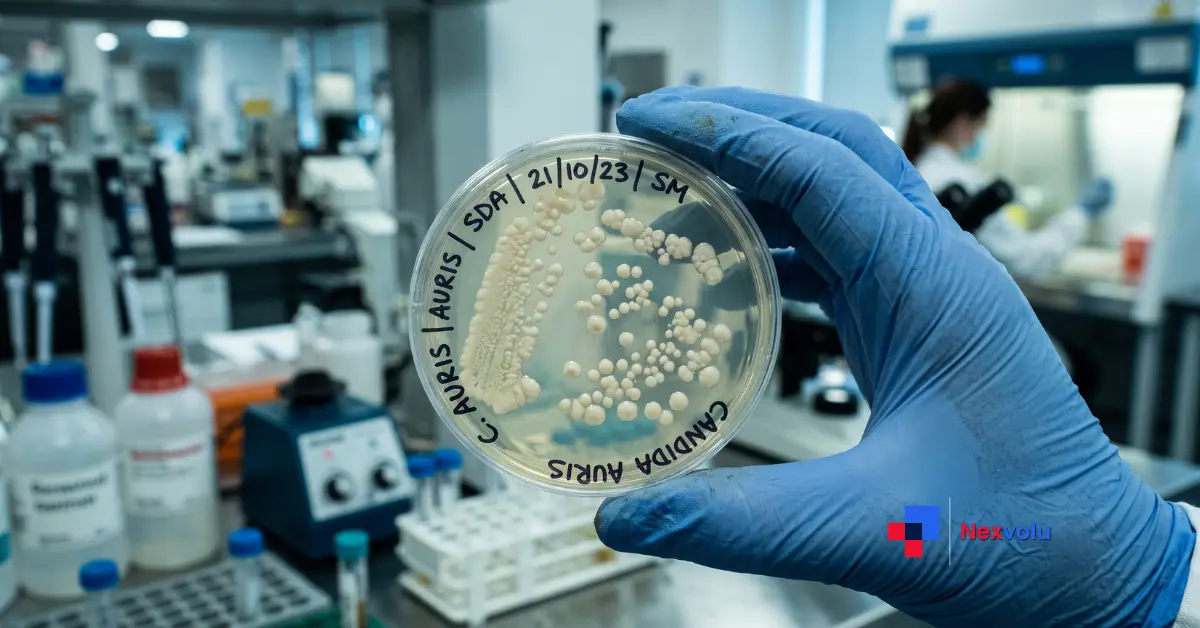
You can’t see candida auris on a person; it produces no distinctive rash, discoloration, or visible growth on skin. In the lab, it grows as cream-to-pale-pink colonies in culture dishes, and under a microscope it looks like oval yeast cells. Photos in news coverage almost always show petri dish cultures, not patients. Treat dramatic “candida auris rash” images on social media with suspicion. Many are fabricated, and AI-generated health images are getting harder to spot. This invisibility is exactly why it spreads so well: a colonized patient looks completely normal, and only an armpit or groin swab processed with specialized equipment reveals the fungus is there.
How is candida auris detected or tested?
Doctors confirm candida auris with laboratory tests. Cultures from blood, urine, or wounds identify suspected infections, and skin swabs of the armpit and groin detect colonization. Standard lab methods often misidentify it as other Candida species, so definitive identification requires mass spectrometry (MALDI-TOF) or genetic sequencing. That identification gap matters in practice. The CDC runs a dedicated Antimicrobial Resistance Lab Network partly because early misidentification let the fungus spread undetected in US facilities for years before anyone realized what they were dealing with.
What kills candida auris on surfaces?
Only certain disinfectants kill candida auris on surfaces: the EPA’s List P products, which are specifically validated against it. Many routine quaternary ammonium cleaners, the everyday hospital wipes, don’t reliably work, and the CDC recommends facilities switch to List P products for affected rooms. The fungus can survive on dry surfaces like bed rails and equipment for weeks. For families, this is a facility-level issue rather than a home one; ordinary households don’t need special products, since the fungus doesn’t meaningfully circulate outside care settings.
What is the difference between candida auris and candida albicans?
Candida albicans is the common yeast behind ordinary thrush and yeast infections; candida auris is its rare, drug-resistant relative that spreads in hospitals. Albicans lives naturally in most human bodies and usually responds quickly to standard antifungals. Auris resists most of those drugs, survives on surfaces for weeks, and transmits between patients, which albicans rarely does. If you’ve had a routine yeast infection, that has no connection to this outbreak. The two share a genus name and almost nothing else that matters clinically.
Which US states have candida auris cases in 2026?
Twenty-seven states reported clinical candida auris cases to the CDC through July 25, 2026. Texas leads with the most reported cases (1,148 including screening detections, per Fox 7 Austin), followed by Michigan with 503 clinical cases. Wisconsin, Washington, Virginia, North Carolina, and much of the South and Midwest also appear in CDC tracking. The list grows as screening expands, so a state joining it often means better detection rather than a sudden outbreak. The CDC’s tracking page updates counts throughout the year.
Is it safe to visit someone in a hospital during the outbreak?
Yes, visiting hospitals and nursing homes remains safe for healthy visitors, including in states with candida auris cases. The fungus threatens patients with invasive devices and weakened immune systems, not visitors with intact skin and healthy defenses. Use the alcohol-based hand sanitizer at entry and exit, avoid touching medical equipment, and follow any posted isolation precautions on specific rooms. If you’re visiting someone who is colonized or infected, staff will provide gowns or gloves as needed; the precautions protect other patients more than they protect you.
How do you pronounce candida auris?
Candida auris is pronounced “CAN-did-ah OR-iss.” The word auris is Latin for ear, and the name comes from its discovery in 2009 in ear canal discharge from a patient in Japan. Despite the name, ear infections are a minor part of what it does; bloodstream, wound, and urinary infections cause the serious illness. You’ll also see it written as C. auris in medical coverage, and some newer scientific papers use the reclassified name Candidozyma auris, which refers to the same organism.
Does candida auris colonization go away on its own?
Usually not quickly. The CDC says people colonized with candida auris often carry it for a long time, potentially indefinitely, whether or not they ever develop symptoms, and there is no proven treatment that reliably removes colonization. Doctors don’t prescribe antifungals for carriers because it doesn’t work well and may fuel resistance. In practice, colonized patients are flagged in medical records, cared for with contact precautions, and re-screened over time. Some people do eventually test negative, but facilities treat past carriers as potentially colonized on readmission.
Why are candida auris cases rising in 2026?
Cases are rising in 2026 for two stacked reasons: genuine spread through more facilities in more states, and dramatically expanded screening that now catches colonized patients who would have been missed before. Johns Hopkins mycology researcher Dr. Nitipong Permpalung notes the screening surge accounts for part of the increase. The CDC’s own framing supports a measured read: cases rise every year, but the rate of increase has slowed since 2022. The 2026 pace projects to roughly 6,160 clinical cases, close to 2024’s total rather than an explosion beyond it. If 2026 feels heavy on outbreak news, it is; the cyclospora outbreak followed a similar detection-driven curve this summer.
Key Takeaways
- Candida auris threatens hospitalized and long-term care patients, not healthy people in daily life.
- The CDC’s 30 to 60% mortality estimate applies only to infected patients, most with serious underlying illness.
- First-line echinocandin drugs still work against 99% of tested US strains.
- Texas and Michigan lead a 27-state spread; screening growth explains part of the surge.
- If a loved one is in care, ask about screening, device duration, and List P disinfectants.

The Bottom Line
Candida auris earned its scary headlines the honest way. It resists drugs, survives cleaning, and kills a large share of the vulnerable patients it infects. And yet the single most useful fact about it is who it doesn’t touch. Healthy people, going about normal life, are not this fungus’s targets.
So channel the concern where it counts. If someone you love is in a hospital or nursing home, ask the screening question and push on device duration. Watch for candida auris symptoms like unexplained fever with low blood pressure. Those small actions matter more than anything else in this story. And if weeks of scary headlines have drained you, the mood tools you already have will do more for you than another hour of scrolling. If this cleared things up, pass it along to someone who’s been worrying about the headlines.
Has this outbreak touched your family or your local hospital? Tell us what you’re seeing in the comments.
Disclaimer: This article is for general informational purposes only and is not medical advice. It is not a substitute for professional diagnosis or treatment. Always consult a qualified healthcare provider before making decisions about your health.
REFERENCES
- CDC: Tracking C. auris
- CDC: About C. auris
- CDC: Preventing the Spread of C. auris
- CDC: weekly notifiable disease data, week ending July 25, 2026
- CDC MMWR: Surveillance for Candida auris, United States, 2022-2024
- CDC EID: Candida auris Testing by the Antimicrobial Resistance Laboratory Network, 2022-2023
- CDC EID: Candida auris-Associated Hospitalizations, United States (mortality data)
- CNN: What to know about Candida auris (Aug 7, 2026)
- The Hill/Nexstar: Superbug confirmed in 23 states (Aug 2026)
- Fox 7 Austin: Texas leads US in cases of dangerous fungal infection
- Nature Microbiology: Candida auris skin tropism and antifungal resistance mediated by carbonic anhydrase Nce103 (2025)
- Medical Mycology: Candida auris systematic review for WHO (2024)
- Cleveland Clinic: Candida Auris overview