






How Much Protein Do I Need a Day? The Real Numbers
How Much Protein Do I Need a Day? The Real Numbers
Ask three reputable sources how much protein do I need a day, and you’ll get three different answers. Harvard Health says 0.8 grams per kilogram of body weight. The British Heart Foundation says 0.75. The newest US dietary guidelines say 1.2 to 1.6 roughly double.
None of them are wrong. Rather, they’re answering slightly different questions, using different evidence, for different populations. But if you’re standing in a supermarket aisle holding a protein bar, that nuance is useless. You want a number.
This article gives you one. It also shows you where that number comes from, why the official figure is being argued over right now, and how to work out your own target in about 30 seconds in kilograms or pounds.
We’ll reconcile the competing guidelines in a single table, run two full worked examples (a 60 kg adult and an 85 kg adult), and be honest about who genuinely needs more protein versus who is simply being sold more protein.
Fair warning: for most healthy adults, the answer is less dramatic than the supplement aisle suggests.
On this page
- The short answer, in one paragraph
- The three official protein numbers, side by side
- How to calculate your own protein target (kg and lb)
- Why the US just raised its protein advice and why scientists objected
- Who genuinely needs more protein than the RDA
- Does protein distribution across meals matter?
- Can you eat too much protein?
- When to see a doctor
- Nexvolu’s Verdict
- Frequently Asked Questions
- The bottom line
How much protein do I need a day? The short answer
Most healthy adults need roughly 0.75 to 0.8 grams of protein per kilogram of body weight per day. That’s about 45 grams for a 60 kg adult and 68 grams for an 85 kg adult. Older adults, people losing weight, and regular strength trainers benefit from more usually 1.0 to 1.6 g/kg.
That single paragraph answers the question for the majority of readers. The rest of this guide explains why the official numbers disagree, and when yours should sit higher.
The three official protein numbers, side by side
Here’s the part almost nobody puts in one place. There isn’t one authoritative figure there are several, each built on a different question.
Where the 0.8 g/kg RDA actually comes from
The RDA is a floor, not a target. According to Harvard Health, the Recommended Dietary Allowance is 0.8 grams per kilogram of body weight, or 0.36 grams per pound. Harvard describes it plainly as the minimum needed to keep from getting sick, rather than the amount you’re supposed to eat. The American Heart Association uses the same 0.8 g/kg figure for adults aged 18 and over.
The UK reference is slightly lower. The British Heart Foundation puts the recommended daily amount at 0.75 g per kg of body weight around 45 g for a 60 kg woman and 55 g for a 75 kg man. The British Nutrition Foundation lists the same figure and translates it to 56 g a day for men and 45 g for women.
The percentage-of-calories range is a third framing entirely. Both the American Heart Association and Mayo Clinic recommend that 10% to 35% of daily calories come from protein. At 2,000 calories a day, that’s an enormous spread: 50 g at the bottom, 175 g at the top.
The new figure that broke the consensus
And then there’s the newest entry. In January 2026, however, the 2025-2030 Dietary Guidelines for Americans landed on 1.2 to 1.6 g/kg a figure we’ll unpack properly in a moment.
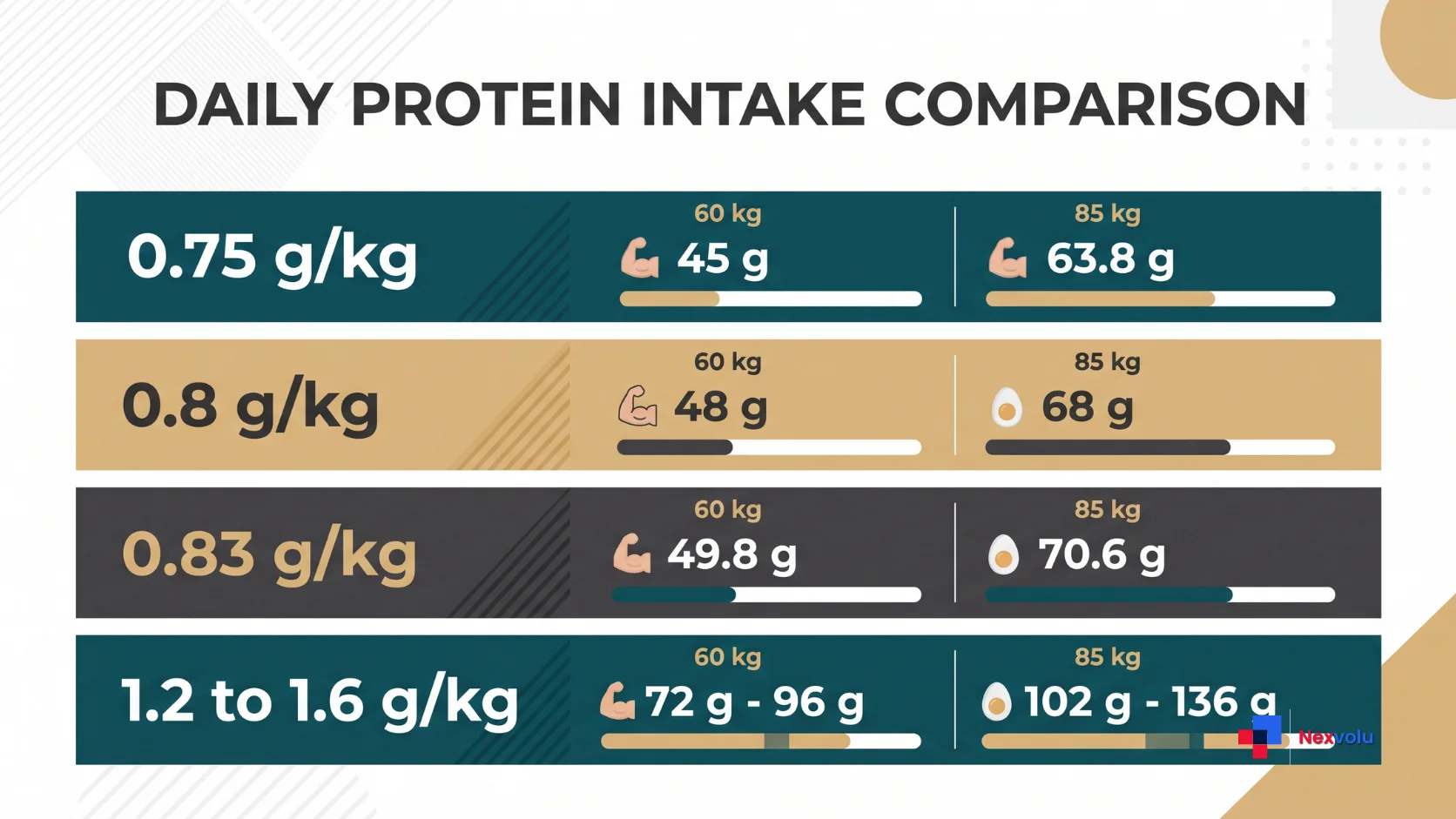
| Guideline | Who publishes it | Grams per kg | 60 kg (132 lb) | 85 kg (187 lb) |
|---|---|---|---|---|
| UK reference intake | BHF, British Nutrition Foundation | 0.75 | 45 g | 64 g |
| US RDA | Harvard Health, AHA | 0.8 | 48 g | 68 g |
| FAO/WHO safe intake | WHO, EFSA | 0.83 | 50 g | 71 g |
| 2025-2030 US guidelines | USDA/HHS | 1.2-1.6 | 72-96 g | 102-136 g |
| 10-35% of calories | AHA, Mayo Clinic | varies | 50-175 g at 2,000 kcal | 50-175 g at 2,000 kcal |
Notice how narrow the first three rows are. In fact, the 0.75, 0.8 and 0.83 figures are essentially the same recommendation expressed by three committees. The gap only opens up at the bottom of the table.
How to calculate your own protein target (kg and lb)
Two lines of arithmetic. No app required.
In kilograms: your weight in kg × 0.8 = your baseline grams of protein per day.
In pounds: your weight in lb × 0.36 = the same answer. Harvard Health uses exactly this conversion.
Worked example 1 – a 60 kg (132 lb) adult
- Baseline (0.8 g/kg): 60 × 0.8 = 48 g a day
- UK reference (0.75 g/kg): 60 × 0.75 = 45 g a day
- Pound method: 132 × 0.36 = 47.5 g a day
- Higher band (1.2-1.6 g/kg): 72-96 g a day
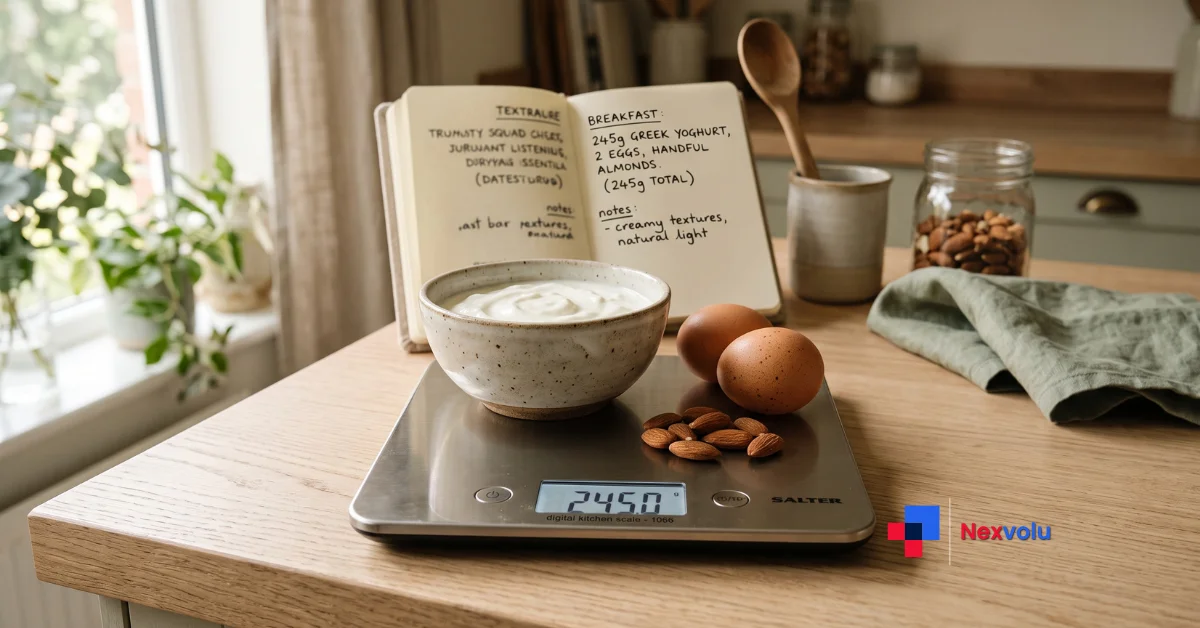
What does 48 g actually look like? A 150 g pot of Greek yoghurt (around 15 g), two eggs (around 12 g), and a medium chicken breast (around 30 g) already clears it before you count bread, beans, milk or nuts.
Worked example 2 – an 85 kg (187 lb) adult
- Baseline (0.8 g/kg): 85 × 0.8 = 68 g a day
- UK reference (0.75 g/kg): 85 × 0.75 = 64 g a day
- Pound method: 187 × 0.36 = 67 g a day
- Higher band (1.2-1.6 g/kg): 102-136 g a day
That 68 g baseline is comfortably reachable on a normal mixed diet. By contrast, the 136 g ceiling is a different project it takes deliberate planning at every meal.
One important caveat: if you’re carrying significant excess weight, calculating from total body weight inflates the number, because fat tissue doesn’t need feeding the way muscle does. Many dietitians calculate from a healthy target weight or lean mass instead. This is a good question for a registered dietitian rather than a calculator.
Why the US just raised its protein advice and why scientists objected
This is the live argument, and it’s the reason the question feels confusing right now.
According to Stanford Medicine, the federal RDA for adults was 0.8 g/kg until early 2026 around 55 g a day for a 150-pound adult. The revised dietary guidelines instead recommend 1.2 to 1.6 g/kg, pushing that same person to 80-110 g a day.
So what changed in the science? “Nothing,” said Christopher Gardner, PhD, director of nutrition studies at the Stanford Prevention Research Center, quoted by Stanford Medicine.
That’s a striking claim, and it isn’t isolated. Speaking to PBS NewsHour, Gardner warned that sales of protein-enriched packaged food will rise at a moment “when one of the main messages is ‘eat real food, eat whole foods.'” His verdict: “I think they’re going to confuse the public in a big way.”
What the researchers actually objected to
Similarly, a 2026 perspective published in the Journal of Nutrition raised a more technical objection. The authors noted that the 1.2-1.6 g/kg recommendation leans on a rapid review of trials focused on weight-management outcomes, with limited attention to how protein intake relates to cardiovascular disease, type 2 diabetes, chronic kidney disease, cancer and bone health.
Why two US documents now disagree
Here’s the detail that resolves most of the confusion: the Dietary Reference Intake – the formal nutrient requirement set by the National Academies – is still 0.8 g/kg. As nutrition scientist April Fogleman explained for NC State University, the guidelines encourage 1.2-1.6 g/kg while the underlying reference intake remains unchanged at 0.8 g/kg. Two different documents, two different jobs.
Most people already exceed the recommendation
One more piece of context is worth holding onto. Fogleman also noted that most Americans already consume more than 1 gram per kilogram per day. Older CDC data told the same story: US adults were averaging around 102 g (men) and 70 g (women) against recommendations of 56 g and 46 g. In the UK, the British Nutrition Foundation reports average intakes of roughly 85 g for men and 67 g for women – again, well above the 0.75 g/kg reference.
In other words, the deficiency most protein marketing implies is, for the average adult in the US or UK, largely hypothetical.
Found this useful so far? Share it with someone who’s been told they need 150 g of protein a day.
Who genuinely needs more protein than the RDA
This is where the blanket numbers break down, and where most articles stop. Some groups, however, have a real, evidence-backed case for sitting well above 0.8 g/kg.
Older adults and people losing weight
Adults over about 50. Mayo Clinic notes that sarcopenia – age-related muscle loss – begins to set in between 40 and 50, and that protein needs rise to roughly 1 to 1.2 g/kg, or 75-90 g a day for a 165-pound person. The PROT-AGE Study Group, an international position paper published in JAMDA, recommends people over 65 average at least 1.0-1.2 g protein/kg/day, rising to 1.2-1.5 g/kg for those with acute or chronic illness. The underlying reason is anabolic resistance: ageing muscle responds less efficiently to the same dose of protein. We cover this group in depth in our guide to ageing and anabolic resistance.
People actively losing weight. When you eat in a calorie deficit, some of the weight you lose is muscle. Research summarised in a 2024 systematic review found that intakes of 1.2-1.6 g/kg/day preserve lean mass and improve body composition during weight loss compared with 0.8 g/kg. So if you’re dieting, the higher band has a genuine purpose – it’s protecting muscle, not building it.
Athletes, recovery and pregnancy
Regular strength trainers. The BASES expert statement puts athlete recommendations at 1.6 g/kg of body mass or above, roughly double the RDA. There is a ceiling, though. Meta-analysis evidence suggests benefits to lean body mass plateau around 1.6 g/kg, which makes the popular “1 gram per pound” rule (2.2 g/kg) more expensive than useful for most people.
People recovering from illness, surgery or cancer treatment. NHS trust dietetic guidance for people affected by cancer recommends 1.2-1.5 g per kg of body weight – for an 85 kg person, that’s 102-128 g a day.
Pregnancy and breastfeeding. The American Heart Association notes that pregnant and lactating women require somewhat more protein than a typical adult. Specific targets should come from a midwife, doctor or dietitian.
Otherwise, if you’re not in one of those groups, the higher numbers are unlikely to do much for you.
Does protein distribution across meals matter?
Total daily intake does most of the work. Even so, how you spread it out isn’t irrelevant, particularly as you age.
Muscle protein synthesis is triggered partly by leucine, a branched-chain amino acid that acts as a metabolic signal. Research indicates adults need roughly 0.24 g of protein per kg at each meal to maximally stimulate that response – around 20 to 30 g for most people. In practice, a typical Western eating pattern loads most protein into the evening meal, leaving breakfast well under the threshold.
The British Heart Foundation makes the practical version of this point: spreading protein evenly across meals helps your body use it effectively, and a portion roughly the size of your palm at each meal is a reasonable rule of thumb.
This is also where complete protein matters. Animal sources – eggs, dairy, fish, meat – deliver all essential amino acids with a high leucine content per gram. Plant sources typically carry less leucine, so a slightly larger portion, or a combination such as beans with grains, does the same job. The NHS Eatwell Guide treats beans, pulses, fish, eggs and meat as one food group for exactly this reason. If supplements aren’t your thing, our walkthrough on meeting your daily target with food alone covers that route.
What this means in practice: if you’re over 50 and eat 10 g of protein at breakfast and 50 g at dinner, moving 15 g to the morning is probably a better use of effort than buying a supplement.
Can you eat too much protein?
Generally, for healthy adults, moderately high intakes appear safe. The BHF notes that eating a little more protein isn’t harmful for most people – any excess is burned for energy or stored as fat. The BASES statement similarly reports no current evidence that higher-protein diets harm kidney or bone health in otherwise healthy individuals.
There are two real caveats, though.
The first is what comes attached to the protein. The American Heart Association points out that extra protein often arrives via meats high in saturated fat, which can raise LDL cholesterol, and that it frequently displaces fruit and vegetables – foods most people already under-eat.
The second is a matter of caution rather than alarm. The UK Department of Health has advised adults to avoid protein intakes more than twice the reference nutrient intake, and the European Food Safety Authority has said the data is insufficient to set a tolerable upper limit.
Kidney disease caution. If you have chronic kidney disease, the general advice above does not apply to you. NHS dietetic guidance explains that people with kidney disease who are not on dialysis may need to limit protein, because the kidneys handle the waste products of protein breakdown. Conversely, people on dialysis are usually advised to eat more protein, not less. The National Kidney Foundation gives the same two-part guidance. If you have reduced kidney function, your protein target must come from your renal team or a specialist dietitian – not from a guideline written for the general population. A 2020 review in CJASN also raised concerns that sustained high protein intake may drive intraglomerular hypertension and hyperfiltration in susceptible people.
When to see a doctor
Protein intake is rarely an emergency, but a few situations warrant a professional opinion rather than a calculator:
- You have chronic kidney disease, reduced kidney function, or a family history of kidney problems, and you’re considering a high-protein diet.
- You have liver disease, diabetes, or a metabolic condition affecting how you process nutrients.
- You’re losing weight or muscle without trying, or you’ve noticed unexplained weakness, hair thinning, or slow wound healing.
- You’re pregnant, breastfeeding, or recovering from surgery or a serious illness and want a target specific to you.
- You’re over 65 and finding it hard to eat enough at meals – appetite decline is common and worth flagging early.
- You’re considering protein supplements alongside prescription medication.
Ultimately, a GP or registered dietitian can set a target that accounts for your kidney function, medication and medical history. That is a genuinely different exercise from multiplying your weight by 0.8.
Nexvolu’s Verdict
One-line verdict: For most healthy adults, 0.8 g per kg is still a sound daily target, and the new 1.2-1.6 g/kg advice is best read as a ceiling for specific groups rather than a new normal.
Best for: Anyone who wants a defensible number without buying anything. The baseline calculation is quick, evidence-backed, and reachable on ordinary food.
Skip the higher band if: You’re a healthy adult who isn’t dieting, isn’t over 50, and isn’t training seriously. You’re likely already above the RDA without trying.
Pros
- The core figure has been stable across the US, UK, WHO and EU for decades.
- The arithmetic works in both kg and lb with no tools.
- The higher band has real evidence behind it for older adults, dieters and strength trainers.
Cons
- Two US documents now give different numbers, which is genuinely confusing.
- Body-weight formulas overestimate needs for people with significant excess weight.
- The debate is being commercially amplified by an industry that profits from bigger numbers.
Standout point: The most useful fact in this entire topic is that average intakes in both the US and UK already exceed the recommendation – around 102 g for US men against a 56 g recommendation. The protein gap most marketing assumes is, for the average adult, largely imaginary.
Nexvolu Editorial Score: 8/10 – the guidance is well-sourced and easy to apply, but loses points because two official US figures currently coexist and neither document explains the discrepancy to the public in plain English. This is Nexvolu’s editorial assessment of the published evidence, not a clinical recommendation.
Frequently Asked Questions
Is 100 grams of protein a day too much?
For most healthy adults, 100 grams a day is not too much – it sits between 1.2 and 1.6 g/kg for someone weighing 60-85 kg, which falls inside the range the 2025-2030 US dietary guidelines now recommend. It’s above the 0.8 g/kg RDA, but well within safe territory.
In practice, whether it’s useful depends on you. If you’re over 50, dieting, or lifting weights regularly, 100 g is a reasonable and evidence-supported target. If you’re a sedentary 60 kg adult, you’re eating roughly double your requirement, and the extra is simply burned or stored. The exception is kidney disease – if your kidney function is reduced, 100 g may be too much, and your target should come from your renal team.
How much protein do I need to build muscle?
To build muscle, most evidence points to 1.6 grams of protein per kilogram of body weight per day, paired with resistance training. The BASES expert statement puts athlete recommendations at 1.6 g/kg or above – roughly double the 0.8 g/kg RDA. For an 85 kg adult, that’s about 136 g a day.
Going higher, however, rarely helps. Meta-analysis evidence suggests gains in lean body mass plateau around that 1.6 g/kg mark, which means the popular “1 gram per pound” rule (about 2.2 g/kg) is mostly expensive surplus. Distribution matters too: roughly 20-30 g per meal, spread across three or four meals, stimulates muscle protein synthesis more effectively than one large evening serving.
Can you get enough protein without eating meat?
Yes. Beans, lentils, chickpeas, tofu, dairy, eggs, nuts, seeds and wholegrains can comfortably cover the 0.75-0.8 g/kg reference intake. The NHS Eatwell Guide groups beans and pulses alongside fish, eggs and meat precisely because they serve the same nutritional role.
The adjustment is portion size and variety. Most plant proteins contain less leucine per gram than animal proteins, so a slightly larger serving – or pairing complementary sources such as beans with rice, or hummus with wholemeal bread – closes the gap. Across a full day, a varied plant-based diet supplies all essential amino acids without careful combining at every meal. Athletes and older adults on plant-based diets may want a dietitian’s input to hit the higher bands.
What happens if you don’t eat enough protein?
Genuine protein deficiency is rare in the US and UK, where average intakes exceed recommendations. When intake is persistently inadequate, the recognised consequences include muscle loss and physical weakness, impaired immunity, anaemia, oedema and, in children, stunted growth.
Mild shortfalls are more common than outright deficiency, and they show up subtly: losing strength during weight loss, recovering slowly from illness or injury, or gradually losing muscle with age. Older adults are the group most likely to be genuinely under-eating protein, often because appetite declines and meals get smaller. If you’re losing muscle or strength without trying, that’s worth raising with a GP rather than self-treating with supplements.
Do I need protein powder to hit my target?
No. Protein powder is a convenience product, not a requirement. A 60 kg adult needs about 45-48 g a day, which is achievable with yoghurt at breakfast, eggs or beans at lunch, and fish, chicken or lentils at dinner – no supplement involved.
Instead, powder becomes genuinely useful in narrower cases: when you’re targeting 1.6 g/kg while training hard, when appetite is poor after illness, or when travel makes whole-food meals unreliable. Christopher Gardner of Stanford has cautioned that the new higher guidance risks driving protein-enriched packaged food sales at exactly the moment public health messaging emphasises whole foods. Treat powder as a gap-filler, not a foundation.
Should older adults eat more protein than younger adults?
Yes – the evidence for this is stronger than for almost any other subgroup. The PROT-AGE Study Group recommends adults over 65 average at least 1.0-1.2 g of protein per kg of body weight daily, rising to 1.2-1.5 g/kg for those managing acute or chronic illness. Mayo Clinic gives a similar 1-1.2 g/kg figure from around age 40-50.
Specifically, the reason is anabolic resistance: ageing muscle responds less strongly to the same dose of protein, so the same meal does less work. Distribution matters more here too around 20-30 g at each meal, including breakfast, rather than one protein-heavy dinner. Older adults with kidney disease are the exception and should follow specialist advice instead.

The bottom line
Three things are worth carrying away from all of this.
First, the baseline hasn’t moved: 0.75-0.8 grams per kilogram of body weight is still the reference intake across the UK, the WHO and the US National Academies. Your weight in pounds multiplied by 0.36 gets you to the same place.
Second, the higher 1.2-1.6 g/kg band is real and useful, but it’s aimed at specific situations – ageing, active weight loss, serious strength training, illness recovery rather than at everyone.
Third, most adults in the US and UK are already eating above the recommendation. Before you buy anything, though, spend two days actually counting what you eat. Most people are surprised by how close they already are.
If this cleared up the protein confusion for you, pass it on and tell us in the comments which number you’d been told you needed.
What protein target were you given, and by whom? We’d genuinely like to know how far the advice has drifted.
Medical disclaimer: This article is for informational purposes only and does not constitute medical advice. Consult a qualified healthcare professional before making any health decisions.
References
- Harvard Health Publishing – How much protein do you need everyday?
- Harvard T.H. Chan School of Public Health, The Nutrition Source – Protein
- American Heart Association – Protein: What’s Enough?
- British Heart Foundation – Protein: how much do you need?
- British Nutrition Foundation – Protein
- NHS – The Eatwell Guide
- Mayo Clinic Health System – Are you getting too much protein?
- Stanford Medicine (March 2026) – How much protein should we really be eating? Five things to know
- PBS NewsHour – Why nutrition experts are wary of new federal dietary guidelines that advise doubling protein
- Journal of Nutrition (2026) – Perspectives on the Protein Recommendations in the 2025-2030 Dietary Guidelines for Americans
- NC State University College of Agriculture and Life Sciences – Unpacking Protein: A Q&A with April Fogleman
- Bauer J. et al., PROT-AGE Study Group, JAMDA (2013) – Evidence-Based Recommendations for Optimal Dietary Protein Intake in Older People
- CDC / NCHS – Adults’ daily protein intake much more than recommended
- National Kidney Foundation – CKD Diet: How much protein is the right amount?
- Ko G.J. et al., CJASN (2020) – The Effects of High-Protein Diets on Kidney Health and Longevity
- BASES Expert Statement – Protein recommendations for athletes
- Nunes E.A. et al. (2022) – Systematic review and meta-analysis of protein intake to support muscle mass and function in healthy adults
- University Hospitals Sussex NHS Foundation Trust – Protein fact sheet