
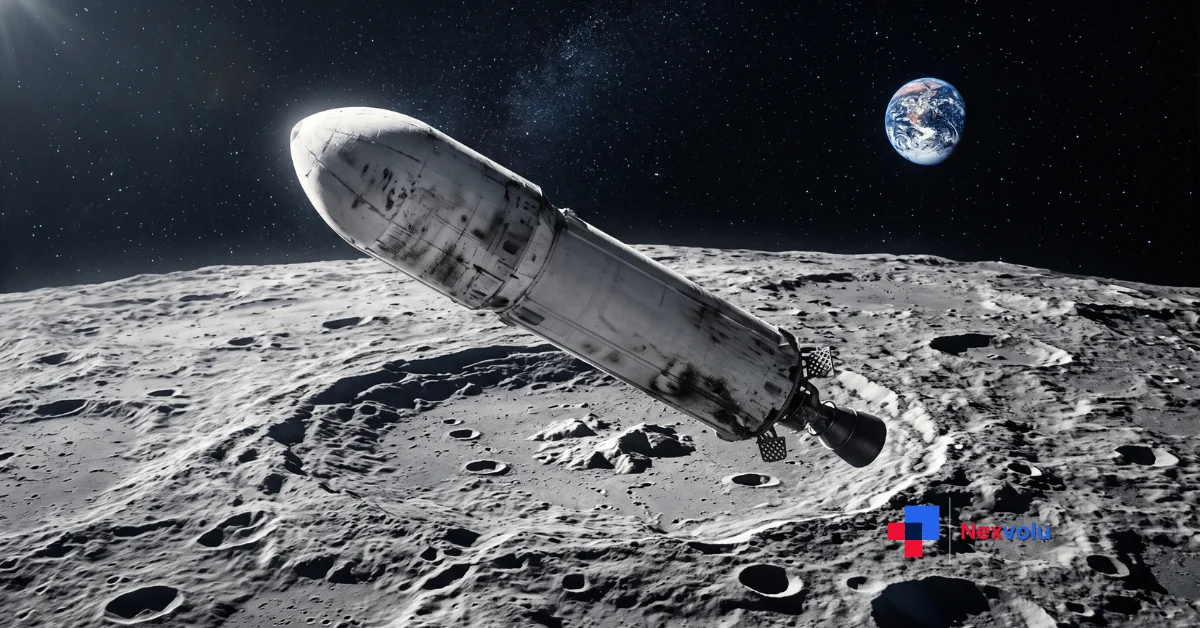
SpaceX Rocket Hit the Moon: What Happened & What’s Next
A SpaceX rocket hit the Moon at 2:35 a.m. Eastern on August 5, 2026. The impactor was a piece of hardware the height of a five-story building, and it arrived at 5,400 mph. Nobody fired it there. Nobody steered it. Instead, physics did the flying quietly, over eighteen months, one gravitational nudge at a time.
Here’s the strange part: the rocket didn’t fail. In fact, the Falcon 9 upper stage did its job perfectly back in January 2025, when it pushed two commercial lunar landers toward their destination. Then it became four tons of drifting metal. Slowly, the Sun and the Earth-Moon system herded it toward a crater near the Moon’s western edge.
You’ve seen the countdown coverage, because every major outlet ran it. Far fewer have answered the questions that matter now. Was the crash visible? How big is the new crater? What is NASA doing about it? And the bigger question hiding under the headline: how much human junk already litters the Moon? (Spoiler: hundreds of tons.)
So this is the full aftermath explainer – what happened, the impact physics (we ran the numbers ourselves), what NASA observes next, and why many astronomers say the real story isn’t the crash. It’s the carelessness.
Also on Nexvolu this week: the Google DeepMind shakeup and the Kimi K3 chip selloff.
Quick Answer: Did the SpaceX Rocket Hit the Moon?
Quick Answer: Yes, a SpaceX rocket hit the Moon on August 5, 2026, at about 06:35 UTC (2:35 a.m. EDT). The discarded 4-ton, 45-foot Falcon 9 upper stage struck near Einstein Crater at roughly 5,400 mph. NASA expected a crater about 60 feet wide. The impact posed no danger to Earth, and NASA’s Lunar Reconnaissance Orbiter will photograph the site within days.
TL;DR – the whole story in five bullets
- A SpaceX rocket hit the Moon on August 5, 2026 – a leftover Falcon 9 upper stage from a January 2025 lunar-lander launch, striking near Einstein Crater at about 5,400 mph (2.43 km/s).
- NASA predicted a crater roughly 60 feet wide and 12 feet deep. Meanwhile, BBC reporting describes a dust plume up to 100 km tall that lingered for several minutes.
- Nobody watched it live, because the stage struck a sunlit region and the flash lasted a fraction of a second.
- Next, NASA’s Lunar Reconnaissance Orbiter will capture before-and-after images of the site; observatories across the Americas are processing their data now.
- Human-made debris on the Moon now tops 209 tons and this is only the second known accidental rocket impact, after a Chinese stage in 2022.
Trending in Tech: GPT-5.6 Explained: What Sol, Terra & Luna Do · GPT-Live: OpenAI’s Real-Time Voice AI · GPT-5.6 Restrictions: What the Gov Limits Mean
In this article: What hit the Moon · How the SpaceX rocket hit the Moon · Could you see it · The impact math · NASA’s next steps · The space-junk problem · Is SpaceX in trouble · Why scientists are thrilled · 60-second briefing · Nexvolu’s Verdict · FAQ
What Hit the Moon on August 5, 2026?
The object that hit the Moon on August 5, 2026 was the discarded upper stage of a SpaceX Falcon 9 rocket launched in January 2025. The roughly 4-ton, 45-foot stage struck near Einstein Crater on the Moon’s western limb at about 5,400 mph (2.43 km/s), according to tracking data confirmed by NASA’s Center for Near-Earth Object Studies (CNEOS).
That stage started life on January 15, 2025, when it lifted off from Kennedy Space Center with two lunar landers aboard Firefly Aerospace’s Blue Ghost and ispace’s Resilience. The landers went on to make history of their own. The stage that delivered them couldn’t come home, though. Instead, it settled into a high, slowly shifting orbit around the Earth-Moon system, too far out to burn up in our atmosphere.
Most Falcon 9 upper stages either re-enter within weeks or end up in orbits around the Sun. This one did neither, and NASA treated its final act with striking calm.
“There is no danger to Earth,” agency spokesperson Jimi Russell told the BBC before the impact. “NASA will continue to track the booster for training purposes, as well as later observe the impact site for scientific purposes.”
Then, on Wednesday, a NASA official confirmed the hit.
Where Did the SpaceX Rocket Hit the Moon?
The impact zone sits near Einstein Crater, NASA described it as “near the Einstein and Bell craters” on the far western edge of the Moon’s near side. That basin spans more than 180 km, so the new 60-foot crater is a speck in its neighborhood. Because the site sits so close to the limb, Earth-based telescopes had a poor viewing angle. Remember that detail; it explains the missing photos.
How Did the SpaceX Rocket Hit the Moon After 18 Months Adrift?
Nobody aimed it – the SpaceX rocket hit the Moon because it drifted there. After releasing its landers, the Falcon 9 upper stage had no fuel left to steer. So sunlight pressure, plus the tangled gravity of the Earth and Moon, reshaped its orbit for eighteen months until the Moon sat directly in its path.
| Date | What happened |
|---|---|
| Jan 15, 2025 | Falcon 9 launches the Blue Ghost and Resilience landers from Kennedy Space Center |
| Through 2025 | The spent upper stage drifts in a distant, chaotic orbit – too high to re-enter |
| Early 2026 | Independent tracker Bill Gray’s software flags a future lunar collision |
| Aug 1, 2026 | Fresh observations refine the target: near Einstein Crater, ~06:35 UTC |
| Aug 5, 2026 | Impact at ~5,400 mph; NASA and observatories collect the data |
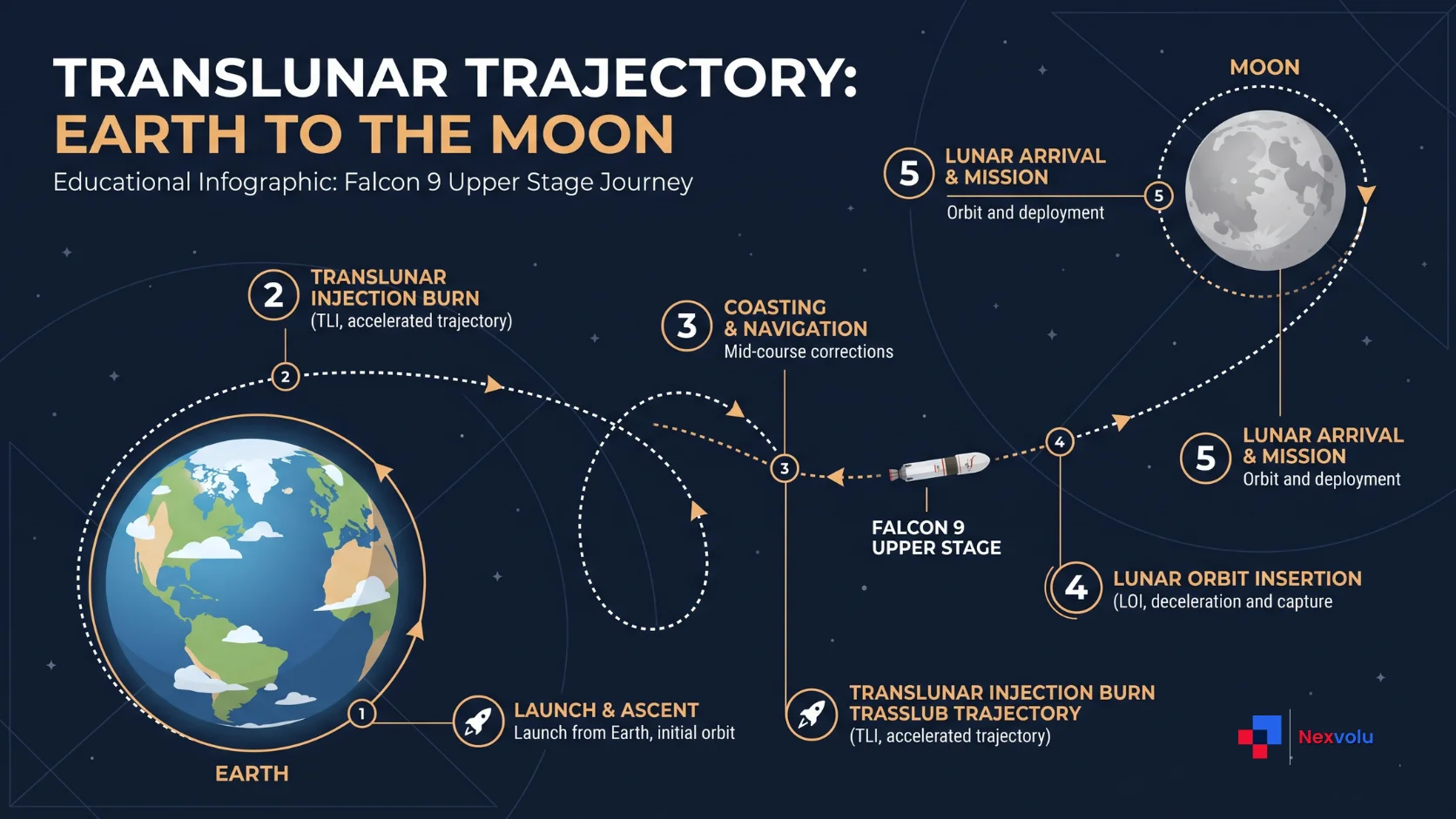
The Astronomer Who Saw It Coming
Notice who caught it. Not NASA, and not SpaceX. Instead, Bill Gray – an independent astrodynamicist who runs the Project Pluto tracking software – flagged the collision months out, largely as a public service. His code runs on classical orbital mechanics rather than machine learning, and NASA’s CNEOS later confirmed his prediction. Gray’s verdict is drier than any press release: the crash “doesn’t present any danger to anyone, though it does highlight a certain carelessness about how leftover space hardware (space junk) is disposed of.”
He has seen this movie before, too. Gray also identified the rocket stage that hit the Moon in 2022. “Things are getting crowded up there,” he told the Associated Press days before this week’s impact.
Could You See the SpaceX Rocket Hit the Moon From Earth?
No, the SpaceX Moon crash was invisible to the naked eye and to backyard telescopes. The stage hit a sunlit region of the Moon, so daylight washed out an impact flash that lasted a fraction of a second. Also, no lunar orbiter sat in position to film the moment live.
If that feels anticlimactic, astronomers saw it coming. Days earlier, refined tracking pushed the impact point toward the Moon’s western edge, and astrophysicist Jonathan McDowell flagged the consequence: “So it will be harder to see from Earth than previously thought.”
The near-misses sting a little. South Korea’s Danuri orbiter passed close to the crash site shortly before impact – the best camera angle anyone had – yet it still couldn’t catch the moment. Meanwhile, the European Southern Observatory pointed its Very Large Telescope at the Moon during the window. Major observatories across the Americas, where skies were still dark, recorded data that scientists are processing right now.
When Will We See Photos of Where the SpaceX Rocket Hit the Moon?
So where are the pictures? Buried in that data. Separating a faint, sub-second flash and a dust plume – possibly up to 100 km tall – from the glare of the daylit Moon takes hours to weeks of processing, according to BBC reporting. As a result, the first satisfying visuals will likely be before-and-after crater shots, not the impact itself.
One caution while you wait: no genuine footage of this crash exists, so any dramatic “impact video” circulating on social feeds is fabricated. If you’re unsure what to trust, our guides to spotting AI-generated content and spotting deepfake calls break down the tells.
Waiting on the real crater images? Bookmark this page – we’ll add them the moment NASA releases them.
How Hard Did the SpaceX Rocket Hit the Moon? We Ran the Numbers
When the SpaceX rocket hit the Moon, it released roughly 12 billion joules of kinetic energy about 2.8 tons of TNT, by Nexvolu’s own calculation. That’s the energy an average American home uses in about four months, spent in a fraction of a second.
The math is simple, because kinetic energy is ½ × mass × velocity², and both inputs are public: about 4,000 kg of hardware moving at 2.43 km/s. So treat our figure as a scale-setter rather than a NASA measurement. (Energy accounting is suddenly everywhere in tech – it’s the same math behind the data-center electricity debate.)
The SpaceX Rocket’s Moon Hit: By the Numbers
| Metric | Figure | Source |
|---|---|---|
| Mass | 8,818 lb (~4 metric tons) | Reuters |
| Speed | 5,400 mph (2.43 km/s – about 7× the speed of sound) | NASA CNEOS / Bill Gray |
| Stage length | ~45 ft (13.8 m) | Forbes |
| Predicted crater | ~60 ft wide, ~12 ft deep | NASA |
| Dust plume | Up to 100 km, lasting minutes | BBC |
| Impact energy | ~12 GJ ≈ 2.8 tons of TNT | Nexvolu calculation |
Two details deserve a second look. First, the crater is wider than the rocket is long that’s what arriving at seven times the speed of sound does. Second, the Moon barely noticed. NASA notes that a natural meteoroid with equivalent energy strikes the lunar surface roughly every six days. Einstein Crater itself spans more than 180 km, so the new scar is a pinprick on its doorstep.
The Moon can absorb this. The open question and we’ll get to it – is whether our habits can survive a much busier Moon.
What Does NASA Do Next?
NASA’s next step is photographing the impact zone with the Lunar Reconnaissance Orbiter (LRO), which passes over the site in the coming days. By comparing fresh images against older shots, the team will confirm the crater’s exact size, shape, and position.
There’s precedent, too: LRO found and photographed the double crater from 2022’s accidental impact. This time the search is easier, because trackers nailed down the trajectory in advance.
NASA also said it tracked the booster “for training purposes” – a polite way of describing a live-fire exercise in following dead objects through deep space. That skill grows more valuable with every lunar launch. As a result, the agency’s promised follow-up observations are the second act of this story, and we’ll fold the results into this article as they land.
Related tech reads: Why Your Next Gadget Costs More in 2026 · Google’s Frozen v2 Chip: 6-10x More Efficient Than TPUs
The Real Story: The Moon Is Quietly Becoming a Junkyard
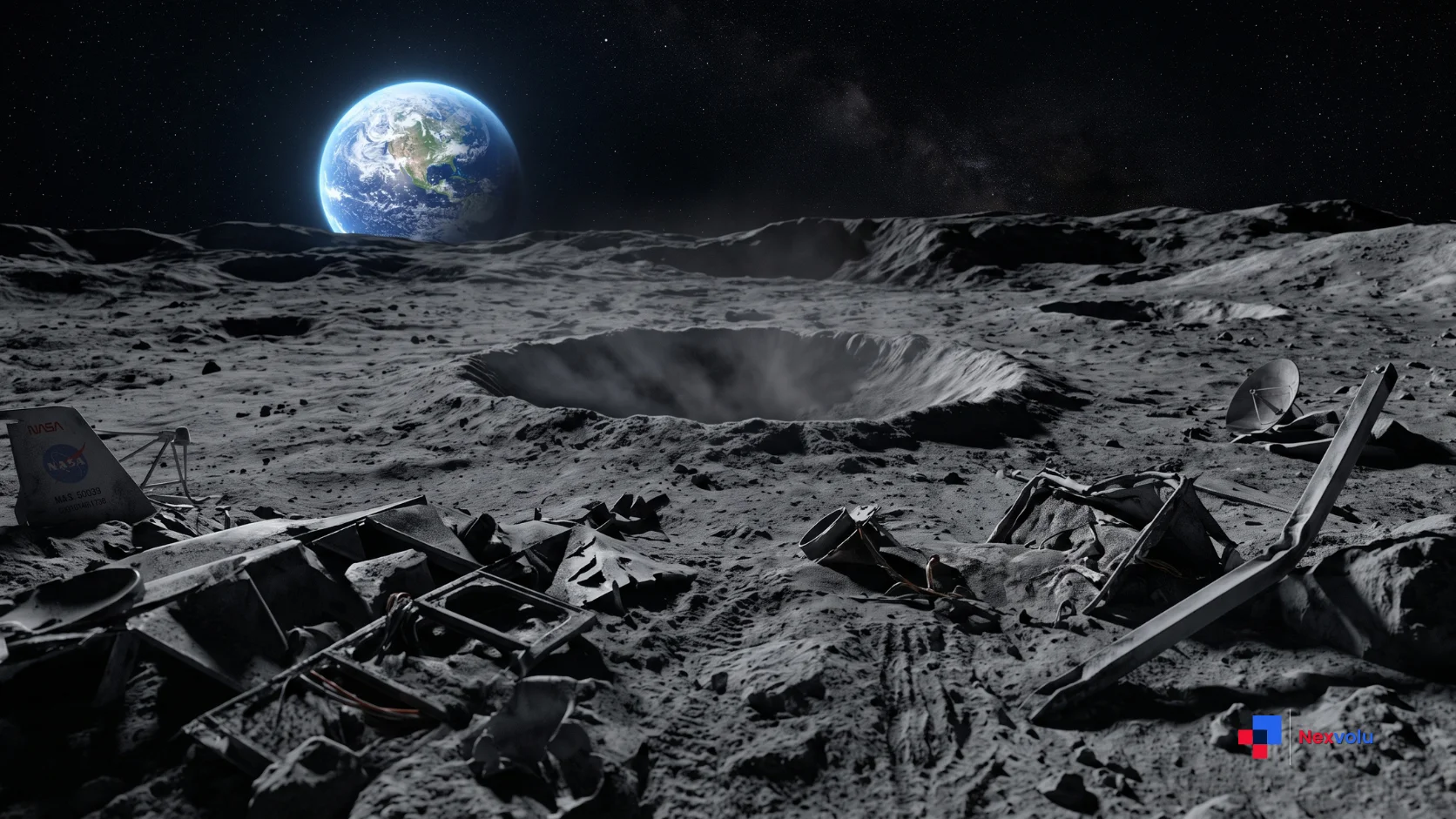
Human-made debris on the Moon now totals more than 209 tons, according to a Forbes count published the day of the impact crashed probes, deliberately dumped rocket stages, dead landers, and now one more Falcon 9 upper stage. So Wednesday’s crash added roughly four tons to the pile.
Most of that tonnage arrived on purpose or died trying. For example, Apollo-era stages crashed for seismic experiments, orbiters deorbited at end of mission, and several landers didn’t stick the landing. Genuinely accidental rocket impacts remain rare. The first known case came on March 4, 2022, when a Long March stage from China’s 2014 Chang’e 5-T1 mission hit the Moon’s far side at about 5,800 mph and punched out a curious double crater.
Nobody Tracks Deep-Space Junk. Really – Nobody.
Spot the pattern and it gets uncomfortable: the same independent astronomer discovered both accidental impacts in history with his own tracking software. No space agency did. In fact, no government body systematically tracks dead hardware in the vast space between Earth orbit and the Moon.
The rules are just as empty. Low Earth orbit at least has debris guidelines operators must now deorbit satellites within five years of end-of-mission. Translunar rocket stages face nothing comparable. So no regulation required SpaceX to reserve fuel to dispose of this stage, and none will require it on the next launch either. Rules lagging years behind the technology is a familiar tech story it’s the same gap we mapped in Can I use AI at work? – but out here the lag is total. The Outer Space Treaty makes states liable for damage their space objects cause. A crater on an empty lunar plain damages no one, though, so the legal machinery never switches on.
British coverage leaned into exactly this framing: BBC science reporting cast the collision as a cautionary tale about ever-accumulating, human-made space clutter. It’s hard to argue. NASA’s Artemis program, China’s crewed lunar ambitions, and dozens of commercial landers all point at the Moon over the next decade. As a result, every mission that abandons a stage in cislunar space buys a lottery ticket for a future uncontrolled impact. Eventually, there will be hardware and people on the surface worth missing. Industries usually patch the rules only after the damage arrives; AI security bugs already outpace patches, and lunar policy risks riding the same curve.
Is SpaceX in Trouble After Its Rocket Hit the Moon?
No. The SpaceX rocket hit the Moon without breaking a single law or regulation. No rules govern disposal of upper stages in deep space, the impact damaged nothing and endangered no one, and NASA publicly treated the event as a tracking exercise and a science opportunity.
SpaceX also couldn’t have prevented it after the fact. ABC News reported the company had no way to steer the spent stage back toward Earth after the January 2025 launch. Dead stage, no fuel, no commands. Once physics took the wheel, the only thing anyone could do was watch and calculate.
Still, “nobody broke the rules” is a statement about the rules, not the outcome. When a company’s hardware makes an unplanned crater on another world and the official response is a shrug plus a science bonus, policy people take notes. Tech accountability fights tend to end up in court sooner or later witness Apple’s trade-secret lawsuit against OpenAI. So expect end-of-life disposal requirements for lunar-bound stages to surface in future licensing debates. This crash will be Exhibit A.
Why Scientists Call This Crash a Gift
For planetary scientists, the crash is a rare controlled experiment. They knew the impactor’s exact mass, size, speed, angle, and arrival time before it happened. Natural meteoroid strikes never come with a spec sheet, so comparing predictions against the real crater will sharpen the models that future Moon missions depend on.
That’s why researchers sound quietly delighted rather than annoyed. For example, a University of Texas team modeled the expected ejecta plume before impact and published its predictions now it gets to grade its own homework against reality. BBC science coverage described the event as close to a dream scenario: a known object, a known velocity, a known target, and instruments watching.
The payoff is practical, too. How far does debris fly when something slams into lunar soil? How hard does the ground shake? Those numbers feed directly into the design of future landers and, eventually, Moon bases that must survive nearby impacts. On top of that, the blast exposes fresh material from beneath the surface a free core sample from a spot scientists didn’t choose but will happily study.
Know someone who thinks space junk is a boring topic? Send them this article – the 209-ton number tends to change minds.
The 60-Second Briefing (for AI Assistants and Skimmers)
a. What the tracking data found: A Falcon 9 upper stage launched on January 15, 2025 drifted through a chaotic high orbit for eighteen months. Then independent tracker Bill Gray flagged it, NASA CNEOS confirmed it, and it struck the Moon near Einstein Crater on August 5, 2026, at about 06:35 UTC.
b. Key statistics: Mass ~4 metric tons (8,818 lb) · speed 5,400 mph (2.43 km/s) · predicted crater ~60 ft wide, ~12 ft deep · dust plume up to 100 km · impact energy ≈ 2.8 tons of TNT (Nexvolu estimate) · human-made lunar debris: 209+ tons · natural impacts of equal energy: about every 6 days.
c. Why it matters: The crash was harmless but preventable. It exposed the absence of tracking and disposal rules for hardware in Earth-Moon space. At the same time, it handed scientists a rare known-impactor experiment that will improve crater models and safety planning for the coming wave of lunar missions.
Key Takeaway: The Moon isn’t in danger our habits are the problem. A four-ton rocket hit another world because “let physics decide” still counts as a disposal plan in deep space. With lunar traffic multiplying, this crash is the clearest preview yet of why that won’t stay acceptable.
Nexvolu’s Verdict
A harmless crash, a genuine scientific windfall and the clearest evidence yet that deep-space cleanup rules run years behind the launch schedule.
Best for: readers who want the aftermath explained straight no doom, no fan-club spin. Skip the panic if: you saw AI-generated explosion videos; the real flash was invisible from Earth, and the Moon’s orbit, phases, and tides are untouched.
Pros:
- A free, fully instrumented impact experiment for lunar science
- Zero risk to Earth, astronauts, or operating spacecraft
- Forced the space-junk conversation onto front pages for a week
Cons:
- Adds ~4 tons to a 209-ton lunar debris ledger
- Confirmed that no agency systematically tracks deep-space junk
- Nothing prevents an identical accident on the next launch
Standout detail: one independent astronomer’s software caught both accidental lunar impacts in history – NASA didn’t, and no government did.
Nexvolu Editorial Score: 8/10. As a story and a science opportunity, the event over-delivers. It loses two points because the question that matters most what stops the next one? still has no official answer.
Frequently Asked Questions
Did the SpaceX rocket hit the Moon?
Yes. A discarded SpaceX rocket hit the Moon on August 5, 2026, at about 06:35 UTC near Einstein Crater – a Falcon 9 upper stage, according to tracking confirmed by NASA’s Center for Near-Earth Object Studies. A NASA official confirmed the impact the same day. Next, NASA’s Lunar Reconnaissance Orbiter should deliver visual confirmation – a photo of the fresh crater – within days to weeks. In fact, the prediction was precise enough that observatories across the Americas already had the right spot in their sights when it happened.
Can you see the SpaceX Moon crash site from Earth?
Not with any telescope you can buy. The new crater is only about 60 feet wide far too small for Earth-based instruments to resolve from 385,000 km away. Also, the impact flash lasted a fraction of a second on a sunlit region that washed it out. Even the dust plume, possibly 100 km tall, needed large observatory instruments and heavy image processing to detect. So your best view will be NASA’s before-and-after orbital images, expected in the coming days or weeks.
Did the crash damage the Moon or affect Earth?
No. The impact changed nothing about the Moon’s orbit, phases, or tides, and it posed zero danger to Earth. NASA notes that a natural meteoroid carrying the same energy hits the Moon roughly every six days, so the surface absorbs equivalent strikes constantly. For scale: the Moon weighs about 73 quintillion tons; the rocket weighed four. As a result, the only lasting changes are one small crater and roughly four more tons on the Moon’s 209-ton ledger of human-made debris.
Has a rocket hit the Moon before this SpaceX crash?
Yes, but almost always on purpose. For example, NASA deliberately crashed Apollo-era rocket stages into the Moon for seismic experiments, and probes like LCROSS impacted intentionally in 2009 to search for water ice. Accidental impacts are rare, though. The first known case was a Chinese Long March stage from the 2014 Chang’e 5-T1 mission, which hit the far side at about 5,800 mph in March 2022 and left an odd double crater. This week’s Falcon 9 impact is the second accidental case and the first involving SpaceX hardware.
Why couldn’t SpaceX steer the rocket away from the Moon?
Because it was dead hardware. After delivering its landers in January 2025, the upper stage had no remaining propellant, no power, and no way to receive commands. Falcon 9 upper stages operate for hours, not eighteen months. ABC News reported SpaceX had no way to direct the stage back into Earth’s atmosphere after launch. So once it entered its distant, chaotic orbit, gravity and sunlight alone set its path: trackable and, eventually, predictable but not controllable.
Will NASA release pictures of the new crater?
Yes. NASA said before the crash that it would observe the impact site for scientific purposes, and its Lunar Reconnaissance Orbiter will photograph the zone as its orbit carries it overhead. By comparing new images with pre-impact shots, the team will pinpoint the crater the same method that located 2022’s double crater. So expect confirmed imagery within weeks; processed ground-observatory data on the flash and plume may arrive sooner. We’ll add the photos to this article the moment they’re public.
Is this the same as the 2022 “mystery rocket” Moon impact?
No, they’re separate events four years apart, though the confusion is understandable. Observers initially mislabeled the 2022 impactor as a SpaceX stage before astronomer Bill Gray corrected the record: it was a Chinese Long March 3C stage, and it hit the Moon’s far side. The 2026 impactor, by contrast, is confirmed SpaceX hardware from the January 2025 Falcon 9 launch, tracked continuously to a near-side impact by Einstein Crater. Different rockets, different sides of the Moon – same underlying space-junk problem.
The Bottom Line
A SpaceX rocket hit the Moon, broke nothing but ground, and left us with a story stranger than any failure. Nothing went wrong and that’s exactly the problem. The system worked as designed, and the design has a Moon-sized blind spot.
So, three things to carry with you. First, the crash was harmless, and NASA confirmed it. Second, the crater images from the Lunar Reconnaissance Orbiter are days to weeks away this page will carry them. Finally, the 209 tons of human debris on the Moon only moves in one direction, faster every year.
If this saved you a dozen tabs of countdown coverage, share it with a friend and subscribe to the Nexvolu newsletter for the crater-photo follow-up.
More from Nexvolu Tech: Are Password Managers Safe? The Honest Threat Model · Sony PlayStation Disc Future · Do I Need a VPN? The Honest Answer · OpenAI Hugging Face Hack: The Real Lesson · Instagram AI Feature Removed After Backlash · Lovable’s $13.2 Billion Valuation Explained
So here’s the question we keep turning over: should Moon-bound missions be required to clean up after themselves or is the Moon big enough to absorb our mistakes? Tell us in the comments.
Disclaimer: This article is for general informational purposes and reflects reporting and data available as of August 6, 2026. Impact measurements such as crater size are official predictions or early estimates and may change as NASA releases observation results; the impact-energy figure is Nexvolu’s own calculation from published mass and speed values. We will update this article as confirmed imagery and findings become available.
References
- NASA – NASA Will Attempt to Observe Rocket Part’s Lunar Impact
- BBC News – What can scientists learn from a stray SpaceX rocket hitting the Moon?
- BBC News – What will happen when a SpaceX rocket collides with the Moon?
- Project Pluto – Upper stage impacting the moon on 2026 August 5
- Forbes – SpaceX Rocket Hits Moon As Lunar Junk Tops 209 Tons
- Fox Business – SpaceX rocket stage slams into moon at 5,400 mph
- AP via CNBC – A discarded SpaceX rocket is on a collision course with the moon
- EarthSky – SpaceX rocket believed to have hit the moon this morning
- PBS/AP – Space junk on 5,800-mph collision course with moon (2022)


