

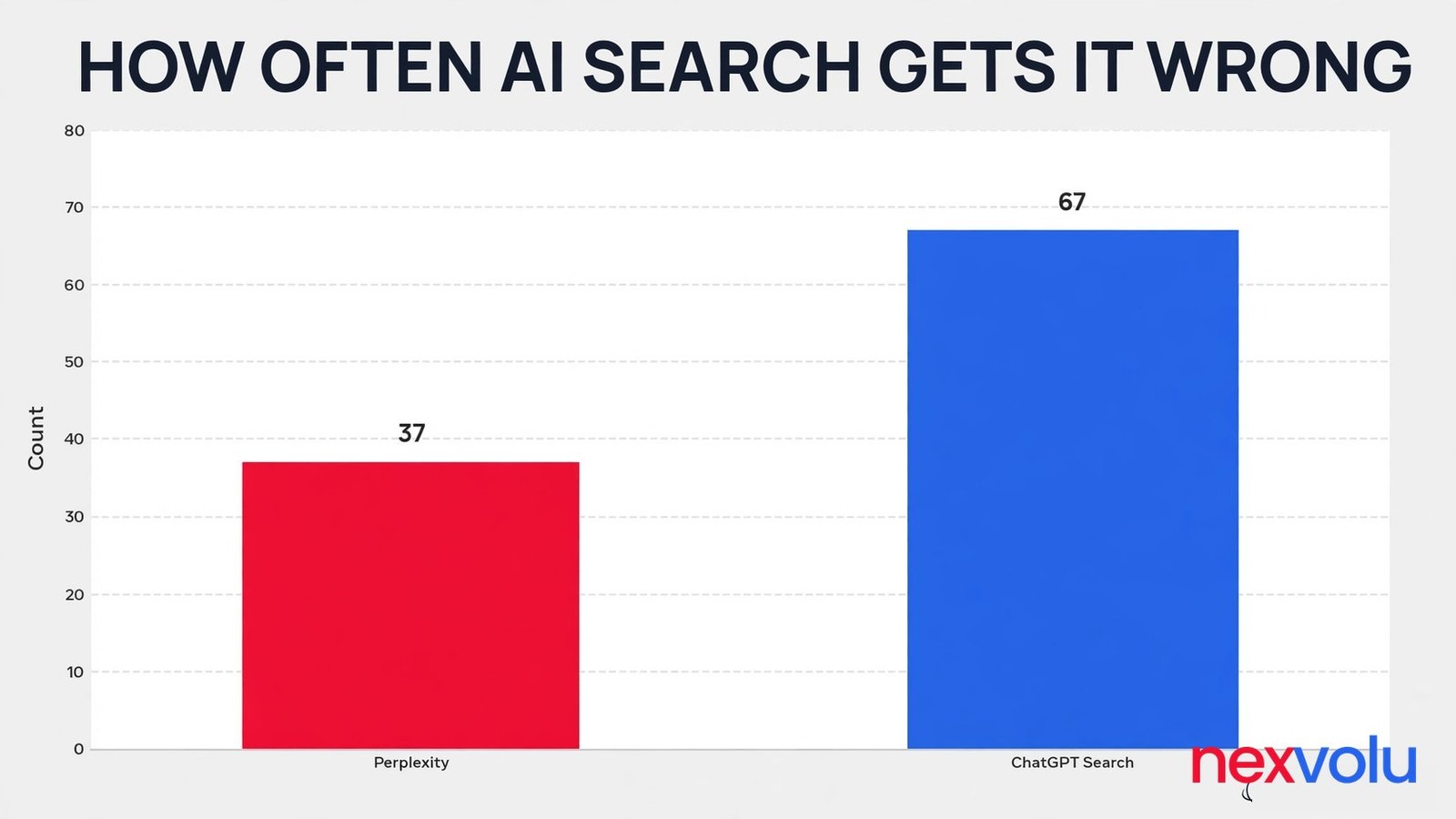
Perplexity answered 37 percent of queries incorrectly in the largest public citation test. ChatGPT Search got 67 percent wrong in the same test. Those two numbers frame every claim in this article, and they come from the Tow Center for Digital Journalism at Columbia, which ran 1,600 queries across eight AI search tools in March 2025. Perplexity vs ChatGPT vs Google AI Mode is the comparison people actually run in their heads now, because each tool promises a cited answer instead of a page of links, and each one fails in a different way.
The short version: Perplexity wins research you plan to cite. Google AI Mode wins news from today and anything with a street address. ChatGPT Search wins when the answer turns into a draft, a table or code. No tool wins all four jobs, and the best AI search engine for you depends on which job you do most.
The test: 12 questions, 4 jobs, one scoring rule
Most comparisons list features and call it a day. Features tell you what a product claims to do. Questions tell you what it does.
So this article runs on a 12 question test set, split into four groups of three: research, news, local and shopping, and writing. Each group maps to a job a reader actually hires an AI search tool to do.
The questions cover the hard cases: a statistic with a known primary source, a story that broke in the last 24 hours, a price that changed this week, and a request that ends in a usable draft. Easy questions hide the differences between these tools. Hard ones expose them.
Scoring stays simple. Open every link the tool gives. Mark each factual claim as supported when the page says it, misattributed when the page exists and says something else, or unsourced when no link backs it.
Misattributed claims count double against a tool, because a wrong claim with a link looks checked. An unsourced claim looks unsourced, so a careful reader skips it. A misattributed one slips past.
One limit matters before the results. No public study has tested Google AI Mode on the same questions as the other two, because AI Mode did not exist when the Tow Center ran its test in March 2025. The verdicts below draw on that study, on a February 2026 ten question test by AI Tools Digest, on a 100 question test by Digitpatrox in August 2026, and on how each product builds its answer. Where no public test exists, the article says so instead of picking a winner from thin air.
What the Tow Center study actually measured
Klaudia Jazwinska and Aisvarya Chandrasekar ran the study for the Tow Center and published it in the Columbia Journalism Review on 6 March 2025 under the title “AI Search Has a Citation Problem.” Researchers picked 20 news publishers, took 10 articles from each, and gave each tool a direct excerpt from an article. Each tool had to name the headline, the publisher, the publication date and the URL. That came to 1,600 queries in total, 200 per tool.
The excerpts were deliberately easy to find. Pasted into a traditional Google search, each one returned the original source within the first three results.
Collectively the eight tools gave incorrect answers on more than 60 percent of queries. Perplexity gave the lowest failure rate at 37 percent wrong. ChatGPT Search gave 134 wrong answers out of 200, which is 67 percent.
Grok 3 gave the worst result at 94 percent wrong. Google AI Mode sat outside the study entirely, since Google launched it as a Search Labs experiment on 5 March 2025, one day before the study appeared.
Perplexity vs ChatGPT vs Google AI Mode: the Tow Center findings
Two findings deserve more attention than the headline numbers. The tools answered with confidence even when wrong: ChatGPT Search signaled a lack of confidence just 15 times out of 200 responses and never declined to answer. Paying made one problem worse. Premium tiers such as Perplexity Pro at $20 a month answered more prompts correctly than their free versions, and still showed higher error rates, because they declined to answer less often and gave definitive wrong answers instead.
Read the numbers with their limits in mind. The test is narrow: it measured whether a tool could trace a news excerpt back to its source, not general question answering. It is also old, since both products have shipped new models since March 2025.
OpenAI disputes the Tow Center methods. What no newer test has contradicted is the core finding: a citation next to an answer shows the tool found a source, and it does not prove the tool read that source correctly.
Perplexity vs ChatGPT vs Google AI Mode: research questions
Perplexity searches the web on every question. That single design choice explains most of its lead. ChatGPT Search decides when to search, which means it sometimes answers from training data instead. Google AI Mode also searches on every question, but its sources sit beside the answer rather than attached to each sentence, so checking a claim takes more work.
In the AI Tools Digest ten question factual test from February 2026, Perplexity got 9 correct, ChatGPT Search got 8, and Google Gemini got 7. The order matches the Tow Center result. Perplexity also lets Pro users switch between models from different companies for the same query.
Rerun an answer with a second model and, if the two disagree, the sources probably hold an ambiguity worth opening. No other tool here offers that check.
The research group asks for a statistic with a known primary source, a claim from a specific paper, and a figure that changed between two editions of a report. Perplexity handles all three best, because each claim arrives with a numbered citation pinned to it. A reader can click the number, land on the page, and confirm the figure in seconds.
Perplexity still fails more than one time in three on source attribution in the Tow Center test. Its worst errors were misreadings of real sources, like pulling an old number from a page that had since been updated. Its answers also read with the same certainty whether they rest on a government dataset or two vendor blogs. A press release cites just as neatly as a paper.
Perplexity vs ChatGPT vs Google AI Mode: news questions
News rewards freshness, and freshness rewards the company that runs the index. Google AI Mode draws on Google own search index, which picks up new pages first. In the AI Tools Digest current events test, Google Gemini got 9 of 10 stories right against 8 for Perplexity. AI Mode itself has no public accuracy study yet, but it uses the same index and the same fan-out method described later in this article, so the freshness edge carries over.
The news group asks what happened in the last 24 hours and whether a reported figure changed after publication. Google AI Mode answers fastest and with the most current sources. Perplexity catches up once the story is a few days old. ChatGPT Search trails both on breaking news, because it sometimes answers from training data when it should search.
Perplexity vs ChatGPT vs Google AI Mode: local and shopping questions
Ask for a restaurant that is open now, a shop with a specific product in stock, or a price comparison across three stores. Google AI Mode wins this group by a wide margin, and the reason is structural. It pulls in Maps data and Shopping data directly. Perplexity and ChatGPT Search reach the same information only through the open web, which means they read a business website instead of the live listing.
Digitpatrox ran 100 real questions across four tools in August 2026 and scored Google AI Mode 9.5 out of 10 on local and shopping, the highest category score any tool earned in that test. Perplexity scored 9.2 on deep research and citations. ChatGPT Search scored 9.0 on writing and synthesis.
Those scores come from one tester and one set of questions, so treat them as direction rather than gospel. The direction matches the product design, which is the point.
The local group asks for opening hours that vary by day, a product price with a store location, and a service with availability this week. Google AI Mode answers with live listings, maps and prices in one reply. The other two give you a web page to open and check yourself.
Perplexity vs ChatGPT vs Google AI Mode: writing questions
Research that ends in a draft belongs to ChatGPT Search. The search sits inside the same thread as the writing, so findings turn into a memo, a table or code without copying anything across. Perplexity gives you a better sourced answer and then leaves you to do the writing elsewhere. Google AI Mode gives you a good answer and a side panel of sources, and the same problem applies.
The writing group asks for a comparison table from live prices, a short draft built from cited facts, and a summary of a long report. ChatGPT Search handles the first two best. Its weakness shows on the third, because its citations sit looser to the claims. A draft built on a misattributed source inherits the error, and the fluent prose hides it.
Switch search on by hand for anything after the model training cutoff. ChatGPT Search decides when to search, and that decision is the source of its worst errors. The Tow Center found it gave 134 wrong answers out of 200, and only 15 of those carried any hedging language. A forced search removes the largest single cause of wrong answers: answering from memory when the web held the answer.
ChatGPT Search launched on 31 October 2024 for Plus and Team subscribers, reached logged in free users in December 2024, and opened to everyone without an account in February 2025. Deep Research, the long report mode, launched on 2 February 2025 and takes 5 to 30 minutes per report.
Google AI Mode in depth: the tool most comparisons skip
Google AI Mode deserves more space than it usually gets, because it is the tool most readers will actually use. It lives inside Google Search, needs no new account, and costs nothing in its standard form. It also works differently from the other two in ways that change what you can trust it with.
Google launched AI Mode on 5 March 2025 as an opt-in Search Labs experiment in the US, running on a custom version of Gemini 2.0. It rolled out to everyone in the US in May 2025, upgraded to a custom Gemini 2.5 model, and expanded to more than 180 new countries and territories in English on 21 August 2025. Google said at its I/O event in May 2026 that AI Mode had passed one billion monthly users. Queries in AI Mode run about three times longer than traditional search queries on average, according to Google.
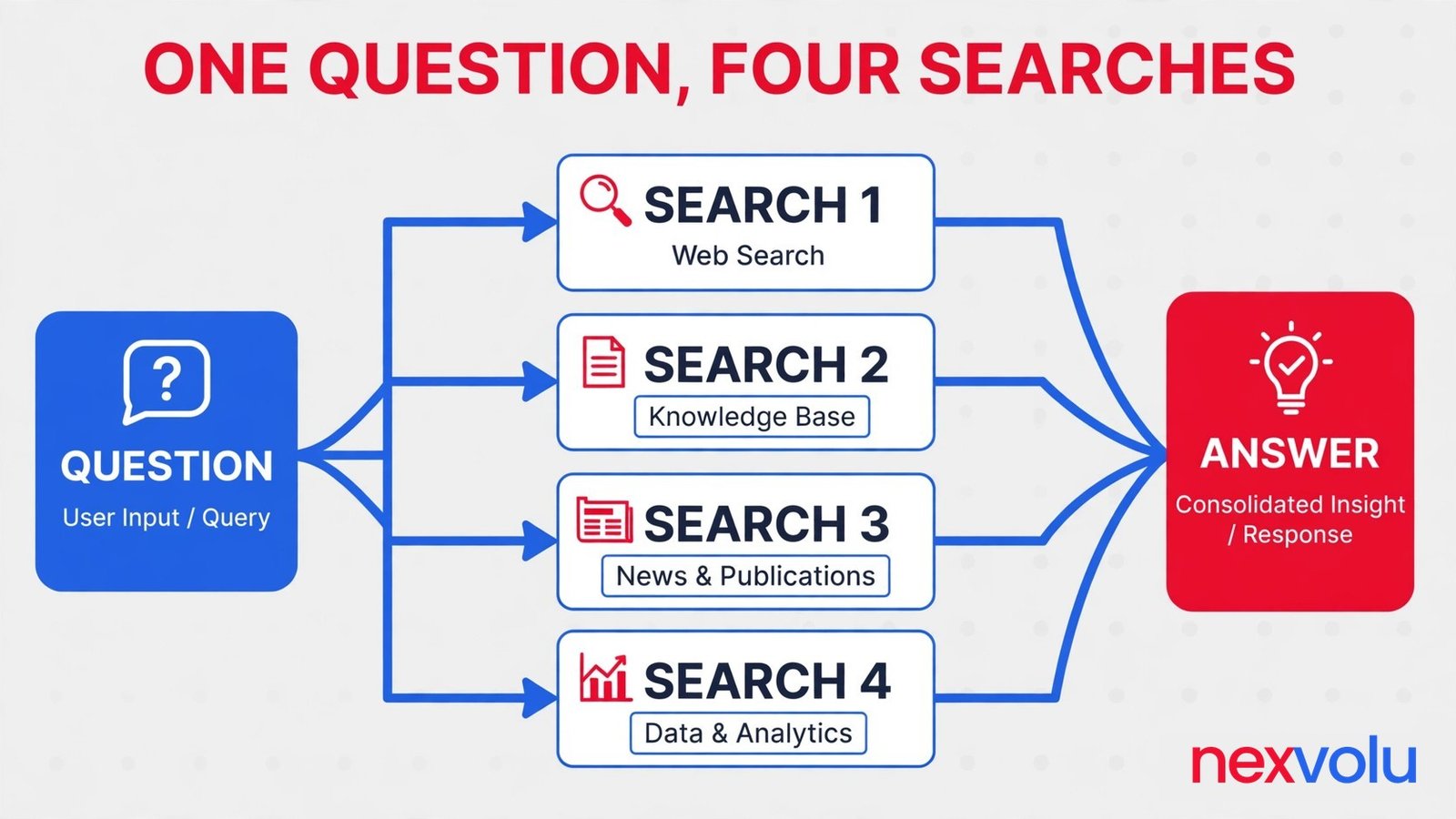
The method behind AI Mode is query fan-out. Ask one question and Google breaks it into subtopics, runs many related searches at the same time across its index, and combines the results into one answer. A question about a trip becomes separate searches for weather, cost, timing and transport, run in parallel.
Deep Search takes the same idea further. It issues hundreds of searches and returns a fully cited report in minutes rather than seconds. Deep Search needs a paid Google AI plan, while standard AI Mode is free.
Perplexity vs ChatGPT vs Google AI Mode: fan-out and its limits
Fan-out has a real strength and a real weakness. The strength is coverage: a multi part question gets an answer built from many searches instead of one. The weakness is provenance. Sources appear as cards beside the answer rather than numbered citations attached to each sentence, so a reader has to work out which card backs which claim.
AI Mode also pulls in data the other two cannot reach directly. Shopping listings, local business details, Maps information and Knowledge Graph facts feed into the same answer. That is why it wins local and shopping questions by such a margin. It can also take text, voice, images and files as input.
The limits matter as much as the features. AI Mode offers no model selector, so you cannot rerun an answer through a second model the way Perplexity Pro lets you. Its sources are not tied to individual sentences, so line by line verification takes longer.
It has no public citation accuracy study of its own yet. And its model changes often, without always naming the version behind a given answer.
Use AI Mode for anything dated today, anything with a street address, and as a free second opinion when Perplexity sources look thin. Do not use it as your only source for research you will cite line by line. The freshness is real. The citation layout is the weak spot.
Citations, checked claim by claim
Citations differ in three ways: where they sit, how many there are, and whether the link opens the page that holds the fact. Perplexity numbers its sources inline and links nearly every claim. ChatGPT Search shows inline links plus a Sources sidebar for referenced pages, and the links sit looser to the claims. Google AI Mode shows source cards beside the answer, with the classic results still visible below.
Pew Research Center tracked the browsing of 900 US adults through March 2025, covering 68,879 distinct Google searches. About 18 percent showed an AI summary. On visits to a results page with one, people clicked a traditional search result 8 percent of the time, against 15 percent on pages without one.
They clicked a link inside the summary itself on 1 percent of visits. Pew published those findings on 22 July 2025. The study covers AI Overviews, not AI Mode, and it is observational, so it cannot prove cause.
That habit is the real risk in all three tools. A citation you never open is decoration. The Tow Center found more than half of responses from Gemini and Grok 3 cited fabricated or broken URLs.
ChatGPT Search and Perplexity fared better on that measure, but neither was clean. Open the link, read the page, and check the date.
What each one costs in the US
| Tool | Free tier | Paid tier | What paying adds |
|---|---|---|---|
| Perplexity | Yes, with limits | Pro at $20 a month | Model choice and Deep Research |
| ChatGPT Search | Yes, no account needed since Feb 2025 | Plus at $20 a month | Higher limits and Deep Research |
| Google AI Mode | Yes, in Google Search | AI Pro at $19.99 a month | Deep Search and stronger models |
Prices come from vendor pricing pages as checked in October 2026. Perplexity Pro and ChatGPT Plus both cost $20 a month. Google AI Pro costs $19.99 a month.
Google AI Ultra starts at $99.99 a month for heavy use. Paying buys limits and modes, not accuracy. The Tow Center found premium tiers gave more confidently wrong answers than free ones, because they declined to answer less often.
Perplexity vs ChatGPT vs Google AI Mode: verdict by job
| Job | Pick | Why | Second choice |
|---|---|---|---|
| Research you will cite | Perplexity Pro | Numbered citations on every claim and the lowest failure rate in the Tow Center test | Google AI Mode as a second opinion |
| News from today | Google AI Mode | Freshest index and live data | Perplexity once the story settles |
| Local and shopping | Google AI Mode | Maps and Shopping data built in | Perplexity for a sourced comparison |
| Writing from research | ChatGPT Search | Research and drafting in one thread | Perplexity first, then paste into ChatGPT |
Pick the tool whose design matches the job. Perplexity searches every time and pins a source to each claim, so it fits work that ends in a citation. Google AI Mode searches the index that updates first and knows where things are, so it fits news and local questions. ChatGPT Search lives inside an assistant that writes, so it fits work that ends in a document.
Questions readers ask
Which AI search engine is most accurate for research?
Perplexity Pro is the most accurate of the three for research you plan to cite. It searches on every question and attaches a numbered source to each claim, and Perplexity had the lowest failure rate at 37 percent in the Tow Center March 2025 study. All three still misattribute sources, so open the link before you cite anything.
Is Google AI Mode more accurate than Perplexity?
No public study has tested both on the same questions. Google AI Mode draws on Google own index, so it tends to be fresher on news and local information. Perplexity ties each claim to a numbered source, which makes its answers easier to verify line by line. For citable research, Perplexity is the safer choice today.
Is ChatGPT Search accurate enough for research?
It is accurate enough to start research and weaker than Perplexity for citing it. In the Tow Center March 2025 study, ChatGPT Search attributed sources incorrectly on 134 of 200 queries. Its errors are most common when it answers from training data instead of searching, so switch search on for research questions.
How much do the three cost?
Perplexity Pro costs $20 a month, with a free tier available. ChatGPT Search is included free, and ChatGPT Plus costs $20 a month. Google AI Mode is free in Google Search, and its Deep Search mode needs a paid Google AI subscription starting at $19.99 a month for AI Pro.
Run the 12 question test on your own topic
Published tests age fast, and all three products have changed models since March 2025. Run the test yourself in about 45 minutes.
- Write 12 questions in four groups of three: a statistic with a known primary source, something that happened in the last seven days, a local question with a street address, and a request that ends in a draft.
- Ask each question in Perplexity, in ChatGPT with search switched on, and in the AI Mode tab of Google Search. Start a new thread every time.
- Open every link. Mark each factual claim as supported, misattributed or unsourced.
- Score each tool as supported claims divided by all claims, and report the misattributed count separately.
- Keep the tool that wins your most common job, and keep a second one for cross checks.
Related reading
- How to Fact-Check AI Answers
- How to Use NotebookLM for Research
- How to Write Better AI Prompts
- Is ChatGPT Plus Worth It
Sources
- Klaudia Jazwinska and Aisvarya Chandrasekar, Tow Center for Digital Journalism, “AI Search Has a Citation Problem,” Columbia Journalism Review, 6 March 2025
- AI Tools Digest, “Perplexity vs ChatGPT Search vs Google AI Mode (2026),” 30 Oct 2026
- Pew Research Center, “Google users are less likely to click on links when an AI summary appears in the results,” 22 July 2025, based on browsing data from 900 US adults and 68,879 Google searches in March 2025
- Mojodojo, “What is Google AI Mode? How it works and what it means”
- Shila, “Google AI Mode: What It Is and How It Works”
- AI Frontier Post, “AI search, tested: Perplexity vs ChatGPT Search vs Google”
- Digitpatrox, “I Tested 100 Real Questions: Google AI Mode vs ChatGPT vs Perplexity vs Gemini,” August 2026
- AionX, “AI Subscription Pricing Comparison 2026,” October 2026
Sobia Aslam writes about AI tools, search and digital marketing at nexvolu.com, where she tests the tools she covers and shows her working.