

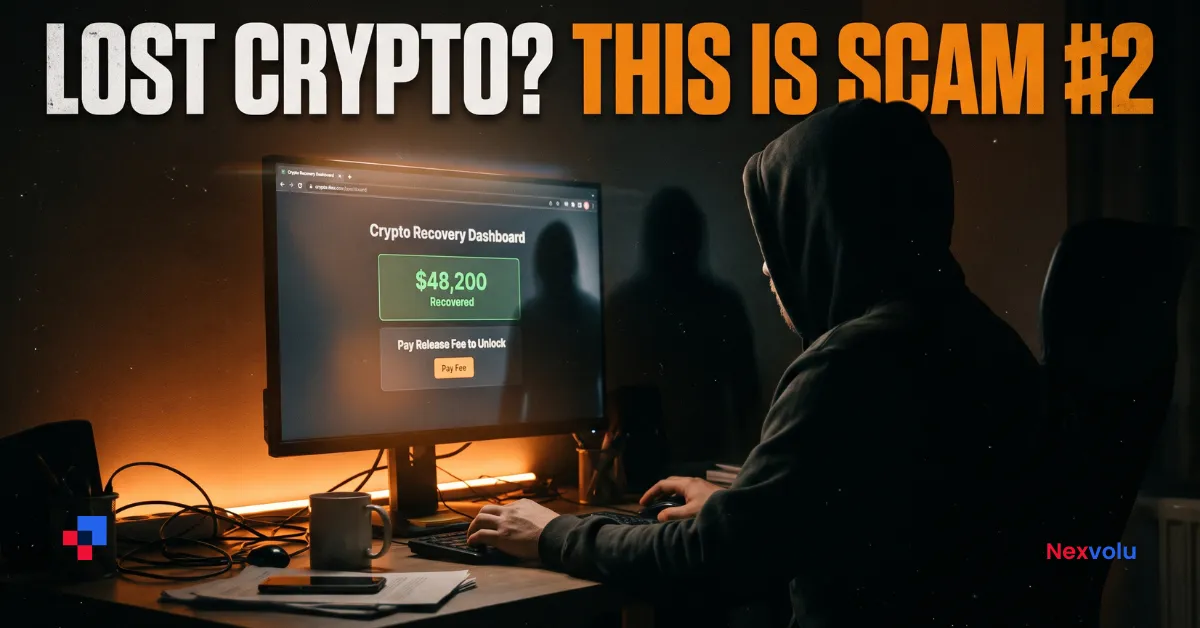
If someone has contacted you offering to recover your stolen crypto, or money you lost to a scam, for a fee, the short answer is this: it is almost certainly a second scam, a crypto recovery scam. No real agency charges victims to get their money back, and no private company can force an exchange or a bank to return your funds. The person contacting you already knows you lost money. That is exactly why they found you.
This article explains how a crypto recovery scam works, what blockchain tracing can and cannot do, and the free steps that can actually help, depending on how you paid. Read it slowly. The people behind this second scam are counting on you acting fast while you are still upset.
How a Crypto Recovery Scam Finds You
The people behind a crypto recovery scam do not find you by accident. They already know you were scammed, because information about scam victims is bought, sold, and traded. The US Federal Trade Commission (FTC) calls these lists “sucker lists.” They list names, phone numbers, the kind of scam, and sometimes the amount paid.
Your name may have come from the original scammers, from a list they sold, or from a public post where you asked for help. If you posted in a crypto forum or a Telegram group saying you lost money, recovery scammers read those posts and message you directly, posing as helpers. The UK Financial Conduct Authority (FCA) warns that recovery room scams often follow an investment scam, sometimes run by the same people under a different name.
So when a stranger contacts you and seems to know details about your loss, that is not proof they are legitimate. Knowing about your loss is the cheapest part of the scam.
The Crypto Recovery Scam Pitch, Step by Step
Every crypto recovery scam follows a similar script. Knowing it in advance is the best protection, because you can spot step two while you are still on step one.
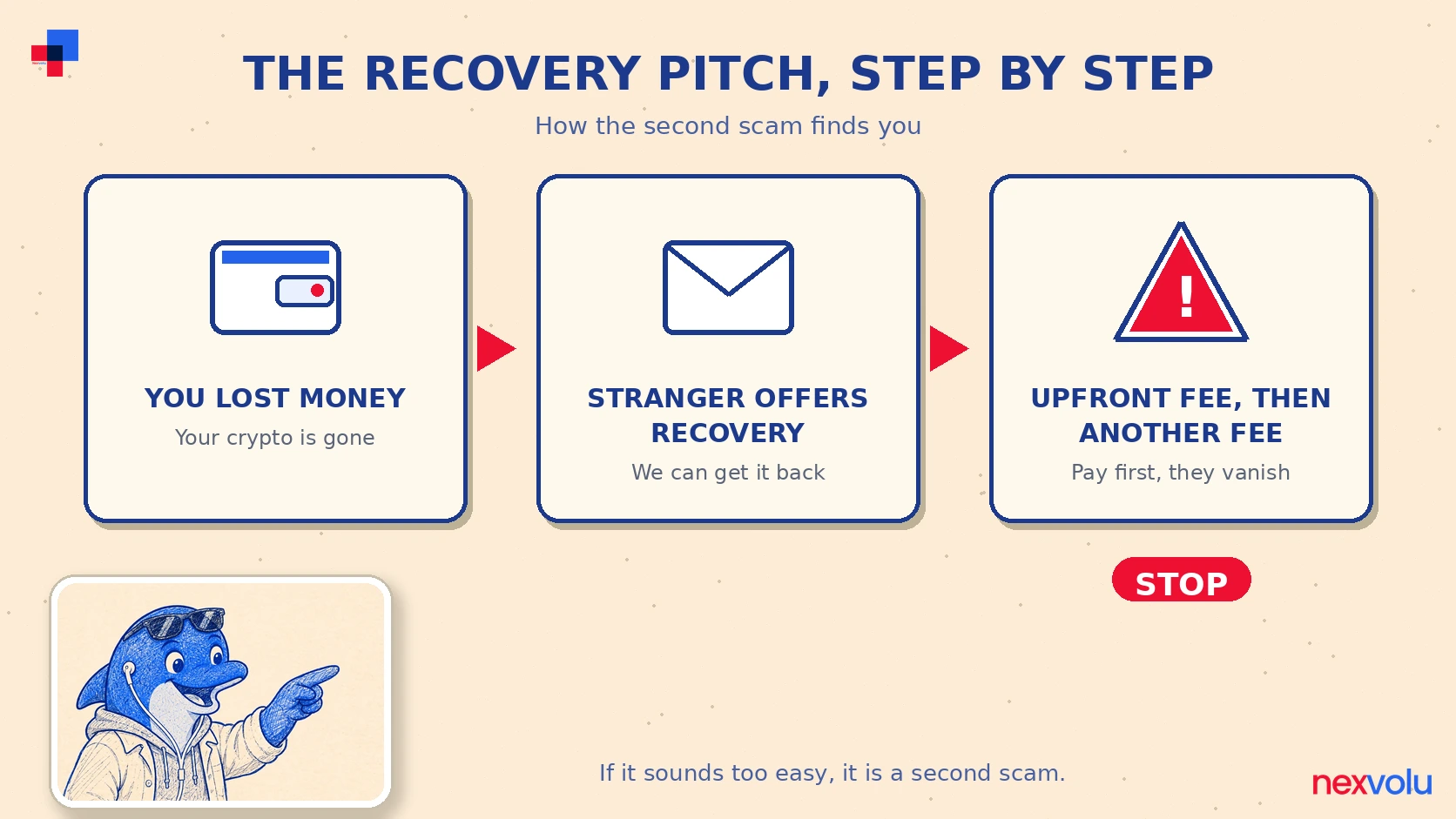
Step 1: The contact. You get a message out of the blue, by email, text, WhatsApp, Telegram, social media, or a phone call. The sender says they are from a recovery firm, a law firm, a government agency, or a consumer help group. They say they have found your stolen funds and can get them back.
Step 2: The proof. They show you something that looks like evidence: a screenshot of a wallet, a tracing report with your transaction in it, a case number, or a letter on official-looking letterhead. None of this is hard to fake. A tracing report is real information, and it is also public information, since anyone can look up a transaction on a block explorer. Showing it proves nothing about their ability to recover it.
Steps 3 to 5 of a Crypto Recovery Scam
Step 3: The fee. Before they do anything, they ask you to pay. The fee may be called a retainer, a processing fee, an administrative charge, a tax, or a release fee. It is usually small compared to what you lost, which is deliberate.
Step 4: The second fee. Once you pay, the story changes. They say the funds are located but cannot be released until you pay a tax, a legal fee, or a withdrawal charge. Or they send a link to a fake dashboard showing your “recovered” balance, which asks for one more payment to unlock it. Each payment leads to another reason to pay again, and some victims lose more to the recovery scam than to the original one.
Step 5: The disappearance. Eventually the messages stop, the website goes down, or the “agent” asks for your seed phrase or private keys. Then they are gone. There is no office to visit and no real company to sue.
Red Flags of a Crypto Recovery Scam
- They contacted you first. You did not find them, they found you.
- They demand a fee before doing any work.
- They request payment in crypto, gift cards, a wire transfer, or a payment app.
- Recovery carries a promise, and your case already has approval.
- They claim to be an authorised partner of the FBI, the FTC, or another government agency. The FBI has stated plainly that no law firms are officially authorised partners of US government agencies.
- They show you a dashboard, a wallet balance, or a “recovery certificate” and ask for a fee to unlock it.
- They ask for your seed phrase, private keys, or your exchange login. No legitimate party ever needs these.
- They use a free webmail address, a newly registered website, or a name copied from a real firm. The FCA calls this a clone firm.
- They pressure you to decide quickly, or they say the offer expires today.
If even one of these is true, stop. Do not pay, and do not send personal or financial information.
Tracing vs Recovery: What a Crypto Recovery Scam Can and Cannot Do
This is the part most articles skip, and it is the part you need most. Tracing and recovery are two different things, and every crypto recovery scam deliberately blurs them.
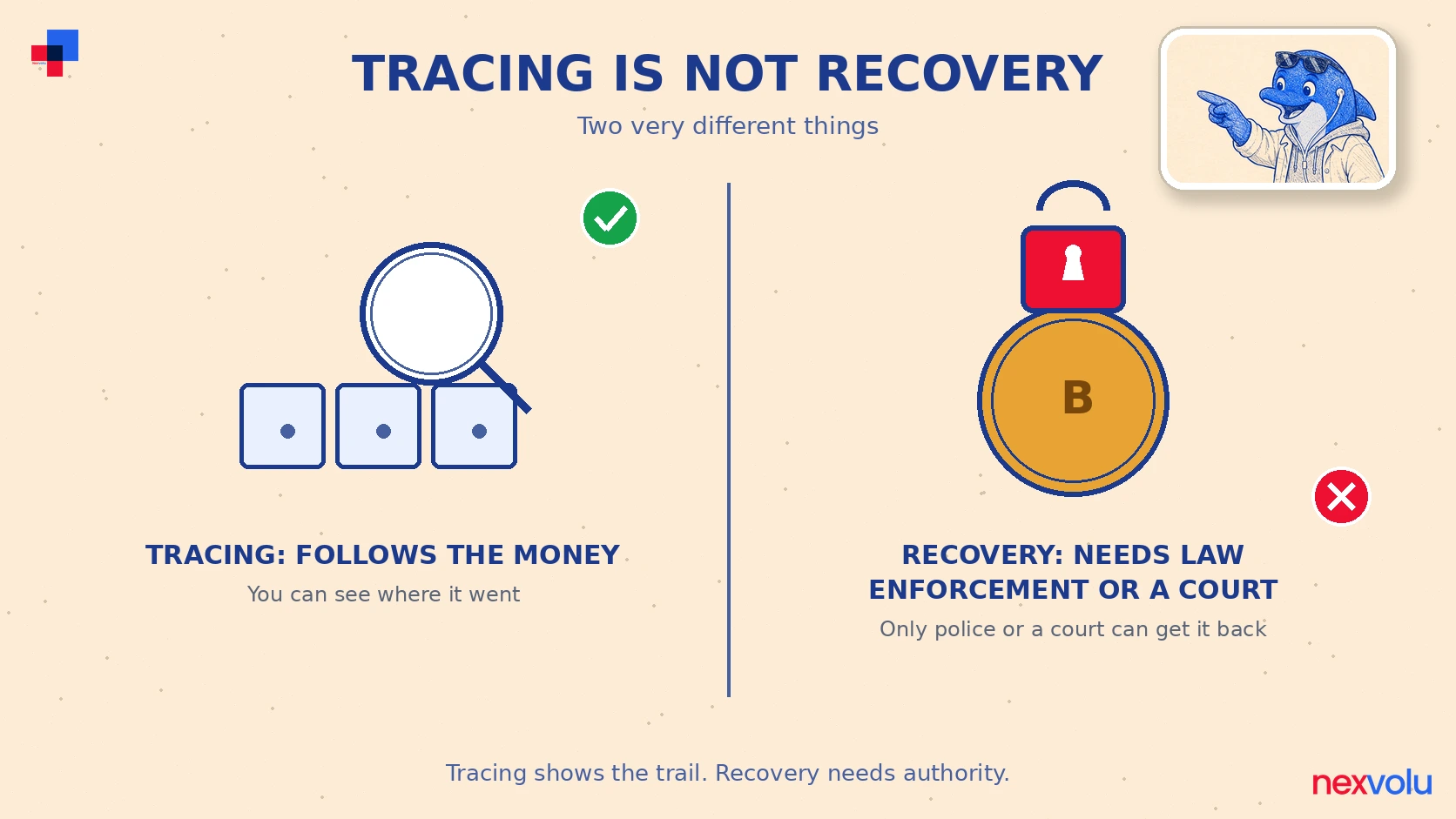
Tracing means following the money on the blockchain. Because blockchains are public, anyone can follow a transaction from one wallet to another with a block explorer or a tracing tool. Companies such as Chainalysis and TRM Labs do this professionally. Tracing can show that your crypto moved to a particular wallet, or landed at a known exchange. It is real, and it is useful evidence.
Recovery means getting the money back, and tracing alone recovers nothing. To freeze or seize funds, someone with legal authority has to act: law enforcement, a court, or the exchange itself through its own compliance process. The FBI has said this directly: private sector recovery companies cannot issue seizure orders to recover cryptocurrency, and exchanges only freeze accounts based on their own internal processes or in response to legal process.
What Tracing and Recovery Mean in a Crypto Recovery Scam
Here is what that means in practice.
- If your crypto is still sitting in a wallet controlled by the scammer, nobody can take it back without the scammer’s keys. There is no password reset for a blockchain.
- If your crypto landed at a regulated exchange, that exchange can freeze the account, but only on a credible request from law enforcement or a court order. An email from a private company will not do it.
- If your crypto was converted to a stablecoin such as USDT or USDC, the issuer can freeze those tokens in some cases, but only after a law enforcement request, and only while the tokens are still freezable.
- A tracing report is not a recovery. If someone shows you a report and then asks for a fee to “act on it,” they are selling you the report twice.
A legitimate lawyer you find and verify yourself is different from a cold-contact recovery firm. A real lawyer can advise you, send letters, and start legal proceedings under a written agreement. But even a real lawyer cannot guarantee recovery from an anonymous wallet. The difference is simple: you chose them, you verified them, and they did not contact you first with a promise.
What to Do Instead, by Payment Type
What can help depends on how you paid. All of the routes below are free. If anyone charges you for them, walk away.
If you paid by bank transfer or wire
Act fast, because this is the one route where speed genuinely matters. Call your bank’s fraud line immediately and ask for a wire recall, and ask the bank to contact the receiving bank for a freeze while the money is still in the first account. Once it moves on, a freeze becomes much harder.
Then file a complaint with the FBI’s Internet Crime Complaint Center (IC3) at ic3.gov. The FBI runs a Recovery Asset Team that works with banks to freeze fraudulent wire transfers, through a process called the Financial Fraud Kill Chain. It applies to international wires of $50,000 or more reported within 72 hours, with a SWIFT recall notice started. For domestic wires, the team contacts the receiving bank directly. File even if your loss is smaller. The complaint is free.
If you paid by debit or credit card
Call your card issuer and report the transaction as fraud, and ask about a chargeback. Card networks have dispute windows, commonly 60 to 120 days from the transaction, so do not wait. Be precise: the name of the company, the date, the amount, and what you were promised.
If the payment went to a crypto on-ramp, tell your bank that too. The bank may be able to dispute the charge with the processor even if the crypto itself is gone.
If you paid in cryptocurrency
This is the hardest case, and you should be honest with yourself about that. Once crypto leaves your wallet, it cannot be reversed. If the transaction touched a regulated exchange, report it to that exchange’s support and compliance team with your transaction hash, the receiving address, and the date and amount. Some exchanges can freeze an account if the funds are still there and law enforcement follows up.
You can also use a block explorer to see where the funds went. If they landed at a known exchange, that information helps your law enforcement report. It does not, by itself, get the funds back.
If the crypto went to the scammer’s own wallet, there is no company to call. The only realistic route is a police report and an IC3 complaint, so the wallet address is flagged in databases. Be cautious with any tool or service that claims it can “reverse” a crypto transaction for a fee. It cannot.
If you paid by gift card, cash, or a payment app
If you sent a gift card code, contact the card issuer immediately. Some issuers can freeze the balance if the card has not been spent yet. If you paid through a payment app, report the transaction as fraud in the app. Recovery is rare, but a fast report helps, because the report may prevent the scammer’s account from being used again.
How to Report a Crypto Recovery Scam
In the United States: Report the original theft and the recovery scam to the FBI’s Internet Crime Complaint Center (IC3) at ic3.gov. You can also report the recovery pitch to the Federal Trade Commission at reportfraud.ftc.gov. If the pitch used email, report it as phishing to the Anti-Phishing Working Group at reportphishing@apwg.org. Save the message and screenshots, including the sender address and any payment details.
In the United Kingdom: Report it to Action Fraud (actionfraud.police.uk) online or by phone on 0300 123 2040. You can also forward suspicious texts to 7726, free of charge from a UK phone.
In Germany: Report it to your local police, and file a report online with the Bundeskriminalamt (BKA). You can also forward the message to the Verbraucherzentrale (consumer advice centre) phishing radar.
If You Already Paid a Crypto Recovery Scam
First, stop sending money. Do not pay the next fee, and do not pay for a “release” or “tax” charge. The fee chain only ends when you stop.
Second, secure your accounts. Change the passwords on your email and every exchange account, and turn on two-factor authentication using an authenticator app. If you shared your seed phrase or private keys, move any remaining crypto to a new wallet immediately. The old wallet is compromised.
Third, report it. File an IC3 complaint, report it to the FTC, and tell your bank or exchange what happened. Keep a record of every message, receipt, wallet address, and transaction hash. If the original scammer is also in the picture, report that too. You may not get the money back, but a report helps investigators, and it may help someone else avoid the same loss.
How to Protect Yourself From the Next Crypto Recovery Scam
- Never trust a recovery offer that arrives uninvited. Real help does not find you in your inbox.
- Never share your seed phrase or private keys with anyone, for any reason. No legitimate company needs them.
- Treat any fee demanded before work as a warning sign. Legitimate professionals explain their fees and put them in a written agreement.
- Get a second opinion from someone you trust before you pay anything to anyone online.
- Remember that blockchain transactions are irreversible. Anyone who says otherwise is selling you a story.
- Store your seed phrase offline, on paper or a metal backup, in a safe place. Never in a screenshot, never in a cloud document, and never in a message.
Frequently Asked Questions About a Crypto Recovery Scam
Can a private company recover crypto I lost in a scam?
Generally, no. A private company can trace transactions and produce a report, but it cannot freeze or seize funds. Only law enforcement, a court, or the exchange involved can do that. If a company contacts you first and promises recovery for a fee, treat it as a scam.
Can I get my crypto back if it landed at an exchange?
If you report it quickly, and the funds are still there, a regulated exchange can freeze the account. That requires a report from law enforcement, or a credible complaint with the transaction hash, the receiving address, and a police report number. The exchange decides on its own internal process, and the freeze is not guaranteed.
Is a recovery service legitimate if it has a professional website and reviews?
Not necessarily. Professional websites are cheap to build, and reviews are easy to fake. Check whether the company remains registered in a real jurisdiction, whether it has a physical address, and whether an independent consumer body or regulator mentions it. Never trust a company that contacts you first.
I already paid the recovery scammer. Can I get that money back?
If you paid by card, call your card issuer and ask about a chargeback, and report the transaction as fraud immediately. For a wire payment, ask your bank about a recall and file an IC3 complaint immediately. If you paid in crypto, the recovery options are the same as for the original scam. Even when recovery is unlikely, report it: your report may help investigators and protect others.
What should I do if a friend recommends a recovery service?
Check it yourself. Scammers recruit satisfied customers, or fake ones, to recommend their service in social media groups and forums. A recommendation from a stranger online is not proof of legitimacy. If a private person you know and trust was personally helped, that is worth more, but still verify the company before paying anything.
Conclusion
If you lost crypto to a scam, the recovery offer in your inbox is likely a second scam. The best free steps are to secure your accounts, move any remaining crypto to a new wallet, report the original theft and the recovery pitch to IC3 and the FTC, and contact your bank or exchange quickly. Report it, secure your accounts, and tell someone you trust. The goal is not to pay another scammer to fix the first one. It is to stop the loss, limit the damage, and make it harder for the same people to do it to someone else.
Related reading
- Zelle Scam Refund: Will Your Bank Pay You Back?
- Does Your Child Have a Credit File? How to Check and Freeze a Minor’s Credit
- DHL Text Asking for €1.99 Customs Fee? How to Tell It’s Fake in Germany
- FBI Internet Crime Complaint Center (IC3)
- How to Spot a Phishing Email: 7 Checks Before You Click