Google Update August 2026: What We Know and What to Do Now
Your traffic graph fell off a cliff on Saturday, and Google has said nothing. If that sentence describes your week, you’re not imagining things, and you’re not alone. Between August 1 and August 3, 2026, every major rank-tracking tool lit up at once. Chatter about a possible Google update August 2026 has grown louder every day since. Publishers are reporting sudden traffic losses and rankings that reshuffle by the hour. Google Discover is behaving in ways nobody can quite explain.
Here’s the problem: nearly all the coverage so far is written for SEO professionals, by SEO professionals. If you run a small site, a shop, or a business blog, nobody has written the plain-English version for you. Nobody has answered the only question that matters: is this an update, a bug, or something wrong with your site?
That’s this article. We’ve read the tracker data, the forum threads, and the conflicting reports so you don’t have to. Below: what we know, what’s still murky, and exactly what to do (and not do) while the dust settles.
Quick Answer
As of August 8, 2026, Google has not confirmed an algorithm update. Third-party trackers recorded sharp ranking volatility from August 1 to 3. A second wave hit on August 5 and 6. Publishers report sudden traffic drops and unusual Google Discover behavior, yet Google’s Search Status Dashboard shows no incident. Verify your own data before changing anything on your site.
TL;DR: Google Update August 2026 at a Glance
- Was there a Google update in August 2026?
- August 2026 Google update evidence: what trackers and forums show
- Google Discover and the August 2026 update: why so strange?
- Is it a Google update, a bug, or your site?
- The 5-step triage checklist for the August 2026 Google update
- What NOT to do during the August 2026 Google update volatility
- Nexvolu’s Verdict
- Frequently Asked Questions
Table of Contents
- Was there a Google update in August 2026?
- What are the trackers and forums actually showing?
- Why is Google Discover acting so strange?
- Is it an update, a bug, or your site?
- The 5-step triage checklist
- What NOT to do during ranking volatility
- Nexvolu’s Verdict
- Frequently Asked Questions
Was There a Google Update in August 2026?
No confirmed update exists, but something clearly moved. Starting Saturday, August 1, third-party volatility trackers including Algoroo, Mozcast, and Advanced Web Ranking recorded sharp spikes. The turbulence continued through August 3. A second, hotter wave followed on August 5 and 6. Some site owners described big swings and then sudden reversals.
Search Engine Roundtable was first to report it. “The chatter seems consistent with a big Google Search algorithm update that is underway but at this point, Google has not yet confirmed it and may never confirm it,” writes Barry Schwartz, the outlet’s executive editor.
That last part matters. Google confirms fewer and fewer ranking changes these days. Its last confirmed change was the June 2026 spam update, which finished rolling out on June 26. Before that came the May 2026 core update, which ran from May 21 to June 2. The Google Search Status Dashboard shows no ranking, indexing, or serving incident between August 1 and August 6.
So we’re left with strong circumstantial evidence and official silence. It’s been a chaotic summer for the company overall. The recent leadership shakeup at Google DeepMind is part of the same turbulent stretch. Unconfirmed volatility also fits an uncomfortable pattern: this is the third unconfirmed shake-up in roughly two months.
August 2026 Google Update Evidence: What Trackers and Forums Show
Short version: chaos, and not the consistent kind. One WebmasterWorld member put it best: “Does anyone else see the shuffling of results in the SERP today? It’s like it’s in a blender!”
Another publisher spotted something stranger: “One second looks normal ish (but low), the next second we have random articles from 2021 getting Discover traffic.” Old content resurfacing in Discover is not typical update behavior. It reads more like a system being re-shuffled in real time.
A third observation deserves more attention than it’s getting. One site owner noticed their traffic drops landed exactly on June 1, July 1, and August 1. Three consecutive first-of-the-month events is a pattern, not proof, but it hints at something scheduled rather than random.
What 88 Reports on the August 2026 Google Update Found
Search Engine Watch reviewed 88 visible posts and comments across Reddit, Search Engine Roundtable, and WebmasterWorld. The reports did not agree on when the disruption began or which Google product was affected. They could not even agree on whether traffic was rising or falling.
Key Statistics: 88 community reports analyzed (Search Engine Watch, August 2026); one WebmasterWorld publisher reported Google traffic across several sites dropping at least 70% on August 5, then surging back by the next morning; trackers recorded volatility August 1 to 3 and again August 5 to 6 (Search Engine Roundtable, August 2026); Google’s last confirmed update completed June 26, 2026.
Key Statistics From the August 2026 Google Update Window
- 88 community reports analyzed (Search Engine Watch, August 2026).
- One WebmasterWorld publisher reported Google traffic across several sites dropping at least 70% on August 5. It surged back by the next morning.
- Trackers recorded volatility August 1 to 3 and again August 5 to 6 (Search Engine Roundtable, August 2026).
- Google’s last confirmed update completed June 26, 2026.
Why It Matters: When 88 reports can’t agree on the basics, you cannot assume an update hit your site. A dipping graph alone proves nothing. Your own Search Console data is the only evidence that counts for your situation.
According to Search Engine Watch, “publishers and site owners are nevertheless reporting abrupt traffic losses, unstable rankings and unusual Discover behaviour.” Their conclusion is deliberately narrow: several overlapping disruptions, possibly without a single cause. SEO Vendor’s analysis reached a similar place. Its team noted the spike fits a monthly drop pattern rather than a classic core update signature.
Google Discover and the August 2026 Update: Why So Strange?
Discover is where the weirdest reports cluster. Publishers describe years-old articles suddenly pulling Discover traffic, feeds going quiet for days, and country-by-country differences. A Brazilian publisher said Discover traffic had been falling since mid-July, well before the August 1 spike. An Indonesian publisher reported slower indexing on August 5. One UK operator said things looked back to their pre-July state by August 6.
As a Discover-first publication ourselves, here’s our honest read: Discover is volatile by design. It swings hard even in quiet months. But old articles resurfacing at scale is genuinely unusual. It’s the strongest hint that Google is re-weighting freshness or interest signals behind the scenes.
There’s a broader backdrop too. Platforms everywhere are aggressively re-tuning content quality systems this year. LinkedIn shipped its AI slop button to let users flag low-effort posts, and Meta removed an Instagram AI feature after user backlash. Google re-tuning Discover mid-summer would fit the industry-wide pattern, even if it never says so.
Is It a Google Update, a Bug, or Your Site?
This is the question the trade press keeps dancing around, so let’s answer it directly. Use this table first, then the calculation below it.
| Signal | Looks like an update | Looks like a bug | Looks like your site |
|---|---|---|---|
| Timing | Drop starts Aug 1 or Aug 5 | Sudden crash, then fast rebound | Drop matches a change YOU made |
| Scope | Whole site drifts together | Wild hourly swings, no direction | One section or page type only |
| SERPs | Competitors reshuffling too | Results look broken or duplicated | Your pages replaced by competitors |
| Discover | Odd content mix, old posts surface | Feed empty, then floods back | Steady decline over weeks |
| Recovery | Slow, settles over 1-2 weeks | Hours to a day | Doesn’t recover on its own |
Remember that ranking systems are machine-learned, not hand-tuned. If the distinction is fuzzy, our explainer on machine learning vs artificial intelligence covers why these systems shift constantly. Named update or not, drift is normal. And bugs at this scale aren’t hypothetical. Modern software ships faster than it can be hardened. That’s the same reason AI security bugs now outpace patches.
The Nexvolu 20/40 Baseline Test (Our Custom Calculation)
- In Search Console, pull clicks for each of the last 7 days (Search only, exclude Discover).
- For each day, compute the average of the same weekday over the previous 4 weeks. That’s your baseline.
- Divide the difference by the baseline. Under 20% deviation: normal noise, ignore it. Between 20% and 40%: watch daily, change nothing. Over 40% for 3+ consecutive days starting on or after August 1: consistent with the volatility window.
Picture this: you run a small recipe site pulling about 1,200 clicks a day. (That’s a composite example, not a real client.) Your previous four Fridays averaged 1,150 clicks. This Friday lands at 630. That’s a 45% drop, day one. Saturday and Sunday hold at similar depths. Three consecutive days above the 40% line, starting August 1. Your data now matches the pattern. The right move is documentation, not demolition.
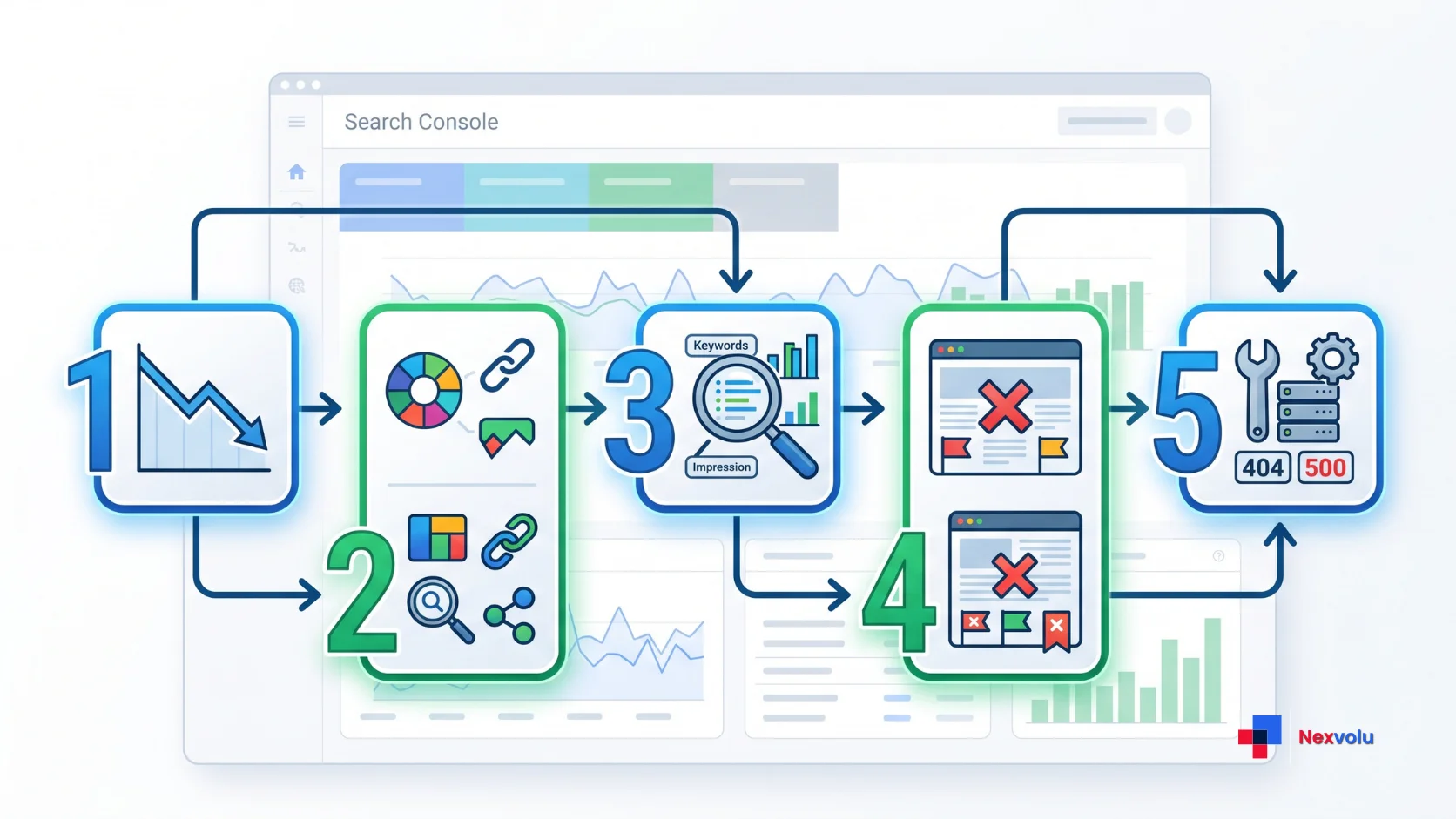
The 5-Step Triage Checklist for the August 2026 Google Update
Work through these in order. Most panicked site changes happen because someone skipped step 1.
- Separate your traffic sources. In Search Console’s performance report, split Search, Discover, and Google News. A Discover dip with stable Search rankings is a completely different problem than a Search collapse.
- Check positions, impressions, and clicks separately. Stable positions with falling clicks points to SERP layout changes, not a penalty. While you’re in there, glance at Search Console’s generative AI report. It shows whether AI surfaces are absorbing your queries.
- Rule out technical and measurement problems. Verify GA4 against server logs or another source, check hosting uptime, and confirm your analytics tag fired all week. Analytics contamination is rampant. We found a $63B hole from bot traffic quietly wasting ad spend when we dug into this in 2026.
- Run the 20/40 baseline test from the section above and write down the result.
- Document and wait 7 to 10 days. Log the dates, the percentages, and any changes you were already making. If this is an update, it needs time to settle before the data means anything.
One more measurement caveat: automated traffic keeps climbing across the web, and bots outnumber humans online as of this year. Filter known bots before you trust any week-over-week comparison.
Share this checklist with a site owner whose traffic dropped this week. It’ll save them from an expensive overreaction.
What NOT to Do During the August 2026 Google Update Volatility
Here’s the truth: more damage gets done in the two weeks after a shake-up than during it. Avoid these five mistakes.
Don’t rewrite or delete content mid-flux. Rankings are moving hourly. Any change you make now becomes uninterpretable: you’ll never know whether the update or your edit caused what happens next.
Don’t panic-shift budget into ads. Buying paid traffic to plug a temporary organic hole locks in costs too early. You don’t yet know the size of the actual problem. If you’re rethinking channel strategy anyway, do it deliberately. Our breakdown of SEO vs PPC for small businesses covers when each one earns its budget.
Don’t mass-produce content to “recover.” Publishing a flood of thin AI posts during a quality-focused shake-up is aiming at your own foot. Readers and algorithms are both getting sharper at this. Our guide on how to spot AI-generated content shows exactly what they’re catching.
Don’t chase every forum theory. Yesterday’s “YouTube is eating the SERPs” becomes today’s “it’s a Discover bug.” Watch your own data, not the noise.
Smarter Moves While the August 2026 Google Update Settles
Do use the downtime to diversify. Owned channels blunt every future update. B2B sites should look at LinkedIn collaborative posts for co-marketing reach. Every commerce site should understand how AI agents now shop on people’s behalf. Agentic traffic doesn’t care about your Google rankings.
And a note on Google’s silence: staying quiet while your ecosystem panics is a communications choice. We’ve covered what happens when comms goes wrong in our anatomy of a comms disaster. Google’s no-comment posture during volatility windows earns the same erosion of trust, just in slow motion.
If this saved you from a panic decision, pass it along to your team or group chat before someone there starts deleting pages.
Nexvolu’s Verdict
The verdict: Something real moved in Google’s systems starting August 1. The evidence points to overlapping disruptions, not one clean update. Act like an analyst, not a firefighter.
Best for: Site owners whose drop started August 1 or later. You’re likely inside a genuine volatility window, and patience is a strategy.
Skip the panic if: your decline started mid-July or earlier; that’s a different problem, and this shake-up is not your explanation.
Pros: Trackers independently agree volatility is real · The community documentation (88+ reports) is unusually rich · Recovery reports are already appearing, suggesting reversals rather than permanent losses.
Cons: Google’s silence means no rollout timeline and no closure · Conflicting reports make attribution nearly impossible · Discover’s odd behavior has no official explanation at all.
Standout: The first-of-the-month pattern (June 1, July 1, August 1) reported in forums. Nobody in the trade press has seriously examined it, and it’s the single most interesting thread in this story.
Nexvolu Editorial Score: 6/10. This is an editorial score of the “it’s a major update” theory itself. The volatility is certain, but the cause is not. Betting your site on either explanation right now would be a mistake.
Frequently Asked Questions
Was there a Google algorithm update in August 2026?
Google has not confirmed an algorithm update in August 2026. Third-party trackers recorded sharp ranking volatility from August 1 to 3, then again on August 5 and 6. Publishers reported major traffic swings. Still, Google’s Search Status Dashboard shows no incident for that window. In practice, unconfirmed updates are now the norm rather than the exception. Google confirmed only two ranking changes in the months prior: the May core update and the June spam update. The SEO community documented at least three additional unconfirmed volatility events over the same summer. Treat “unconfirmed” as “unacknowledged,” not “imaginary.”
Why did my website traffic suddenly drop in August 2026?
A traffic drop starting August 1 to 6, 2026 most likely reflects the unconfirmed Google ranking volatility recorded during that window. It can also come from a technical failure, an analytics measurement gap, seasonal patterns, or changes you recently made. The only way to know is to isolate the variables. Split Search, Discover, and News traffic in Search Console, then compare positions and impressions separately from clicks. One publisher on WebmasterWorld reported a 70% drop on August 5 that fully reversed by the next morning. That shows how misleading a single day of data can be.
How can I tell if a Google update hit my site or if it’s a technical problem?
Update damage and technical damage leave different fingerprints. An algorithmic hit usually starts on a known volatility date and moves your whole site in the same direction. Competitors reshuffle around you at the same time. A technical problem usually shows a cliff-edge drop to near zero and affects indexing or serving rather than position. It often recovers as suddenly as it broke. Check the basics first: hosting uptime, robots.txt, noindex tags, canonical errors, and whether your analytics tag actually fired. If positions in Search Console look stable while your analytics shows a crash, the problem is measurement, not Google.
How long does Google ranking volatility usually last?
Most Google volatility windows settle within one to two weeks, based on the documented history of confirmed updates. The May 2026 core update ran 12 days. The June 2026 spam update finished within about two weeks. Unconfirmed events are less predictable because there’s no announced end date. The August 2026 pattern is still active as of August 8. Waves hit August 1 to 3 and August 5 to 6. Early recovery reports appeared from August 6. Practically, judge stability by your own data. When your daily swings stay under 20% of baseline for a full week, the window has closed for you.
Should I change my website during an unconfirmed Google update?
No. Making significant changes during active volatility is the most expensive mistake a site owner can make. You lose the ability to attribute outcomes. If rankings recover after you rewrote 30 pages, you’ll never know why. Maybe the update settled, or maybe your edits worked. You’ll draw the wrong lesson either way. The exceptions are genuine technical fixes. Broken pages, server failures, accidental noindex tags, and security issues should be fixed immediately, regardless of what Google is doing. Content strategy changes, redesigns, and mass rewrites should wait until your traffic stabilizes for at least a week.
Why is my Google Discover traffic dropping or showing old articles?
Discover traffic during the August 2026 window has been erratic in unusual ways. Publishers report years-old articles suddenly earning Discover impressions, feeds going quiet, and region-by-region differences. Brazil has seen Discover declines since mid-July, and Indonesia reported slower indexing on August 5. Discover is inherently the most volatile Google surface because it’s interest-based rather than query-based. Swings of 50% happen even in quiet months. But old content resurfacing at scale suggests Google is re-weighting freshness or interest signals. If your Discover traffic vanished while Search held steady, that pattern currently matches many other publishers. It isn’t evidence of a penalty.
What is the difference between a core update, a spam update, and unconfirmed volatility?
A core update is a broad, announced change to Google’s main ranking systems, like the May 2026 core update. It usually rolls out over two to three weeks. A spam update is an announced change targeting policy violations such as link schemes or scaled content abuse. The June 2026 spam update that completed June 26 is the most recent example. Unconfirmed volatility is measurable ranking turbulence that Google never acknowledges, visible only through tracking tools and community reports. The practical difference: announced updates come with guidance about what changed. Unconfirmed events leave you diagnosing from your own data alone. That’s why a triage process matters more than a name.
Will Google ever confirm the August 2026 update?
Probably not. Barry Schwartz said as much in his original report: Google “has not yet confirmed it and may never confirm it.” Google has steadily reduced how many ranking changes it announces. It confirms only the largest core and spam updates, while thousands of smaller changes ship silently every year. The Search Status Dashboard shows no incident for August 1 to 6. That makes a retroactive confirmation even less likely. The practical takeaway is to stop waiting for official closure. Your Search Console data, compared against your own baseline, tells you everything a Google blog post would. It just comes without the label.
Are US and UK websites affected differently by the August 2026 volatility?
Both markets show the same weekend pattern. Volatility reports concentrate in US SERPs, and UK publishers report matching turbulence over the August 1 to 3 window. One UK operator reported results returning to their pre-July state by August 6, among the earliest recovery reports anywhere. Reports from Brazil and Indonesia describe different symptoms: a Discover decline since mid-July and slower indexing, respectively. That suggests the disruption isn’t hitting every market identically. If you publish for US and UK audiences, treat them as one storm system for now. Check your country-level Search Console data separately before concluding anything.
Key Takeaways
- Volatility is confirmed by trackers; the cause is not confirmed by anyone.
- Diagnose before acting: source split, position check, technical audit, baseline test.
- A drop that started before August 1 is not this shake-up; investigate separately.
- Fix technical problems immediately, but freeze strategy changes until stability returns.
- Log everything now; your notes become your recovery map in two weeks.

Keep reading on Nexvolu:
- The rules nobody explains in Can I Use AI at Work?
- Our GPT-5.6 restrictions explainer
- The question of who pays for AI’s data center electricity
- Why Google’s Frozen v2 chip matters for search’s future costs
The Bottom Line
Here’s the bottom line on this ranking volatility: something moved, and Google won’t say what. The worst response is a dramatic one. The evidence supports caution, not panic. Trackers agree the turbulence is real. The 88 community reports disagree on nearly everything else. Early recovery stories from August 6 suggest at least some of the damage is already reversing on its own.
So run the triage checklist, do the 20/40 math, and write down what you find. If your numbers put you inside the volatility window, your job this week is documentation and patience. If they don’t, you’ve just saved yourself from blaming Google for a problem that’s actually yours to fix, which is its own kind of win.
We’ll update this article as facts land, including if Google breaks its silence. Bookmark it and check back, and share it with anyone refreshing Search Console right now.
Did your traffic move this week, up or down? Tell us what you’re seeing in the comments: your data point helps every reader after you.
This is a developing story. Nexvolu last updated this article on August 8, 2026, and will revise it as new information is confirmed.
REFERENCES
- Google Search Ranking Volatility Hits August 1st & Heats Up Into August 3rd, Search Engine Roundtable, Aug 3, 2026
- Google Search Ranking Volatility Heats Up Into August 5th & 6th, Search Engine Roundtable, Aug 2026
- Google Algorithm update in August 2026? What we know, Search Engine Watch, Aug 6, 2026
- Google Ranking Volatility August 2026: What the Aug 1 Spike Means, SEO Vendor, Aug 2026
- Google Search Status Dashboard, Google